Within Paper Forensics
Does the Missing Eagle Watermark Prove a Forgery?
Authentic Cutler-era onionskin carbons could lack an eagle watermark, so the memo's missing watermark cannot prove forgery by itself.
On this page
- What the Eisenhower Library sample actually found
- Why genuine onionskin copies weaken a simple watermark test
- How Stanton Friedman challenged claims of stationery uniformity
Page outline Jump by section
Introduction
The missing eagle watermark on the disputed 14 July 1954 Cutler–Twining memorandum is not, by itself, proof that the document was forged. The strongest official evidence is more qualified than that claim suggests. The US National Archives and Records Administration (NARA) says that the Eisenhower Presidential Library examined a representative sample of Robert Cutler material: the sampled bond-paper documents produced while Cutler served on the National Security Council (NSC) staff carried an eagle watermark, but authentic onionskin carbon copies could have either an eagle watermark or no watermark at all.[National Archives]archives.govOpen source on archives.gov.
That distinction substantially weakens a simple “no eagle equals forgery” test. Yet it does not make the questioned sheet physically ordinary. NARA’s conservation examination identified it as a ribbon copy, rather than a carbon, prepared on thin “dictation onionskin”; it also lacked official government letterhead. Most outgoing NSC documents, NARA reported, were prepared on White House letterhead.[National Archives]archives.govOpen source on archives.gov. The real forensic question is therefore not whether every genuine Cutler document bore the eagle. They demonstrably did not. It is whether this particular combination of paper, typing method and lack of letterhead makes sense for the memorandum it purports to be.
What the Eisenhower Library sample actually found
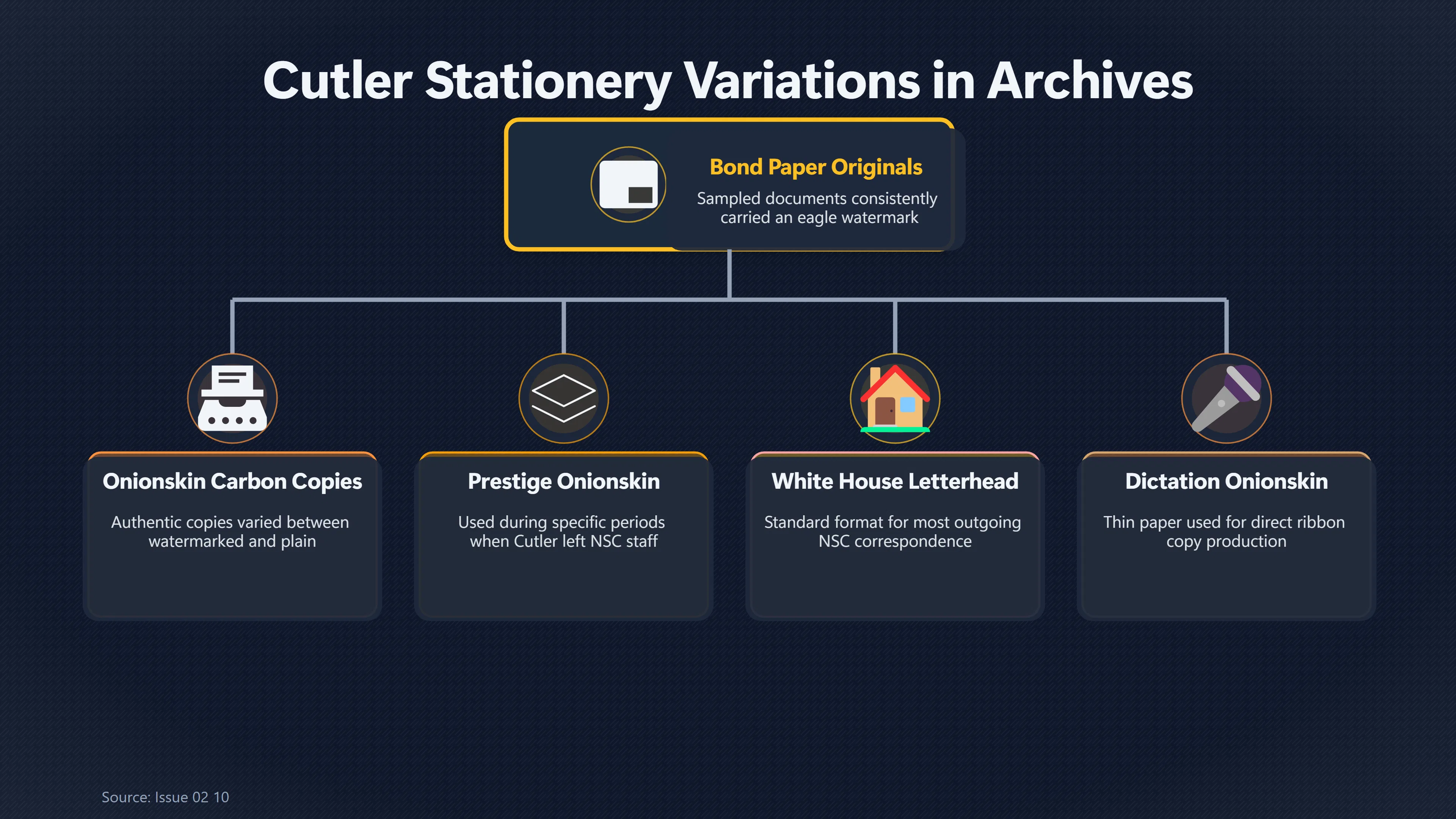
The most useful starting point is NARA’s present account of the examination, because it carefully distinguishes bond paper from onionskin carbon paper. According to the National Archives, the Eisenhower Library reviewed a “representative sample” from its Cutler holdings. Every document in that sample created while Cutler was on the NSC staff had an eagle watermark on the bond paper. By contrast, onionskin carbon copies in the collection came in two varieties: some bore the eagle watermark and some bore no watermark.[National Archives]archives.govOpen source on archives.gov.
That wording matters. Older reproductions of the archival correspondence can give a much more categorical impression. A July 1987 National Archives communication, reproduced online, states that documents created by Cutler while on the NSC staff had an eagle watermark in the “onionskin carbon paper”.[raids.org]raids.orgOpen source on raids.org. The current NARA page instead explicitly separates watermarked bond paper from variable onionskin carbons. That is a materially more nuanced formulation and prevents an evidential category error: a pattern established for one paper type cannot automatically be imposed on another.
The Library also reported a further variation in Cutler stationery. During the brief period when he was away from the NSC, carbon copies were made on what it called “prestige onionskin”. Meanwhile, NARA says that most material sent out by the NSC was produced on White House letterhead.[National Archives]archives.govOpen source on archives.gov. These observations describe an office using several kinds of paper for different purposes rather than one invariant sheet for every document.
That makes the watermark evidence probabilistic, not binary. A watermarked Cutler bond original would fit the Library’s sampled pattern very well. An unwatermarked onionskin carbon could also be entirely authentic. The mere absence of an eagle therefore cannot carry the authentication argument on its own.
Why genuine onionskin copies weaken a simple watermark test
The complication is that the Cutler–Twining sheet was not identified by NARA as one of those ordinary carbon copies. A conservation specialist examined the physical document and concluded that it was a ribbon copy prepared on dictation onionskin. In practical terms, the surviving sheet itself had been struck through the typewriter ribbon rather than being produced as a secondary carbon beneath another sheet.[National Archives]archives.govOpen source on archives.gov.
That changes what the authentic unwatermarked carbons can establish. They demonstrate that unwatermarked paper existed in genuine Cutler files, which defeats an absolute eagle-watermark rule. They do not demonstrate that a directly typed outgoing memorandum to General Nathan Twining would normally have been produced on the same plain onionskin. NARA’s additional finding — that most NSC documents sent outside the office were prepared on White House letterhead — keeps the questioned memo outside the clearest documented norm.[National Archives]archives.govOpen source on archives.gov.
This distinction was central to sceptical treatments of the document. A Skeptical Inquirer discussion reported that impressions from the typewriter keys were visible through the sheet and interpreted those impressions as evidence that the document was an original typed sheet rather than the carbon copy it superficially resembled.[Skeptical Inquirer]skepticalinquirer.orgIssueIssue That interpretation broadly accords with NARA’s more authoritative description of the sheet as a ribbon copy.
There is, however, another wrinkle in the terminology. MJ-12 advocate Stanton Friedman subsequently maintained that the physical sheet itself bears a “Dictation Onionskin” watermark associated with Fox Paper Company when viewed against the light. In his account, Fox told him that this paper had been manufactured in bid lots from the early 1950s into the early 1970s and had been purchased by the US government rather than sold as ordinary retail stationery.[Medium]medium.comOpen source on medium.com.
That claim is easily confused with the original allegation. “No watermark” in the archival criticism refers to the absence of the expected eagle watermark; Friedman’s argument concerns a manufacturer’s “Dictation Onionskin” marking. They are not necessarily mutually exclusive propositions. The more precise question is whether the sheet lacks the characteristic eagle associated with some authentic Cutler stationery, not whether no identifying paper mark of any kind can be detected.
Friedman’s Fox Paper claim is nevertheless weaker evidence than NARA’s physical description because the publicly accessible material located for it is his retrospective account rather than independent documentation from the manufacturer. It may support the proposition that the paper itself was compatible with government procurement in the 1950s, but it cannot establish that Cutler’s office actually used that particular sheet for this particular kind of memorandum.

How Stanton Friedman challenged stationery uniformity
Friedman’s strongest response to the eagle-watermark objection was not that watermarks were irrelevant. It was that the comparison set had been treated as more uniform and comprehensive than it really was.
When the watermark criticism first circulated, Friedman challenged the size and representativeness of the sample. Responding to the assertion that Cutler’s memoranda characteristically bore the eagle, he asked, in effect, how many documents had actually been examined, and pointed to additional Cutler-to-Twining memoranda located in the Library of Congress rather than the Eisenhower Library or National Archives.[raids.org]raids.orgOpen source on raids.org. His underlying methodological objection was reasonable: an authentication rule based on archival stationery is only as strong as the range of genuine documents used to establish that rule.
He later made a more concrete claim. Writing about his own examination of the Eisenhower Library holdings, Friedman said he found “many carbons of Cutler memos” on unwatermarked onionskin, contrary to the earlier claim that Cutler carbons invariably carried the eagle. The same account appears in material preserved by the Center for UFO Studies.[Center for UFO Studies]cufos.orgOpen source on cufos.org. A later Friedman article likewise says that the Library’s original assertion was corrected after he showed staff examples on onionskin bearing different watermarks or none.[Medium]medium.comOpen source on medium.com.
Most importantly, NARA’s current published wording independently confirms the central factual point underlying that challenge: genuine onionskin carbon copies in the Eisenhower Library sample could indeed lack an eagle watermark.[National Archives]archives.govOpen source on archives.gov. Whatever one thinks of Friedman’s broader defence of MJ-12, that specific qualification cannot simply be dismissed as an advocate’s assertion.
There are also archival research notes in the William Moore material now made available through a MUFON collection that describe groups of Cutler-related carbons on onionskin with no watermark. Those notes additionally mention another Cutler-to-Twining memorandum bearing an eagle watermark, illustrating the very variability at issue.[Project Aquarius]mufon.comOpen source on mufon.com. Because these are research notes connected to proponents of the documents rather than an institutional finding, they should not outweigh NARA’s assessment, but they reinforce the point that the surviving Cutler record is not physically homogeneous.
Does the Missing Eagle Watermark Prove a Forgery?
No. The available archival evidence does not support that categorical conclusion.
The watermark argument is strongest when framed narrowly: the questioned memorandum does not match the watermarked bond-paper pattern found in the Eisenhower Library’s representative sample of Cutler’s NSC-period material. That discrepancy is legitimate forensic evidence. But the same official comparison establishes that authentic onionskin carbon copies could be unwatermarked, so absence of the eagle is not an authentication test with a simple pass-or-fail result.[National Archives]archives.govOpen source on archives.gov.
The more consequential discrepancy is the combination of characteristics. The questioned sheet lacks White House letterhead; NARA identified it as a ribbon copy rather than a carbon; it was typed on dictation onionskin; and NARA says most outgoing NSC correspondence was prepared on White House letterhead.[National Archives]archives.govOpen source on archives.gov. Authentic unwatermarked carbons explain why plain onionskin could appear in Cutler’s files, but they do not fully explain why a directly typed memorandum apparently intended for the Air Force Chief of Staff would survive in this form.
Conversely, Friedman’s research makes it unsafe to turn normal stationery practice into an absolute rule. His examples of unwatermarked Cutler onionskins are consistent with NARA’s current account, and his claim that the questioned sheet carries a period-compatible “Dictation Onionskin” manufacturer’s watermark, if accepted, would further weaken any argument that the paper itself was simply unavailable in the 1950s.[Medium]medium.comOpen source on medium.com. Neither point authenticates the message printed on that paper.
The defensible forensic conclusion is therefore narrower than either pole of the MJ-12 debate. The missing eagle watermark is an anomaly only in relation to certain classes of authentic Cutler stationery, not a stand-alone demonstration of forgery. The Eisenhower Library’s own comparison shows enough genuine variation to rule out that simple inference. What remains significant is that the Cutler–Twining memo’s particular configuration — a directly typed onionskin sheet without the normal outgoing letterhead — does not neatly correspond to the most common documented pattern. In the wider paper-and-letterhead authentication problem, the watermark contributes to a cumulative case; it does not settle the case by itself.
Amazon book picks
Further Reading
Books and field guides related to Does the Missing Eagle Watermark Prove a Forgery?. Use these as the next step if you want deeper reading beyond the article.
Detecting Forgery: Forensic Investigation of Documents
Detecting Forgery reveals the complete arsenal of forensic techniques used to detect forged handwriting and alterations in documents and...
Forensic Document Examination: Principles and Practice
This book introduces the reader to the basic principles of handwriting and the factors that affect their development. The book discusses...
Scientific Examination of Questioned Documents
Disputed document inquiries encompass extensive and varied technical examinations, unique phases of investigation, and specialized legal...
Top Secret/Majic: Operation Majestic-12 and the United States...
Exposing the U.S. government's biggest-kept secret: a fifty-eight-year UFO cover-up. Top Secret/Majic is the result of nuclear physicist...
eBay marketplace picks
Marketplace Samples
Live-tested eBay searches with available results related to this page.
Selected fromUFO poster oneBay.co.uk.




Endnotes
1.
Source: archives.gov
Link:https://www.archives.gov/research/military/air-force/ufos
2.
Source: medium.com
Link:https://medium.com/stanton-friedmans-articles/book-review-kevin-d-randles-case-mj-12-the-true-story-behind-the-government-s-ufo-conspiracies-9e06f4e82250
3.
Source: raids.org
Link:https://raids.org/files/ufo2/mj12doc6.htm
4.
Source: skepticalinquirer.org
Title: Issue 02 10
Link:https://skepticalinquirer.org/wp-content/uploads/sites/29/2019/03/Issue-02-10.pdf
Additional References
5.
Source: youtube.com
Link:https://www.youtube.com/watch?v=ogJplVuElLs
Source snippet
Cutler Twining memo Majestic 12 The 1954 Top-Secret Intel Memo Exposing the Government's Most Guarded UAP Working Group...
6.
Source: youtube.com
Link:https://www.youtube.com/watch?v=dA69pv9AQx0
Source snippet
The Majestic-12 Documents [With Ryan S. Wood]...
7.
Source: youtube.com
Title: Karl Pflock discusses The Cutler
Link:https://www.youtube.com/watch?v=I6smHEhd9MI
Source snippet
The 1954 Top-Secret Intel Memo Exposing the Government's Most Guarded UAP Working Group...
8.
Source: youtube.com
Title: Karl Pflock
Link:https://www.youtube.com/watch?v=8g5tYfcQ9RQ
Source snippet
A secret history: Inside shadow intelligence, the MJ-12 documents | Reality Check...
9.
Source: youtube.com
Title: The Majestic-12 Documents [With Ryan S. Wood]
Link:https://www.youtube.com/watch?v=vzB87RJkQVU
Source snippet
Karl Pflock - The creation of the MJ-12 documents...