Within SOM 1 01
Can Old Film Stock Date the SOM 1 01 Photos?
Even if the film stock was manufactured in 1954, that does not establish when the photographed pages were created or when the film was exposed.
On this page
- What the reported film stock date would establish
- Why manufacture date differs from exposure date
- What custody evidence would be needed to strengthen the claim
Page outline Jump by section
Introduction
The reported 1954 Kodak Tri-X film associated with SOM1-01 is, at most, evidence about the age of the photographic stock. It does not establish when the alleged manual was printed, when its pages existed, or even when those pages were photographed. That distinction is crucial because SOM1-01 reached researcher Don Berliner anonymously in 1994 as undeveloped 35 mm film, rather than as an original paper manual with a documented government chain of custody. Proponent Robert M. Wood states that the Tri-X itself was manufactured in 1954 and argues that this means the photographs “might have been taken as early as” that year.[SOM1-01]specialoperationsmanual.comSOM1-01SOM1-01 Overview & AuthenticationSOM1-01SOM1-01 Overview & Authentication
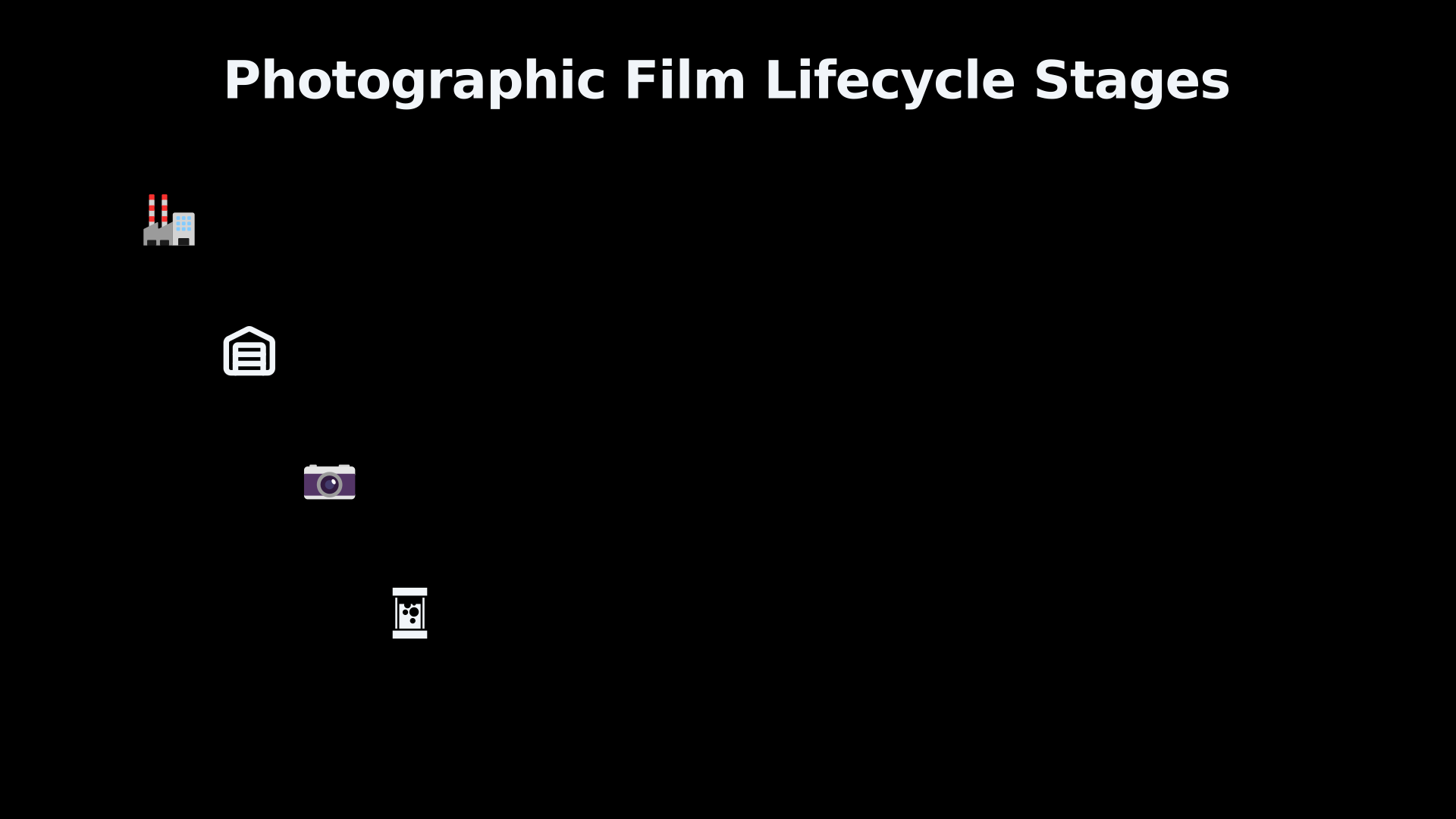
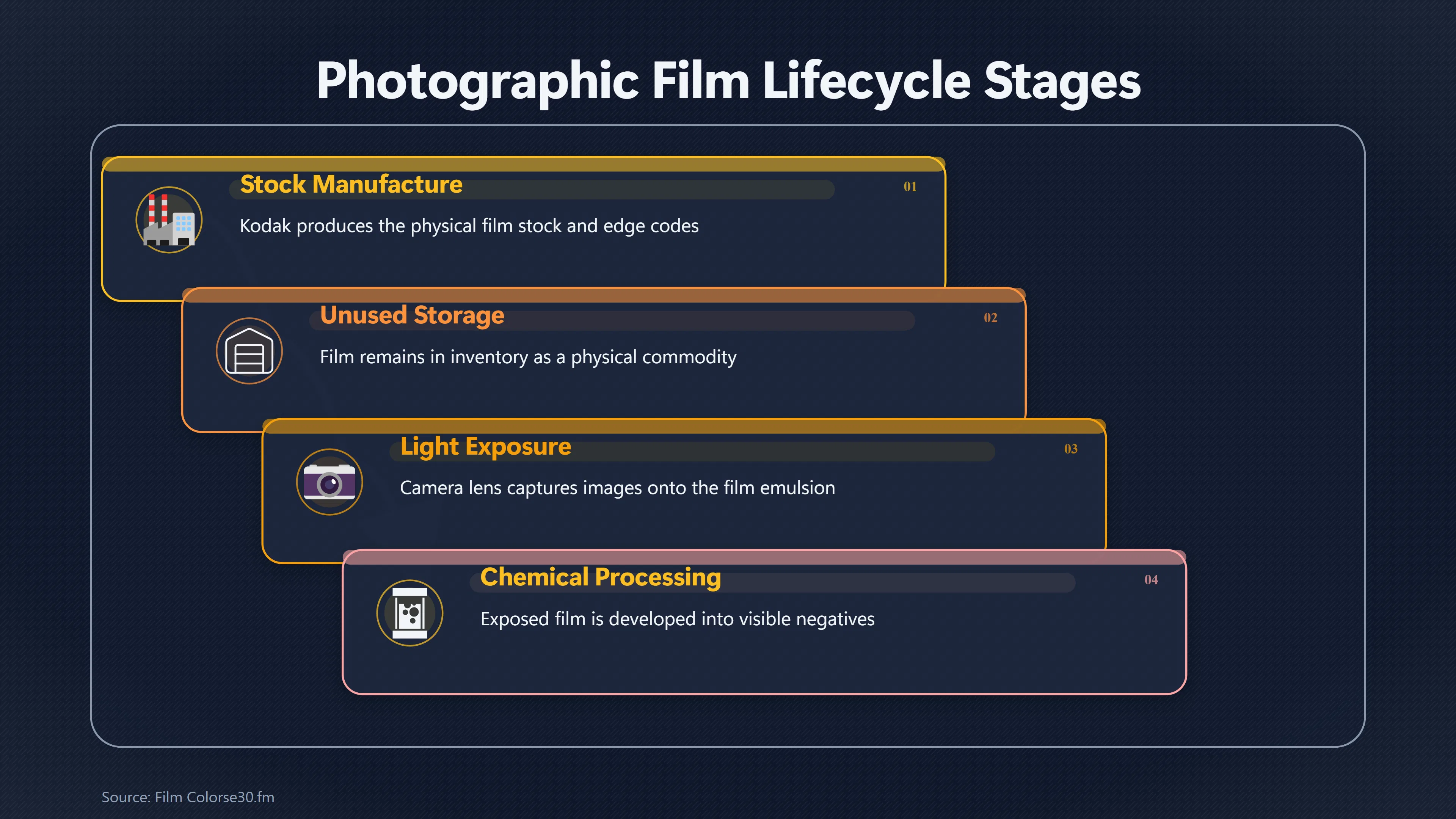
The first proposition may be useful if the film-stock dating is independently verified. The second does not follow from it. Photographic film can be stored unused and exposed much later. Kodak’s own technical guidance treats manufacture, exposure and processing as separate events, while archival practice likewise uses film manufacturing codes as constraints rather than exposure dates.[FilmColors]filmcolors.orgFilm Colorse30.fmFilm Colorse30.fm
What a 1954 film-stock date would establish
Kodak confirms that Tri-X was introduced in 1954. Its corporate history lists Kodak Tri-X Film among the company’s 1954 introductions, while independent histories distinguish the earlier sheet-film version from the 35 mm and 120 roll-film formats released in 1954.[Kodak]kodak.comMilestones | KodakMilestones | Kodak… That makes identification of genuine early Tri-X potentially relevant to SOM1-01, but only in a limited way.
Wood’s authentication presentation makes the stronger, SOM1-01-specific claim: Berliner received undeveloped 35 mm Tri-X film and the stock had been manufactured in 1954. The presentation then says that this fact suggests the photographs “might have been taken as early as” 1954.[SOM1-01]specialoperationsmanual.comSOM1-01SOM1-01 Overview & AuthenticationSOM1-01SOM1-01 Overview & Authentication That wording is important. Even the proponent argument describes an earliest possible period, not a demonstrated exposure date.
Film manufacturing codes work in essentially that fashion. Preservation guidance explains that Kodak placed manufacturing information along film edges and that these markings can help establish when the stock was made. But Kodak’s older codes were sometimes repeated in cycles, so identifying the stock can require additional evidence. The National Film Preservation Foundation specifically warns that an edge code may identify several possible manufacturing years and recommends using other datable information to narrow the result.[Paperzz]paperzz.comMellon Guide.qxdMellon Guide.qxd - National Film Preservation Foundation… The Smithsonian similarly describes a Kodak edge code on a surviving V-Mail strip as denoting the year in which the film reel was manufactured.[Smithsonian Institution]si.eduSmithsonian Institution V-Mail microfilm strip | Smithsonian InstitutionSmithsonian Institution V-Mail microfilm strip | Smithsonian Institution
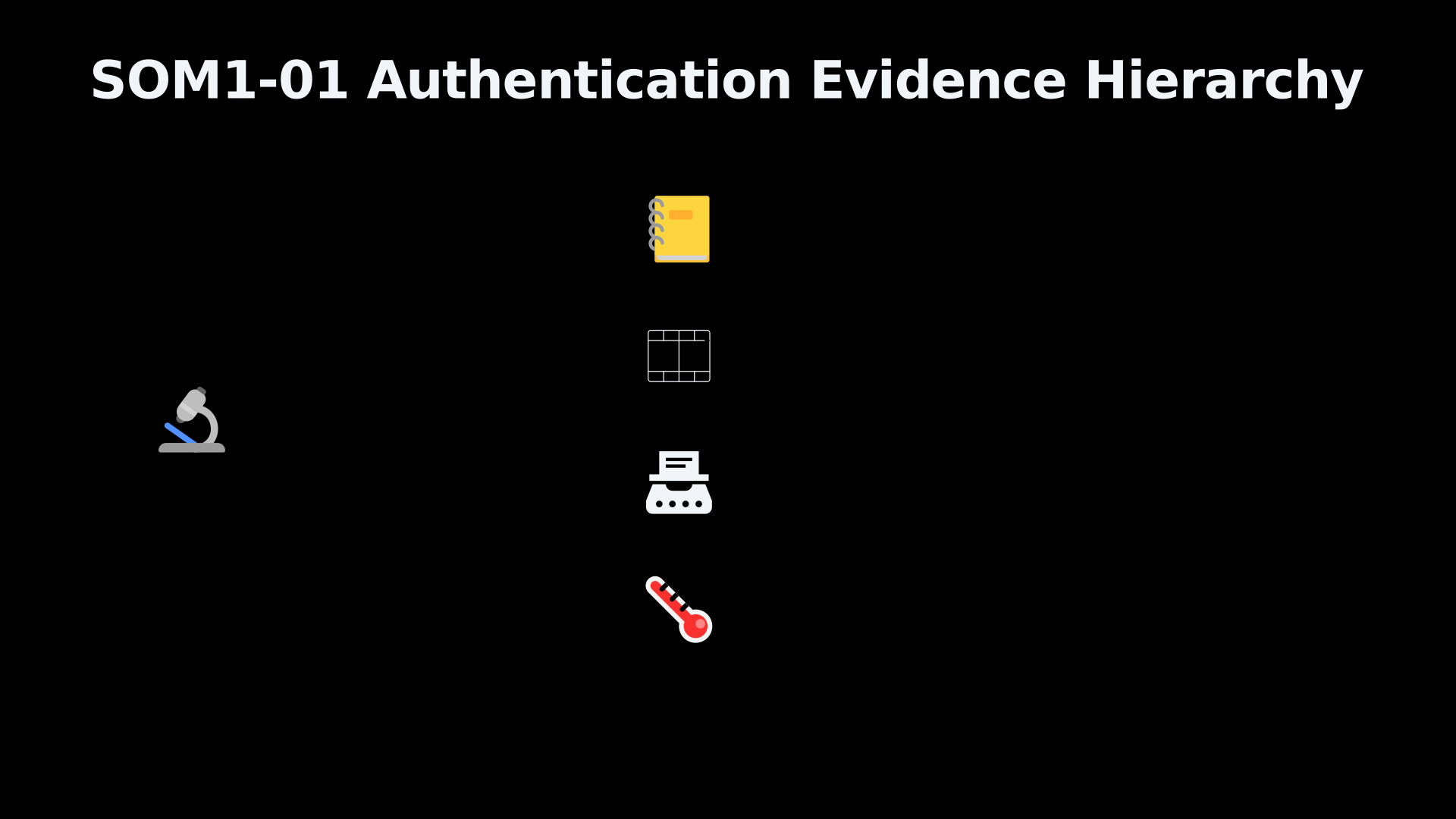
That distinction produces a simple evidential hierarchy:
- Manufacturing date: when Kodak produced the film stock.
- Exposure date: when light from the SOM1-01 pages formed latent images on that film.
- Processing date: when the exposed film was chemically developed into visible negatives.
- Document-production date: when the pages being photographed were actually printed or assembled.
A date for the first event does not automatically date any of the other three.
There is also a chronological complication specific to SOM1-01. The alleged manual carries an April 1954 date, whereas 35 mm Tri-X itself became commercially available later in 1954 according to histories of the product.[johnnymartyr.wordpress.com]johnnymartyr.wordpress.comhappy birthday kodak tri xHappy Birthday Kodak Tri-X!November 1, 2017 — 1 Nov 2017 — Kodak Tri-X was originally introduced sometime in 1940 but November 1st, 1954… That need not prove the manual false, because a document printed in April could obviously have been photographed months or years later. But for exactly the same reason, the film cannot authenticate an April 1954 production date. The photographic medium and the photographed object have separate timelines.
Why manufacture date is not exposure date
Unexposed film is a physical commodity that can remain in storage after manufacture. Kodak explicitly describes unprocessed photographic film as a perishable product whose characteristics change gradually after manufacture, and advises users to store it appropriately and use it before its recommended processing date. Refrigeration or freezing can slow deterioration, although Kodak cautions that storage should not simply be assumed to extend useful life indefinitely.[FilmColors]filmcolors.orgFilm Colorse30.fmFilm Colorse30.fm
This matters because nothing inherent in a roll made in 1954 required somebody to put it into a camera in 1954. A roll could be purchased, stockpiled, forgotten, deliberately preserved or acquired second-hand and exposed years later. The longer the interval, the more questions arise about fogging and image quality, especially with high-speed film, but deterioration is not a clock that automatically reveals the exposure year. Kodak notes that temperature, humidity, radiation and other environmental conditions affect unprocessed film.[FilmColors]filmcolors.orgFilm Colorse30.fmFilm Colorse30.fm
Real-world experience reinforces the basic point. Photographer John Sexton has described successfully using frozen Tri-X more than ten years beyond its expiration date, demonstrating that old stock can remain photographically usable when stored well.[johnsexton.com]johnsexton.comJohn Sexton.comNewsletter - February, 2010… Such examples do not prove that a particular 1954 roll could survive four decades in good condition; its actual condition would depend heavily on storage history. They do show why “old film” and “old photograph” cannot be treated as synonyms.
The reverse problem applies after exposure. Once film has been exposed but not processed, the invisible latent image can itself change with time. Kodak recommends processing exposed film promptly in order to minimise such changes.[FilmColors]filmcolors.orgFilm Colorse30.fmFilm Colorse30.fm Consequently, the state of an old negative might potentially provide clues about its history under controlled forensic circumstances, but it does not supply a straightforward calendar date without information about storage, radiation exposure, temperature and other variables.
For SOM1-01, therefore, several very different scenarios remain compatible with the bare fact of 1954-manufactured film: it could have been exposed relatively soon after manufacture; it could have remained unused for years before exposure; or old stock could deliberately have been selected much later because its period characteristics would strengthen the appearance of provenance. The film date alone cannot discriminate among those possibilities.
The film does not date the pages it photographed
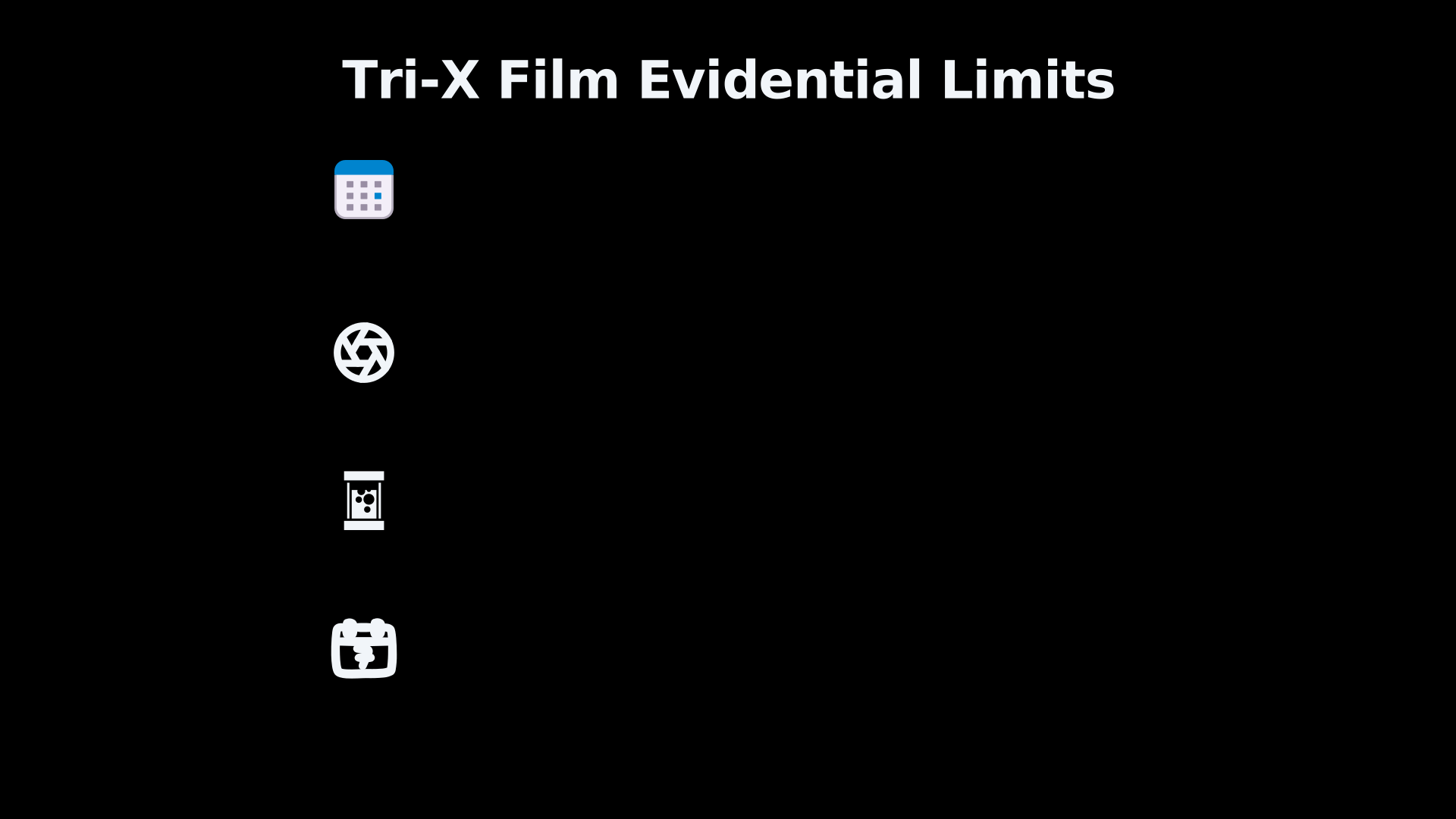
There is a second inferential jump that is even more important. Suppose, for argument’s sake, that forensic work could establish that the Tri-X was manufactured in 1954 and exposed in the 1950s. That would still date the photographing of the pages, not necessarily their original creation.
Photographs reproduce appearances. They do not ordinarily provide direct access to the paper fibres, ink chemistry, physical impressions, alterations or other properties of the photographed object. Forensic-document literature consequently treats examination of non-original material as more limited than examination of an original. Research published by the American Society of Questioned Document Examiners notes that copying processes can add or remove fine characteristics and that some physical information, such as the depth of an ink line in paper, cannot be recovered from a reproduction.[journal.asqde.org]journal.asqde.orgJune 1, 2022…
Dating disputed documents is itself a difficult forensic discipline. A 2021 review in Microchemical Journal describes estimating document age as one of the more challenging areas of questioned-document examination.[ScienceDirect]sciencedirect.comOpen source on sciencedirect.com. Techniques can involve the physical and chemical properties of inks and other materials; NIST, for example, describes the US Secret Service’s International Ink Library as containing chemically tested ink formulations whose identification can help establish the earliest possible origin of a document.[NIST]nist.govforensic database questioned documents tableforensic database questioned documents table Those are precisely the sorts of examinations that photographs cannot substitute for.
This limitation is unusually clear in the SOM1-01 debate because its own defenders acknowledge it. The SOM1-01 authentication FAQ states that, without the originals, investigators have had to rely on typography, chronology, content and related methods. It expressly says that paper and ink testing of originals would be the decisive way to establish whether those materials came from the claimed period.[SOM1-01]specialoperationsmanual.comOpen source on specialoperationsmanual.com.
That concession defines the proper evidential weight of the Tri-X claim. The film can potentially say something about the carrier on which the surviving images reside. It cannot chemically date the paper or printing material visible inside those images.
Old stock also creates a deliberate-backdating risk
The strongest criticism of the film argument does not require proving that SOM1-01 was forged. It requires only recognising that old photographic materials can be reused.
If somebody in a later period wanted photographs to possess period-compatible physical characteristics, obtaining old film would be one possible route. The more time that passed, the more unusual usable 1954 high-speed stock would become, but rarity is not impossibility. Indeed, Kodak’s preservation guidance explicitly discusses refrigeration and freezing of photographic material, while documented photographers have successfully used substantially expired Tri-X.[FilmColors]filmcolors.orgFilm Colorse30.fmFilm Colorse30.fm
This creates an asymmetry in the authentication argument. Finding genuinely modern film would be potentially damaging to a claim that the negatives themselves originated in the 1950s, because the film could not have been exposed before it existed. Finding old film does not provide the mirror-image conclusion. An object manufactured in 1954 can still be used in 1964, 1974 or later.
That is the familiar difference between a terminus post quem — an earliest possible date — and a positive date of creation. A material introduced or manufactured in a particular year may rule out earlier production, but it ordinarily cannot by itself rule out later use.
For SOM1-01, the distinction becomes especially significant because the negatives appeared only in 1994. Wood’s account says Berliner received the undeveloped roll through the post, and the dedicated SOM1-01 source history identifies no named photographer whose possession of the film can be traced back to the 1950s.[SOM1-01]specialoperationsmanual.comSOM1-01SOM1-01 Overview & AuthenticationSOM1-01SOM1-01 Overview & Authentication The approximately four-decade evidential gap is therefore not filled merely by dating the raw stock.
What custody evidence would strengthen the claim
The film evidence would become considerably more informative if it could be joined to an independently documented chain of custody. The crucial question is not simply “When did Kodak make this film?” but “Where was this particular roll between manufacture and its arrival in 1994?”
A stronger case would require evidence capable of connecting those stages: original Kodak packaging with verifiable lot information; purchase, laboratory or processing records; dated inventories showing continuous possession; testimony from an identifiable photographer supported by contemporary records; or other physical evidence capable of independently constraining when the roll was exposed. The SOM1-01 material presently described by its proponents does not supply that continuous history. Their FAQ itself characterises provenance as an issue and acknowledges that the original paper document is unavailable for paper-and-ink examination.[SOM1-01]specialoperationsmanual.comOpen source on specialoperationsmanual.com.
Ideally, investigators would also need the original negatives available for independent specialist examination rather than relying on enlargements or reproductions. Film identification could then be documented transparently: exact edge markings, emulsion and base characteristics, manufacturing-code interpretation, signs of age or storage damage, frame sequence and any physical discontinuities could all be recorded. Even a firm manufacturing result, however, would remain only one component of provenance.
Most importantly, discovery of the alleged paper original would change the evidential problem entirely. Paper, printing and ink could then be investigated directly rather than inferred from photographs. SOM1-01’s own authentication site recognises this point, saying that locating an original would permit dating of its ink and paper.[SOM1-01]specialoperationsmanual.comOpen source on specialoperationsmanual.com.
What the Tri-X claim can and cannot support
The reported 1954 film stock should therefore neither be dismissed as meaningless nor promoted into a date stamp for SOM1-01. If independently confirmed, genuine 1954-manufactured Tri-X would show that the surviving photographs were made on period film stock. That is a real physical observation and may be relevant when evaluating the history of the negatives.
Its evidential reach stops well short of authenticating the manual’s claimed date. Kodak’s technical literature distinguishes manufacture, storage, exposure and processing, and film-preservation practice treats manufacturing markings as dating aids that must be combined with other information.[FilmColors]filmcolors.orgFilm Colorse30.fmFilm Colorse30.fm A 1954 roll could have been exposed after 1954, while photographs made on it cannot directly establish the age of the paper and ink they depict.
The central authenticity question is consequently not whether old Tri-X existed, but whether there is independent evidence tying this film’s exposure and these photographed pages to the claimed historical period. On the publicly described provenance, that connection remains missing. The film may establish an earliest possible boundary for the photographic artefact; without custody records or the paper original, it cannot establish when SOM1-01 itself was created.
Amazon book picks
Further Reading
Books and field guides related to Can Old Film Stock Date the SOM 1 01 Photos?. Use these as the next step if you want deeper reading beyond the article.
Photography: The Definitive Visual History
This lavish ebook traces the history of photography from the first black and white images to celebrated examples of 21st-century digital...
The Demon-haunted World
Rating: 4.5/5 from 43 Google Books ratings
Are we on the brink of a new Dark Age of irrationality and superstition? In this book, the writer shows how scientific thinking is necess...
The Manual of Photography
The tenth edition of The Manual of Photography is an indispensable textbook for anyone who is serious about photography. It is ideal if y...
The Camera
Ansel Adams (1902-1984) produced some of the 20th century's most iconic photographic images and helped nurture the art of photography thr...
eBay marketplace picks
Marketplace Samples
Live-tested eBay searches with available results related to this page.
Selected fromUFO poster oneBay.co.uk.




Endnotes
1.
Source: filmcolors.org
Title: Film Colorse30.fm
Link:https://filmcolors.org/wp-content/uploads/2025/12/Kodak_Storage-and-Care-of-Kodak-Photographic-Materials-Before-and-After-Processing_E-30.pdf
2.
Source: paperzz.com
Title: Mellon Guide.qxd
Link:https://paperzz.com/doc/7711853/mellon-guide.qxd—national-film-preservation-foundation
Source snippet
Mellon Guide.qxd - National Film Preservation Foundation...
3.
Source: kodak.com
Title: Milestones | Kodak
Link:https://www.kodak.com/en/company/page/milestones/
Source snippet
Milestones | Kodak...
4.
Source: johnnymartyr.wordpress.com
Title: happy birthday kodak tri x
Link:https://johnnymartyr.wordpress.com/2017/11/01/happy-birthday-kodak-tri-x/
Source snippet
Happy Birthday Kodak Tri-X!November 1, 2017 — 1 Nov 2017 — Kodak Tri-X was originally introduced sometime in 1940 but November 1st, 1954...
Published: November 1, 2017
5.
Source: johnsexton.com
Title: John Sexton.com
Link:https://www.johnsexton.com/newsletter11-2024.html
Source snippet
Newsletter10 Nov 2024 — On November 1, 1954—nearly a year and a half after I was born—Eastman Kodak revolutionized photography by introdu...
Published: November 1, 1954
6.
Source: johnsexton.com
Title: John Sexton.com
Link:https://www.johnsexton.com/newsletter02-2010.html
Source snippet
Newsletter - February, 2010...
7.
Source: journal.asqde.org
Link:https://journal.asqde.org/articles/10.69525/jasqde.282
Source snippet
June 1, 2022...
Published: June 1, 2022
8.
Source: journal.asqde.org
Link:https://journal.asqde.org/articles/279?_rsc=f6n96
9.
Source: sciencedirect.com
Link:https://www.sciencedirect.com/science/article/pii/S0026265X21008080
10.
Source: nist.gov
Title: forensic database questioned documents table
Link:https://www.nist.gov/forensics/forensic-database-questioned-documents-table
11.
Source: specialoperationsmanual.com
Link:https://www.specialoperationsmanual.com/source/
12.
Source: sciencedirect.com
Link:https://www.sciencedirect.com/science/article/pii/S0379073826000058
13.
Source: journal.asqde.org
Link:https://journal.asqde.org/en/articles/10.69525/jasqde.292
14.
Source: rosehlacroix.wordpress.com
Title: kodak tri x in the kodak signet
Link:https://rosehlacroix.wordpress.com/2024/02/21/kodak-tri-x-in-the-kodak-signet/
15.
Source: journal.asqde.org
Link:https://journal.asqde.org/articles/10.69525/jasqde.280
16.
Source: nist.gov
Title: handwriting examiners digital age
Link:https://www.nist.gov/news-events/news/2021/06/handwriting-examiners-digital-age
17.
Source: nist.gov
Title: forensic handwriting examination and human factors
Link:https://www.nist.gov/programs-projects/forensic-handwriting-examination-and-human-factors
18.
Source: negative.supply
Title: Film Review: Kodak Tri-X 400 AND Tri-X 320 — Negative Supply
Link:https://www.negative.supply/blog/2020/9/10/film-review-kodak-tri-x-400
19.
Source: journal.asqde.org
Link:https://journal.asqde.org/articles/10.69525/jasqde.255
20.
Source: journal.asqde.org
Link:https://journal.asqde.org/articles/10.69525/jasqde.244
21.
Source: journal.asqde.org
Link:https://journal.asqde.org/articles/10.69525/jasqde.247
22.
Source: sciencedirect.com
Link:https://www.sciencedirect.com/science/article/abs/pii/S0026265X17303806
23.
Source: nist.gov
Link:https://www.nist.gov/node/1249446
24.
Source: sciencedirect.com
Link:https://www.sciencedirect.com/science/article/abs/pii/S0003267015010478
25.
Source: sciencedirect.com
Link:https://www.sciencedirect.com/science/article/pii/S0003267015010478
26.
Source: journal.asqde.org
Link:https://journal.asqde.org/articles/10.69525/jasqde.217
27.
Source: journal.asqde.org
Link:https://journal.asqde.org/articles/10.69525/jasqde.194
28.
Source: paperzz.com
Title: alien interview
Link:https://paperzz.com/doc/8781629/alien-interview—exopolitics-hong-kong
29.
Source: nist.gov
Title: influence ink quality fingerprint impressions
Link:https://www.nist.gov/publications/influence-ink-quality-fingerprint-impressions
30.
Source: journal.asqde.org
Link:https://journal.asqde.org/
31.
Source: asqde.org
Title: Find an Expert
Link:https://www.asqde.org/experts.html
32.
Source: asqde.org
Title: Experts in the U.S
Link:https://www.asqde.org/usa-experts.html
33.
Source: asqde.org
Link:https://www.asqde.org/faq.html
34.
Source: kodak.com
Title: chronology of film
Link:https://www.kodak.com/en/motion/page/chronology-of-film/
35.
Source: kodak.com
Link:https://www.kodak.com/en/still-film/product/professional/tri-x-320-film/
36.
Source: kodak.com
Link:https://www.kodak.com/en/still-film/product/professional/tri-x-400-film/
37.
Source: kodak.com
Title: tri x black white 7266
Link:https://www.kodak.com/en/motion/product/camera-films/tri-x-black-white-7266/
38.
Source: kodak.com
Link:https://www.kodak.com/en/motion/product/camera-films/tri-x-black-white-7266/resources/
39.
Source: kodak.com
Link:https://www.kodak.com/content/products-brochures/Film/kodak-essential-reference-guide-for-filmmakers.pdf
40.
Source: filmcolors.org
Link:https://filmcolors.org/wp-content/uploads/2025/12/KODAK-Color-Films-The-Differences-between-professional-Films-and-Films-for-general-Picture-taking_E-6.pdf
41.
Source: sciencedirect.com
Title: Forensic analytical approaches to the dating of documents: An overview
Link:https://www.sciencedirect.com/science/article/abs/pii/S0026265X21008080
42.
Source: sciencedirect.com
Link:https://www.sciencedirect.com/science/article/pii/S037907382500026X
43.
Source: nist.gov
Link:https://www.nist.gov/image/questioned-handwriting-and-known-samples
44.
Source: paperzz.com
Link:https://paperzz.com/doc/9317594/photography-faq
45.
Source: specialoperationsmanual.com
Title: SOM1-01SOM1-01 Overview & Authentication
Link:https://www.specialoperationsmanual.com/2014/12/30/som1-01-overview-authentication/
46.
Source: Wikipedia
Title: Kodak Tri-X
Link:https://en.wikipedia.org/wiki/Kodak_Tri-X
47.
Source: si.edu
Title: Smithsonian Institution V-Mail microfilm strip | Smithsonian Institution
Link:https://www.si.edu/object/v-mail-microfilm-strip%3Anpm_2008.2017.1
48.
Source: specialoperationsmanual.com
Link:https://www.specialoperationsmanual.com/faq/
49.
Source: specialoperationsmanual.com
Title: The Manual
Link:https://www.specialoperationsmanual.com/the-manual/
50.
Source: filmarchive.gov.hk
Title: Preservation and Conservation
Link:https://www.filmarchive.gov.hk/en_US/web/hkfa/conservation.html
51.
Source: filmarchive.gov.hk
Link:https://www.filmarchive.gov.hk/sc/web/hkfa/conservation.html
52.
Source: speakerdeck.com
Title: som1 01 majestic 12 group special operations manual 1954
Link:https://speakerdeck.com/aliengrip/som1-01-majestic-12-group-special-operations-manual-1954
53.
Source: 35mmc.com
Title: Kodak Tri-X Review
Link:https://www.35mmc.com/07/02/2020/kodak-tri-x-review/
54.
Source: specialoperationsmanual.com
Link:https://www.specialoperationsmanual.com/2014/12/28/summary-skeptic-objections-to-authenticity/
55.
Source: specialoperationsmanual.com
Title: Why The Critics Are Wrong About SOM1-01
Link:https://www.specialoperationsmanual.com/2014/12/28/why-the-critics-are-wrong-about-som1-01-mufon-journal-jan-2015/
56.
Source: indiankanoon.org
Link:https://indiankanoon.org/doc/194871/
57.
Source: indiankanoon.org
Link:https://indiankanoon.org/doc/54174/
58.
Source: studylib.net
Title: kodak professional tri
Link:https://studylib.net/doc/8359402/kodak-professional-tri
59.
Source: bibliotecapleyades.net
Title: SO M1-01
Link:https://www.bibliotecapleyades.net/sociopolitica/sociopol_som1-01.htm
60.
Source: ru.scribd.com
Title: SOM1 01
Link:https://ru.scribd.com/doc/132064327/SOM1-01
61.
Source: pt.scribd.com
Link:https://pt.scribd.com/doc/5014360/SOM1-01-Extraterrestrial-Entities-and-Technology-Recovery-and-Disposal-April-1954-part-1
Published: April 1954
62.
Source: specialoperationsmanual.com
Title: Learn More
Link:https://www.specialoperationsmanual.com/learn-more/
63.
Source: specialoperationsmanual.com
Title: Authentication Archives
Link:https://www.specialoperationsmanual.com/category/articles/
64.
Source: kenrahn.com
Link:https://www.kenrahn.com/Marsh/Zapruder/select.shtml
65.
Source: canada.ca
Title: photographic materials
Link:https://www.canada.ca/en/conservation-institute/services/preventive-conservation/guidelines-collections/photographic-materials.html
66.
Source: brianpritchard.com
Link:https://brianpritchard.com/wp/british-motion-picture-laboratories/kodak-edge-printing/
67.
Source: 125px.com
Link:https://125px.com/docs/film/kodak/E7019_en-Ultra_Max_400.pdf
68.
Source: kodak.photosys.com
Title: tri x 400 reversal film 7266 16 mm
Link:https://kodak.photosys.com/products/tri-x-400-reversal-film-7266-16-mm
69.
Source: kodak.photosys.com
Title: tri x 400 reversal film 7266 16 mm
Link:https://kodak.photosys.com/products/tri-x-400-reversal-film-7266-16-mm?variant=36566472513
70.
Source: emirco.net
Title: KODA K: H-1 Film Identification
Link:https://emirco.net/photo/projects/OldFilm/KODAK%20H-1%20Film%20Identification.htm
71.
Source: ars-imago.ch
Link:https://www.ars-imago.ch/web/content/111904?download=true&unique=85e47898abde3c971d5958b124179822e156f620
72.
Source: foto.ru
Title: Широкая Kodak Tri-X в родинале
Link:https://foto.ru/forums/topics/shirokaya-kodak-tri-x-v-rodinale-vashi-mneniya/page/2
73.
Source: kodakprofessional.com
Link:https://www.kodakprofessional.com/en-gb/photographers/film/black-white/kodak-professional-tri-x-films/515
75.
Source: dps.ms.gov
Title: questioned document
Link:https://www.dps.ms.gov/forensic-laboratories/Crime-Lab/questioned-document
76.
Source: arch.ies.gov.pl
Link:https://arch.ies.gov.pl/index.php?catid=10&id=46&view=article
77.
Source: mr-alvandi.com
Link:https://www.mr-alvandi.com/downloads/film-and-processing/kodak-t-max-100-400-and-p3200.pdf
78.
Source: designlife-cycle.com
Link:https://www.designlife-cycle.com/kodak-film-roll
79.
Source: pimhens.com
Title: kodak 35 1938
Link:https://pimhens.com/collection-item/kodak
80.
Source: usermanuals.au
Link:https://www.usermanuals.au/kodak/tri-x-reversal-film-7266/manual
81.
Source: scribd.com
Title: SOM1 01
Link:https://www.scribd.com/document/826001136/SOM1-01
Additional References
82.
Source: youtube.com
Title: Ep 021: A Full Reading of the MJ-12 Special Operations Manual SOM1-01
Link:https://www.youtube.com/watch?v=6gXZLebZolU
Source snippet
Majestic 12 documents authentication Robert Wood Ryan Wood The Majestic-12 Documents [With Ryan S. Wood]...
83.
Source: youtube.com
Title: The Secret TV Documentary: Authentication of Majestic Documents (MJ-12)
Link:https://www.youtube.com/watch?v=UG8rEABhzMY
Source snippet
Xcon 2005 - Ryan & Bob Wood - Mj-12 Documentation Authentication Workshop...
84.
Source: youtube.com
Link:https://www.youtube.com/watch?v=UMBfGEVC1sQ
Source snippet
Ryan Wood|PBP|17: Majestic-12 (MJ12) Authentication...
85.
Source: in.gov
Link:https://www.in.gov/isp/labs/forensic-disciplines/documents/
86.
Source: loc.gov
Link:https://www.loc.gov/preservation/care/photolea.html
87.
Source: michigan.gov
Link:https://www.michigan.gov/msp/divisions/forensic-science/technical-disciplines/questioned-documents
88.
Source: youtube.com
Title: Ryan Wood|PBP|17: Majestic-12 (MJ12) Authentication
Link:https://www.youtube.com/watch?v=NBfD99E5w98
Source snippet
Ep 021: A Full Reading of the MJ-12 Special Operations Manual SOM1-01...
89.
Source: youtube.com
Title: The Majestic-12 Documents [With Ryan S. Wood]
Link:https://www.youtube.com/watch?v=vzB87RJkQVU
Source snippet
The Secret TV Documentary: Authentication of Majestic Documents (MJ-12)...
90.
Source: facebook.com
Link:https://www.facebook.com/amiarchivists/posts/until-a-method-of-saving-degraded-film-is-optimised-the-most-effective-thing-we-/10156806432099718/
91.
Source: researchgate.net
Link:https://www.researchgate.net/publication/388949117_Pantographs_as_a_Security_Feature_Why_They_Work_Why_They_Fail