Within Register Numbers
Why Not Every Top Secret Document Looked the Same
Air Force rules distinguished registered documents from other classified paperwork, so a missing number cannot serve as a universal forgery test.
On this page
- Registered documents versus other classified material
- Copy numbers, short titles, and control practices
- What these distinctions do and do not explain
Page outline Jump by section
Introduction
The absence of a Top Secret register number on the alleged 14 July 1954 Cutler–Twining memorandum is a genuine archival anomaly, but Air Force Regulation 205-1 makes one important caution necessary: not every Top Secret document belonged to the same administrative category or displayed the same set of identifiers. The regulation separately governed ordinary classified material, nonregistered Top Secret documents and the narrower category of “registered documents”. Those categories could overlap in classification level while being controlled differently.[Computer UFO Network]cufon.org205 1s23Computer UFO NetworkAIR FORCE REGULATION 205-1 (15 Dec 1953) Sections II & IIIDecember 15, 1953…
That means “no register number, therefore forgery” is too broad a test. The stronger objection is more specific. The National Archives says the Cutler–Twining sheet was found in a records series filed by Top Secret register number, yet the sheet bears no such number. Air Force rules explain why one should not expect every Top Secret document to look identical; they do not, by themselves, explain why this particular document apparently lacks the identifier used to organise the series containing it.[National Archives]archives.govNational Archives Project BLUE BOOKNational ArchivesProject BLUE BOOK - Unidentified Flying Objects | National ArchivesJune 25, 2024…
Registered documents were a special category
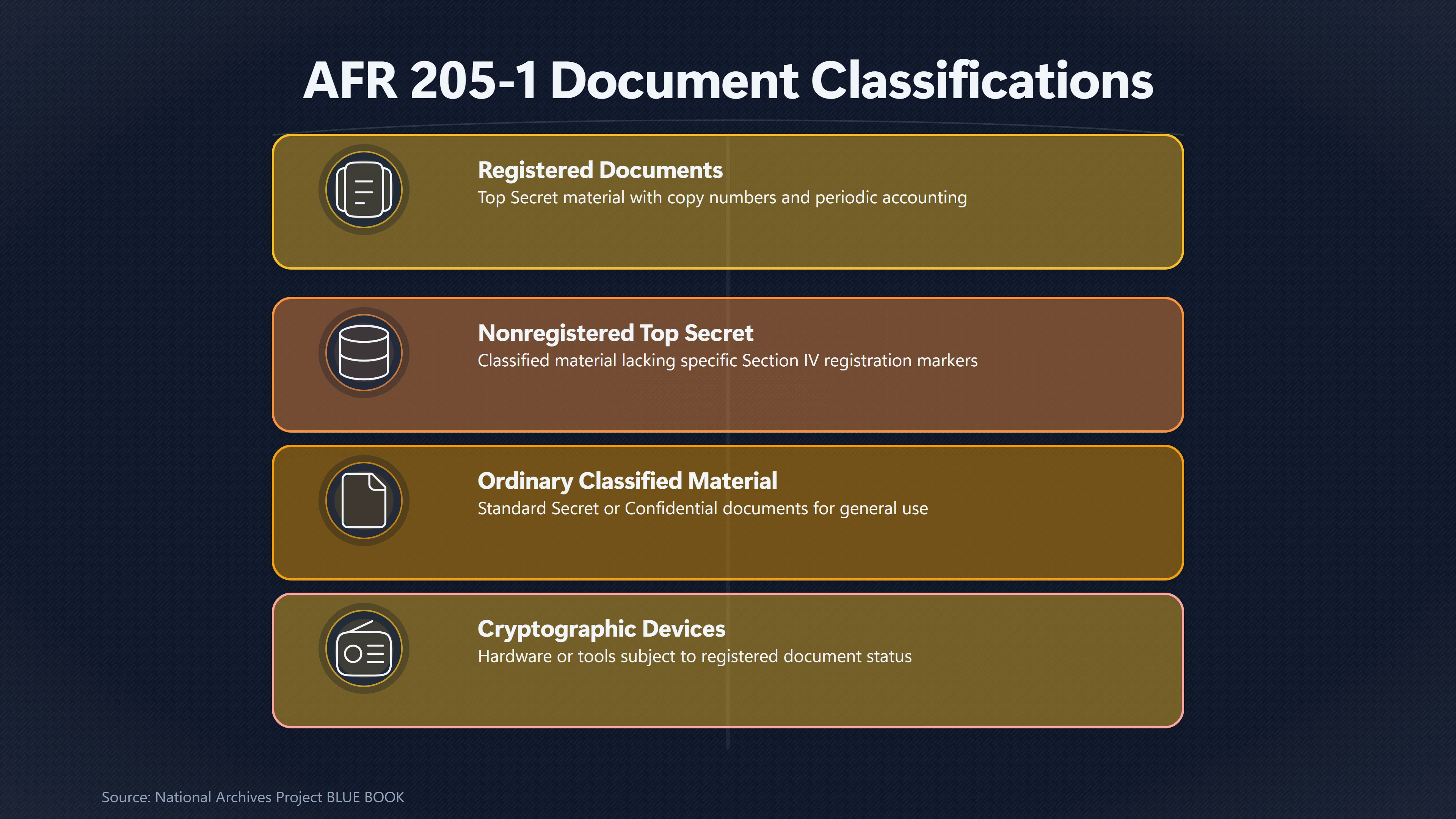
The key distinction in AFR 205-1 is between a document’s security classification and its administrative control status. “Top Secret”, “Secret” and “Confidential” were classification categories describing the protection required by the information. Registration was a separate control mechanism. The regulation devoted an entire section to “Registered Documents”, distinct from its general rules for classification, marking, handling and transmission.[Computer UFO Network]cufon.org205 1tocComputer UFO NetworkAIR FORCE REGULATION 205-1 (15 Dec 1953) Table of ContentsDecember 15, 1953…
Paragraph 38 defined a registered document as a Top Secret, Secret or Confidential document — or a cryptographic device — carrying a copy number, short title and instructions for periodic accounting. Most importantly for authenticity arguments, the regulation explicitly warned that such a document was not to be confused with an ordinary classified document given a copy number or short title merely for bookkeeping or reference. Registration therefore described a particular accountability regime, not a synonym for being classified.[Computer UFO Network]cufon.org205 1s47Computer UFO NetworkAIR FORCE REGULATION 205-1 (15 Dec 1953) Sections IV - VII…
The distinction worked in both directions. A document did not have to be Top Secret to be registered: Secret and Confidential material could also be placed in the registered-document system. Conversely, AFR 205-1 expressly discussed “nonregistered TOP SECRET documents”, proving that Top Secret material did not automatically become a registered document in the regulation’s technical sense.[Computer UFO Network]cufon.org205 1s23Computer UFO NetworkAIR FORCE REGULATION 205-1 (15 Dec 1953) Sections II & IIIDecember 15, 1953…
This is not merely a distinction inferred from regulatory wording. A surviving 1953 history of the Air Force’s 4602d Air Intelligence Service Squadron similarly explained to personnel that a registered document was one assigned a short title and copy number with periodic-accounting requirements, and distinguished it from classified documents carrying numbers for administrative purposes. The example shows that Air Force personnel were expected to recognise these as operationally different categories.[Nicap]nicap.orgCUFON(SM) 4602d AISS UNIT HISTORY SAMPLER (Part 2 of 7)July 24, 1953…
Copy numbers did not all mean the same thing
The complication deepens because numbering itself performed several jobs. AFR 205-1 required each copy of a Top Secret document to be “numbered in series, for accounting purposes”. Distribution records and receipts were also supposed to identify the copy number of each Top Secret document transmitted. Those requirements applied to Top Secret control generally, including documents that were not registered under Section IV.[Computer UFO Network]cufon.org205 1s23Computer UFO NetworkAIR FORCE REGULATION 205-1 (15 Dec 1953) Sections II & IIIDecember 15, 1953…
Registered documents had additional identifying machinery. Besides a copy number, they carried a short title and instructions for periodic accounting. Their preparation rules called for the copy number and short title to appear in prescribed positions and for information such as the office of origin, office of record, page total, custody-reporting instructions and ultimate-disposal instructions to be supplied.[Computer UFO Network]cufon.org205 1s47Computer UFO NetworkAIR FORCE REGULATION 205-1 (15 Dec 1953) Sections IV - VII…
A short title was itself a security device rather than necessarily a descriptive title. AFR 205-1 defined it as a designation used for security and brevity that conveyed no information about the document’s classification or contents. Elsewhere, the regulation allowed correspondence concerning classified documents to refer to them by file number, date and subject when doing so disclosed nothing classified; if the subject itself was classified, a short title could substitute for it.[Computer UFO Network]cufon.org205 1s1Computer UFO NetworkAIR FORCE REGULATION 205-1 (15 Dec 1953) Section IDecember 15, 1953…
The resulting paperwork could therefore contain several superficially similar identifiers serving different functions:
- a serial or copy number identifying a particular Top Secret copy;
- a short title concealing or abbreviating a sensitive subject;
- bookkeeping or reference numbers assigned for ordinary administration;
- identifiers associated with the registered-document accountability system;
- local or headquarters-level control records maintained by Top Secret Control Officers.
Treating every such number as though it were one universal “Top Secret register number” collapses administrative distinctions that AFR 205-1 deliberately kept separate.[Computer UFO Network]cufon.org205 1s23Computer UFO NetworkAIR FORCE REGULATION 205-1 (15 Dec 1953) Sections II & IIIDecember 15, 1953…

Top Secret still carried stringent accountability
Recognising those categories does not mean that nonregistered Top Secret paperwork was casually handled. Executive Order 10501, which took effect in December 1953 and supplied the government-wide framework applicable in July 1954, required departments and agencies to maintain good accountability records and exercise particularly severe control over Top Secret material. It directed the designation of Top Secret Control Officers, as required, to receive and dispatch Top Secret material and maintain accountability registers for it.[The American Presidency Project]presidency.ucsb.eduOpen source on ucsb.edu.
AFR 205-1 translated that principle into Air Force procedure. Headquarters initiating or receiving Top Secret information were to appoint Top Secret Control Officers to receive the material, maintain accountability registers and dispatch it. The regulation also required a receipt system for the transmission and custody of each Top Secret document, distribution records showing copy numbers, and records identifying people given access to Top Secret information.[Computer UFO Network]cufon.org205 1s23Computer UFO NetworkAIR FORCE REGULATION 205-1 (15 Dec 1953) Sections II & IIIDecember 15, 1953…
This creates an important two-level distinction. A registered document under Section IV was a specialised kind of classified document subject to periodic accounting and other formal features. But Top Secret accountability registers were part of the wider machinery for controlling Top Secret material. Consequently, demonstrating that a document was not a Section IV registered document does not automatically establish that it should have left no Top Secret control trail at all.[Computer UFO Network]cufon.org205 1s23Computer UFO NetworkAIR FORCE REGULATION 205-1 (15 Dec 1953) Sections II & IIIDecember 15, 1953…
That is the point most easily lost when the terminology is reduced to a simple rule about whether a number appears on the page.
Why the Cutler–Twining anomaly survives the distinction
For the alleged MJ-12 memorandum, the decisive question is therefore not, “Did every Top Secret document have to be a registered document?” AFR 205-1 shows that the answer is no. The better question is, “What sort of control identifier should a document have had to enter and remain in this particular Air Force records series in the ordinary way?”
NARA’s finding is unusually specific. Its Military Reference Branch reported that the Cutler–Twining memorandum was discovered in Record Group 341, entry 267, and that the series was filed by a Top Secret register number. NARA then identified the problem directly: the purported memorandum did not bear such a number. It was in folder T4-1846, where archivists found no other documents concerning “NSC/MJ-12”. Searches of related Air Force, Joint Chiefs of Staff and defence records also failed to locate corroborating material.[National Archives]archives.govNational Archives Project BLUE BOOKNational ArchivesProject BLUE BOOK - Unidentified Flying Objects | National ArchivesJune 25, 2024…
AFR 205-1 therefore weakens one argument against the memorandum while leaving another substantially intact. It weakens the universal proposition that a genuine Top Secret memorandum of the period must necessarily display every feature associated with a formally registered document. The regulation expressly recognises nonregistered Top Secret documents, so authenticity cannot sensibly be decided by comparing every Top Secret sheet with the Section IV registered-document template.[Computer UFO Network]cufon.org205 1s23Computer UFO NetworkAIR FORCE REGULATION 205-1 (15 Dec 1953) Sections II & IIIDecember 15, 1953…
But this does not neutralise NARA’s narrower archival observation. If entry 267 was actually organised according to a Top Secret register number, the relevant comparison is not with all Top Secret paperwork produced by the Air Force. It is with the records-management practice governing that series. AFR 205-1 establishes administrative variety; NARA establishes the particular mismatch that requires explanation.[National Archives]archives.govNational Archives Project BLUE BOOKNational ArchivesProject BLUE BOOK - Unidentified Flying Objects | National ArchivesJune 25, 2024…
What the distinctions explain — and what they do not
Air Force rules make the authenticity test more discriminating rather than eliminating it. They show why researchers should avoid treating one expected marking as a universal fingerprint of genuine 1950s classified paperwork.
They do explain why two authentic documents bearing the same Top Secret classification might look administratively different. One might be a registered document requiring periodic inventory; another might be nonregistered Top Secret correspondence. Copy numbers, short titles and other numbers could also have different administrative purposes.[Computer UFO Network]cufon.org205 1s23Computer UFO NetworkAIR FORCE REGULATION 205-1 (15 Dec 1953) Sections II & IIIDecember 15, 1953…
They also explain why the word “register” requires care. Executive Order 10501 and AFR 205-1 required accountability registers for Top Secret control, while AFR 205-1 separately defined “registered documents” as a specialised category. The similarity of the terminology can encourage a false equivalence between a Top Secret document entered into an accountability system and a formally registered document possessing all Section IV characteristics.[The American Presidency Project]presidency.ucsb.eduOpen source on ucsb.edu.
They do not explain, on the evidence presently available, why the Cutler–Twining sheet lacks the number by which NARA says its archival series was filed. Nor do they establish that the memorandum was exempt from the Top Secret accountability practices applicable to material in that records system. Those would require evidence about the actual processing, receipt or filing history of this particular sheet, rather than a general observation that nonregistered Top Secret documents existed.[National Archives]archives.govNational Archives Project BLUE BOOKNational ArchivesProject BLUE BOOK - Unidentified Flying Objects | National ArchivesJune 25, 2024…
The distinction therefore cuts against arguments at both extremes. A missing register number is not a universal forgery detector, because AFR 205-1 demonstrates that Top Secret documents occupied more than one administrative category. Yet the existence of those categories does not make the Cutler–Twining discrepancy disappear. The historically sound test is narrower and stronger: determine which control regime applied to the particular document and records series, then ask whether the surviving paperwork conforms to that regime. On that test, the National Archives’ register-number observation remains an unresolved problem for the alleged MJ-12 memorandum rather than a stand-alone proof of forgery.[archives.gov]archives.govNational Archives Project BLUE BOOKNational ArchivesProject BLUE BOOK - Unidentified Flying Objects | National ArchivesJune 25, 2024…
Amazon book picks
Further Reading
Books and field guides related to Why Not Every Top Secret Document Looked the Same. Use these as the next step if you want deeper reading beyond the article.
Top Secret/Majic: Operation Majestic-12 and the United States...
Top Secret/Majic is the result of nuclear physicist and renowned UFO investigator Stanton T. Friedman's twenty-one year search for the tr...
UFOs and Government: A Historical Inquiry
Governments around the world have had to deal with the UFO phenomenon for a good part of a century. How and why they did so is the subjec...

Secrecy: The American Experience
Senator Daniel Patrick Moynihan, the late senior U.S. Senator from N.Y., here presents an eloquent & fascinating account of the developme...
The UFO Files: The Inside Story of Real-life Sightings
'What does all this stuff about flying saucers amount to? What can it mean? What is the truth?' Winston Churchill, prime minister's perso...
eBay marketplace picks
Marketplace Samples
Live-tested eBay searches with available results related to this page.
Selected fromAir Force patch oneBay.co.uk.



Endnotes
1.
Source: archives.gov
Title: National Archives Project BLUE BOOK
Link:https://www.archives.gov/research/military/air-force/ufos
Source snippet
National ArchivesProject BLUE BOOK - Unidentified Flying Objects | National ArchivesJune 25, 2024...
Published: June 25, 2024
2.
Source: reaganlibrary.archives.gov
Link:https://reaganlibrary.archives.gov/public/2021-06/40-654-209237726-004-008-2021.pdf
3.
Source: nicap.org
Link:https://www.nicap.org/4602smpl2.htm
Source snippet
CUFON(SM) 4602d AISS UNIT HISTORY SAMPLER (Part 2 of 7)July 24, 1953...
Published: July 24, 1953
4.
Source: device.report
Title: PD F document
Link:https://device.report/m/d094406bc198816903d749ed6b31ea11942e25b220b03e7c5681f09384ca48c1_pdf
5.
Source: cufon.org
Title: 205 1s23
Link:https://cufon.org/cufon/205-1s23.htm
Source snippet
Computer UFO NetworkAIR FORCE REGULATION 205-1 (15 Dec 1953) Sections II & IIIDecember 15, 1953...
Published: December 15, 1953
6.
Source: cufon.org
Title: 205 1s47
Link:https://www.cufon.org/cufon/205-1s47.htm
Source snippet
Computer UFO NetworkAIR FORCE REGULATION 205-1 (15 Dec 1953) Sections IV - VII...
7.
Source: cufon.org
Title: 205 1toc
Link:https://cufon.org/cufon/205-1toc.htm
Source snippet
Computer UFO NetworkAIR FORCE REGULATION 205-1 (15 Dec 1953) Table of ContentsDecember 15, 1953...
Published: December 15, 1953
8.
Source: cufon.org
Title: 205 1s1
Link:https://www.cufon.org/cufon/205-1s1.htm
Source snippet
Computer UFO NetworkAIR FORCE REGULATION 205-1 (15 Dec 1953) Section IDecember 15, 1953...
Published: December 15, 1953
9.
Source: presidency.ucsb.edu
Link:https://www.presidency.ucsb.edu/documents/executive-order-10501-safeguarding-official-information-the-interests-the-defense-the
10.
Source: cufon.org
Title: 205 1sat
Link:https://cufon.org/cufon/205-1sat.htm
12.
Source: cufon.org
Title: 205 1int
Link:https://cufon.org/cufon/205-1int.htm
13.
Source: cufon.org
Title: 205 1s89
Link:https://cufon.org/cufon/205-1s89.htm
14.
Source: en.wikisource.org
Title: Executive Order 10501
Link:https://en.wikisource.org/wiki/Executive_Order_10501
Additional References
15.
Source: cia.gov
Link:https://www.cia.gov/readingroom/document/loc-hak
16.
Source: cia.gov
Link:https://www.cia.gov/readingroom/document/cia-rdp79r01012a000600020025-5
17.
Source: youtube.com
Title: The MJ-12 Conspiracy Debunked
Link:https://www.youtube.com/watch?v=9dF-iggJusY
Source snippet
Majestic 12 [Cutler Twining memo]({{ 'cutler-memo/' | relative_url }}) Ep 020: A Full Reading of the MJ-12 Eisenhower Briefing Document...
18.
Source: youtube.com
Title: UFOs and MJ-12
Link:https://www.youtube.com/watch?v=zHqIXLOqRak
Source snippet
Dr Kevin D Randle - The Growing MJ-12 Controversy...
19.
Source: doczz.net
Link:https://doczz.net/doc/6536901/–1–
20.
Source: it.scribd.com
Link:https://it.scribd.com/document/774580531/Advancements-in-Industry-4-0-Asset-Management-Interoperability-and-Cyber-Security-Challenges-and-Opportunities
21.
Source: wayup.com
Link:https://www.wayup.com/i-Other-j-Government-Security-Specialist-Air-Force-Research-Laboratory-767750426805100/
22.
Source: tpub.com
Link:https://www.tpub.com/ans/73.htm
23.
Source: scribd.com
Link:https://www.scribd.com/doc/173687506/Important-Decision
24.
Source: studylib.net
Link:https://studylib.net/doc/28154537/computer-org