Within Archive Anomalies
Was the MJ 12 Security Marking Used in 1954?
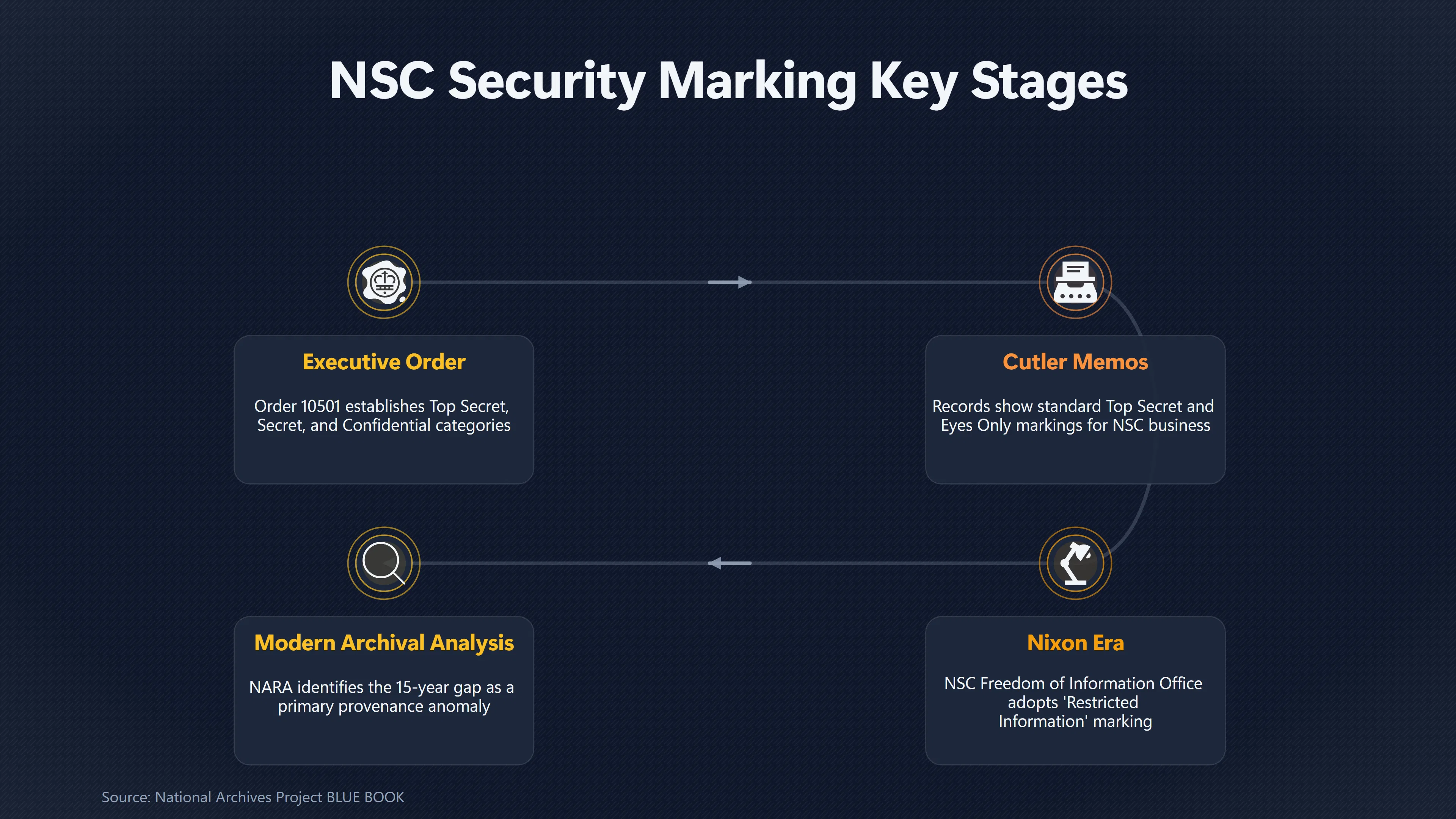
NARA found no Eisenhower-era NSC precedent for the memo's unusual 'Top Secret Restricted Information' marking.
On this page
- The wording printed on the questioned memo
- What Eisenhower era NSC records normally used
- Why classification chronology matters to authenticity
Page outline Jump by section
Introduction
The security marking on the alleged 14 July 1954 Cutler–Twining memorandum is troublesome for a simple chronological reason. The sheet carries the phrase “Top Secret Restricted Information”, yet the National Archives and Records Administration (NARA) reported that the National Security Council’s own Freedom of Information Office said this marking did not come into NSC use until the Nixon administration, beginning in 1969. The Eisenhower Presidential Library separately confirmed that this particular marking was not used during the Eisenhower administration.[National Archives]archives.govNational Archives Project BLUE BOOKNational ArchivesProject BLUE BOOK - Unidentified Flying Objects | National ArchivesJune 25, 2024
That does not prove forgery by itself. Security markings varied between agencies, and genuinely sensitive information could receive special handling. But authentication asks whether a document behaves like records genuinely produced by the office, institution and period it claims. Here, the disputed wording appears to belong to a later NSC documentary culture, while surviving 1953–54 records involving Robert Cutler show ordinary period markings such as “Top Secret” and “Top Secret — Eyes Only”.[Office of the Historian]history.state.govOffice of the Historian Historical DocumentsOffice of the HistorianHistorical Documents - Office of the HistorianJuly 22, 1954…
The wording printed on the questioned memo
The important anomaly is not the words “Top Secret”. That was unquestionably a valid US classification in 1954. President Eisenhower’s Executive Order 10501, issued in November 1953, established three basic defence-information classification categories: Top Secret, Secret and Confidential. It defined Top Secret as the highest of those categories, reserved for information whose unauthorised disclosure could cause exceptionally grave damage to the United States.[presidency.ucsb.edu]presidency.ucsb.eduExecutive Order 10501—Safeguarding Official Information in the Interests of the Defense of the United States | The American Presidency Pr…
The questionable element is the combined expression “Top Secret Restricted Information”. In its reference report on MJ-12, NARA recorded the conclusion supplied by the NSC Freedom of Information Office: that this marking did not come into use at the National Security Council until the Nixon administration. NARA also reported corroboration from the Eisenhower Presidential Library, which confirmed that the particular marking was not used during Eisenhower’s presidency.[National Archives]archives.govNational Archives Project BLUE BOOKNational ArchivesProject BLUE BOOK - Unidentified Flying Objects | National ArchivesJune 25, 2024
That is a particularly relevant comparison because the memorandum purports to come from Robert Cutler, Eisenhower’s Special Assistant for National Security Affairs. The question is therefore narrower than whether somebody somewhere in the federal government could have written words resembling “restricted information” in 1954. The archival question is whether this specific formal marking belongs on an NSC-related Cutler memorandum dated July 1954. The two institutions best placed to compare it with the relevant documentary population — the NSC and Eisenhower Presidential Library — told NARA that it did not.[National Archives]archives.govNational Archives Project BLUE BOOKNational ArchivesProject BLUE BOOK - Unidentified Flying Objects | National ArchivesJune 25, 2024
The surviving 1987 NARA reference report is unusually useful because it preserves this conclusion as part of an archivists’ anomaly assessment rather than as a later argument assembled solely within the UFO controversy. Its wording identifies both the institutional source of the finding and the chronological discrepancy.[Ronald Reagan Presidential Library]reaganlibrary.archives.govOpen source on archives.gov.
What Eisenhower-era NSC records normally used
Published contemporary records provide a useful control group. They show that highly sensitive Eisenhower-era material certainly carried additional handling restrictions, but those restrictions do not reproduce the questioned MJ-12 formula.
A genuine Robert Cutler memorandum of 4 January 1954, for example, concerning the President and NSC discussion of Iran, is identified in the State Department’s official Foreign Relations of the United States series as “top secret”. A Cutler memorandum of 19 May 1954 concerning US objectives in Southeast Asia is likewise recorded as “top secret”. On 1 June 1954, another Cutler memorandum was classified the same way.[Office of the Historian]history.state.govOffice of the Historian Historical DocumentsOffice of the HistorianHistorical Documents - Office of the Historian…
Documents could add handling language when greater compartmentation was required. A Cutler memorandum of 3 May 1954 is recorded as “top secret / personal and private”, while a memorandum of conversation written by Cutler on 1 November 1954 carries “top secret / eyes only”. NSC meeting records provide the same pattern: the record of the 204th NSC meeting on 24 June 1954 and the 207th meeting on 22 July — only eight days after the date on the questioned MJ-12 sheet — are both identified as “top secret / eyes only”.[Office of the Historian]history.state.govOffice of the Historian Historical DocumentsOffice of the HistorianHistorical Documents - Office of the HistorianMay 3, 1954…
The comparison is especially telling because it is not based on an assumption that all classified documents looked identical. They plainly did not. Rather, surviving records demonstrate a recognisable vocabulary of classification and special handling around Cutler and the Eisenhower NSC: Top Secret, Eyes Only, and in some circumstances additional instructions such as Personal and Private. The disputed “Top Secret Restricted Information” formula stands outside that observed pattern, exactly as the NSC and Eisenhower Library later told NARA.[state.gov]history.state.govOffice of the Historian Historical DocumentsOffice of the HistorianHistorical Documents - Office of the HistorianJuly 22, 1954…
There is also an important distinction between “restricted information” and the legally defined nuclear category Restricted Data. The latter was not an invented or anachronistic concept. Restricted Data had existed under atomic-energy law since 1946 and covered specified nuclear information; the 1954 Atomic Energy Act continued that statutory system and introduced Formerly Restricted Data for certain information primarily concerning the military utilisation of atomic weapons. Modern federal descriptions of the system retain this distinction between ordinary national-security classification and the statutory RD/FRD regime.[National Archives]archives.govpidb report to the president improving declassificationpidb report to the president improving declassification
Historical military instructions likewise show how nuclear material could combine an ordinary classification level with a Restricted Data designation. A document might therefore be Top Secret while also containing Restricted Data, but the formal nuclear designation was “Restricted Data”, accompanied by prescribed Atomic Energy Act identification — not simply an unexplained NSC phrase “Restricted Information”.[National Security Agency]nsa.govOpen source on nsa.gov.
That matters because otherwise the MJ-12 marking can sound superficially plausible: “Top Secret” plus “Restricted Information” seems like an intuitive way of saying “extremely secret”. Government authentication does not work by intuitive plausibility, however. Classification markings are administrative conventions. Their precise wording, placement and institutional use can change over time, making them potentially dateable features of a document.
Why classification chronology matters to authenticity
A chronological mismatch in a security marking is analogous to finding terminology in a supposed 1954 bureaucratic document that the issuing office did not adopt until years later. It does not require proving who created the paper or when it was physically typed. It instead creates a provenance problem: why does a document supposedly generated in one administrative era display a convention associated by the responsible institution with a later one?
In this case the gap is substantial. The memorandum is dated July 1954, during Eisenhower’s first term. NARA says the NSC placed the appearance of the disputed marking only in the Nixon administration, which began in January 1969. That means the problem is not a difference of a few months around a regulatory transition; it separates the document’s claimed date from the identified NSC usage by roughly a decade and a half.[National Archives]archives.govNational Archives Project BLUE BOOKNational ArchivesProject BLUE BOOK - Unidentified Flying Objects | National ArchivesJune 25, 2024
The anomaly becomes more significant because appropriate comparison documents survive. Officially published records preserve Cutler memoranda from before, during and after the period in question. A 28 May 1954 memorandum of conversation involving Eisenhower, Dulles, Radford, Twining and Cutler is marked Top Secret. Cutler’s 2 June memorandum to the Secretary of State is also Top Secret. The 22 July NSC meeting record — close in date and from precisely the institutional environment at issue — uses Top Secret / Eyes Only.[Office of the Historian]history.state.govOffice of the Historian Historical DocumentsOffice of the Historian Historical Documents
This makes the security-marking objection stronger than an argument based merely on what a modern observer thinks a 1950s secret memorandum ought to look like. There is a contemporaneous documentary baseline against which the disputed sheet can be compared.
At the same time, the anomaly should not be overstated. NARA’s finding does not establish a universal rule that the words “restricted information” could never have appeared anywhere in the US government in 1954. Contemporary documents used “restricted” in ordinary prose, while atomic-energy law had its separate Restricted Data regime.[Office of the Historian]history.state.govOffice of the Historian Historical DocumentsOffice of the Historian Historical Documents The narrower and better-supported conclusion is that NARA could not reconcile the Cutler–Twining memo’s particular “Top Secret Restricted Information” marking with Eisenhower-era NSC practice.
That is the authentication significance. A genuine exceptional programme might explain unusual secrecy, unusual distribution or missing public references, but secrecy alone does not automatically explain a security marking that the purported originating institution says belongs to a later period. An exception would itself need evidence — for example, a genuine 1954 NSC document using the same marking, a contemporary classification manual prescribing it, or a documented special programme whose records used that exact convention. NARA’s investigation did not identify such a precedent; instead, it reported the opposite conclusion from both the NSC and Eisenhower Library.[National Archives]archives.govNational Archives Project BLUE BOOKNational ArchivesProject BLUE BOOK - Unidentified Flying Objects | National ArchivesJune 25, 2024
The marking is a dating clue, not a verdict by itself
The strongest way to interpret this anomaly is as cumulative authentication evidence. Security terminology is one feature among several that archivists can compare with records whose provenance is secure. If the disputed memorandum had otherwise displayed an impeccable administrative trail, a strange marking might be treated as an unexplained exception. But the Cutler–Twining sheet does not acquire authenticity merely because it physically survives in NARA’s holdings, and NARA specifically listed the marking among the document’s problems.[National Archives]archives.govNational Archives Project BLUE BOOKNational ArchivesProject BLUE BOOK - Unidentified Flying Objects | National ArchivesJune 25, 2024
The classification chronology therefore reverses an intuitive argument sometimes made about the alleged MJ-12 papers. An exotic secret programme would certainly have required stringent security. But greater secrecy does not make any unusual security terminology historically plausible. Genuine secrecy was bureaucratised: Top Secret documents, compartmented material and nuclear Restricted Data all operated through rules, markings and handling practices. Executive Order 10501 itself formalised the Top Secret, Secret and Confidential hierarchy then governing defence information, while nuclear information followed its statutory system.[presidency.ucsb.edu]presidency.ucsb.eduExecutive Order 10501—Safeguarding Official Information in the Interests of the Defense of the United States | The American Presidency Pr…
For the Cutler–Twining memorandum, the central question is therefore not whether “Top Secret Restricted Information” sounds secret enough for MJ-12. It is whether that phrase belongs to the NSC paperwork of 1954. On the surviving institutional evidence, NARA’s answer was no: the NSC dated that marking to the Nixon era, and the Eisenhower Presidential Library found no Eisenhower-era use of it. Against surviving Cutler and NSC documents that employ period-consistent markings such as Top Secret and Top Secret / Eyes Only, that chronological mismatch remains one of the clearest document-level reasons for treating the memorandum’s claimed 1954 provenance with caution.[archives.gov]archives.govNational Archives Project BLUE BOOKNational ArchivesProject BLUE BOOK - Unidentified Flying Objects | National ArchivesJune 25, 2024
Amazon book picks
Further Reading
Books and field guides related to Was the MJ 12 Security Marking Used in 1954?. Use these as the next step if you want deeper reading beyond the article.
Top Secret/Majic: Operation Majestic-12 and the United States...
Top Secret/Majic is the result of nuclear physicist and renowned UFO investigator Stanton T. Friedman's twenty-one year search for the tr...
Watch the Skies!: A Chronicle of the Flying Saucer Myth
"On June 24, 1947, pilot Kenneth Arnold flew from Chehalis, Washington, on his way to Yakima. As he headed toward Mt. Rainier, he witness...
UFOs and Government: A Historical Inquiry
Governments around the world have had to deal with the UFO phenomenon for a good part of a century. How and why they did so is the subjec...
The UFO Files: The Inside Story of Real-life Sightings
'What does all this stuff about flying saucers amount to? What can it mean? What is the truth?' Winston Churchill, prime minister's perso...
eBay marketplace picks
Marketplace Samples
Live-tested eBay searches with available results related to this page.
Selected fromTop Secret sign oneBay.co.uk.


Endnotes
1.
Source: archives.gov
Title: National Archives Project BLUE BOOK
Link:https://www.archives.gov/research/military/[air-force
Source snippet
National ArchivesProject BLUE BOOK - Unidentified Flying Objects | National ArchivesJune 25, 2024...
Published: June 25, 2024
2.
Source: reaganlibrary.archives.gov
Link:https://reaganlibrary.archives.gov/public/2021-06/40-654-209237726-004-008-2021.pdf
3.
Source: history.state.gov
Title: Office of the Historian Historical Documents
Link:https://history.state.gov/historicaldocuments/frus1952-54v01p2/d127
Source snippet
Office of the HistorianHistorical Documents - Office of the HistorianJuly 22, 1954...
Published: July 22, 1954
4.
Source: history.state.gov
Title: Office of the Historian Historical Documents
Link:https://history.state.gov//historicaldocuments/frus1952-54v10/d402fn3
Source snippet
Office of the HistorianHistorical Documents - Office of the Historian...
5.
Source: history.state.gov
Title: Office of the Historian Historical Documents
Link:https://history.state.gov//historicaldocuments/frus1952-54v12p1/d192
Source snippet
Office of the HistorianHistorical Documents - Office of the Historian...
6.
Source: presidency.ucsb.edu
Link:https://www.presidency.ucsb.edu/documents/executive-order-10501-safeguarding-official-information-the-interests-the-defense-the
Source snippet
Executive Order 10501—Safeguarding Official Information in the Interests of the Defense of the United States | The American Presidency Pr...
7.
Source: history.state.gov
Title: Office of the Historian Historical Documents
Link:https://history.state.gov//historicaldocuments/frus1952-54v13p2/d941fn3
Source snippet
Office of the HistorianHistorical Documents - Office of the Historian...
8.
Source: history.state.gov
Title: Office of the Historian Historical Documents
Link:https://history.state.gov//historicaldocuments/frus1952-54v13p2/d828fn4
Source snippet
Office of the HistorianHistorical Documents - Office of the HistorianMay 3, 1954...
Published: May 3, 1954
9.
Source: history.state.gov
Title: Office of the Historian Historical Documents
Link:https://history.state.gov//historicaldocuments/frus1952-54v14p1/d372fn1
Source snippet
Office of the HistorianHistorical Documents - Office of the Historian...
10.
Source: history.state.gov
Title: Office of the Historian Historical Documents
Link:https://history.state.gov//historicaldocuments/frus1952-54v02p1/d120fn6
11.
Source: archives.gov
Title: pidb report to the president improving declassification
Link:https://www.archives.gov/files/congress/documents/pidb-report-to-the-president-improving-declassification.pdf
12.
Source: history.state.gov
Title: Office of the Historian Historical Documents
Link:https://history.state.gov//historicaldocuments/frus1952-54v12p1/d209fn5
13.
Source: history.state.gov
Title: Office of the Historian Historical Documents
Link:https://history.state.gov//historicaldocuments/frus1952-54v12p1/d210fn1
14.
Source: history.state.gov
Title: Office of the Historian Historical Documents
Link:https://history.state.gov//historicaldocuments/frus1952-54v02p2/d3fn4
15.
Source: archives.gov
Link:https://www.archives.gov/research/jfk/available-online
16.
Source: archives.gov
Title: Redaction Codes | National Archives
Link:https://www.archives.gov/declassification/iscap/redaction-codes.html
17.
Source: archives.gov
Title: Atomic Energy Defense Provisions | National Archives
Link:https://www.archives.gov/about/laws/atomic-defense.html
18.
Source: archives.gov
Title: Executive Orders Disposition Tables | National Archives
Link:https://www.archives.gov/federal-register/executive-orders/1951.html
19.
Source: archives.gov
Title: Executive Orders Disposition Tables | National Archives
Link:https://www.archives.gov/federal-register/executive-orders/1961-eisenhower.html
20.
Source: archives.gov
Title: Executive Orders Disposition Tables | National Archives
Link:https://www.archives.gov/federal-register/executive-orders/1961-kennedy.html
21.
Source: archives.gov
Title: Records of J. Lee Rankin | National Archives
Link:https://www.archives.gov/research/jfk/finding-aids/rankin-records.html
22.
Source: history.state.gov
Title: september 2013
Link:https://history.state.gov//about/hac/september-2013
Published: september 2013
23.
Source: history.state.gov
Title: september 2013
Link:https://history.state.gov/about/hac/september-2013
Published: september 2013
24.
Source: history.state.gov
Link:https://history.state.gov//historicaldocuments/frus1977-80v28/d34fn5
25.
Source: presidency.ucsb.edu
Link:https://www.presidency.ucsb.edu/documents/executive-order-11652-classification-and-declassification-national-security-information
26.
Source: energy.gov
Link:https://www.energy.gov/ehss/statutes-regulations-and-directives-classification-program
27.
Source: presidency.ucsb.edu
Title: executive orders
Link:https://www.presidency.ucsb.edu/documents/app-categories/written-presidential-orders/presidential/executive-orders?items_per_page=60&page=65
28.
Source: presidency.ucsb.edu
Title: executive orders
Link:https://www.presidency.ucsb.edu/documents/app-categories/written-presidential-orders/presidential/executive-orders?items_per_page=20&page=195
29.
Source: presidency.ucsb.edu
Title: written presidential orders
Link:https://www.presidency.ucsb.edu/documents/app-categories/presidential/written-presidential-orders?items_per_page=40&page=397
30.
Source: presidency.ucsb.edu
Title: executive orders
Link:https://www.presidency.ucsb.edu/documents/app-attributes/executive-orders?items_per_page=20&page=211
31.
Source: presidency.ucsb.edu
Link:https://www.presidency.ucsb.edu/documents/executive-order-11382-amendment-executive-orders-relating-functions-the-department
32.
Source: presidency.ucsb.edu
Link:https://www.presidency.ucsb.edu/documents/executive-order-11097-amendment-executive-order-no-10501-amended-relating-authority-for
33.
Source: history.state.gov
Link:https://history.state.gov/historicaldocuments/frus1961-63v01/d326
34.
Source: history.state.gov
Link:https://history.state.gov//historicaldocuments/frus1961-63v01/d326fn1
35.
Source: presidency.ucsb.edu
Link:https://www.presidency.ucsb.edu/documents/executive-order-10964-amendment-executive-order-10501-safeguarding-official-information
36.
Source: presidency.ucsb.edu
Link:https://www.presidency.ucsb.edu/documents/executive-order-10901-amendment-executive-order-10501-relating-safeguarding-official
37.
Source: presidency.ucsb.edu
Link:https://www.presidency.ucsb.edu/documents/executive-order-10816-amendment-executive-order-no-10501-november-5-1953-relating
38.
Source: history.state.gov
Link:https://history.state.gov//historicaldocuments/frus1955-57v04/d145fn4
39.
Source: history.state.gov
Link:https://history.state.gov//historicaldocuments/frus1955-57v04/d145
40.
Source: history.state.gov
Link:https://history.state.gov//historicaldocuments/frus1955-57v04/d145fn3
41.
Source: history.state.gov
Link:https://history.state.gov//historicaldocuments/frus1955-57v14/d364
42.
Source: history.state.gov
Link:https://history.state.gov//historicaldocuments/frus1955-57v14/d364fn3
43.
Source: history.state.gov
Link:https://history.state.gov//historicaldocuments/frus1952-54v14p1/d455fn4
44.
Source: history.state.gov
Link:https://history.state.gov//historicaldocuments/frus1952-54v02p2/d290
45.
Source: history.state.gov
Link:https://history.state.gov/historicaldocuments/frus1952-54v02p1/d133
46.
Source: history.state.gov
Link:https://history.state.gov/historicaldocuments/frus1952-54v14p1/d321
47.
Source: history.state.gov
Link:https://history.state.gov/historicaldocuments/frus1952-54v14p1/d303fn5
48.
Source: history.state.gov
Link:https://history.state.gov/historicaldocuments/frus1952-54v12p1/d297
49.
Source: history.state.gov
Link:https://history.state.gov//historicaldocuments/frus1952-54v13p2/d990
50.
Source: history.state.gov
Link:https://history.state.gov//historicaldocuments/frus1952-54v13p2/d941fn5
51.
Source: history.state.gov
Link:https://history.state.gov//historicaldocuments/frus1952-54v14p1/d196fn1
52.
Source: history.state.gov
Link:https://history.state.gov//historicaldocuments/frus1952-54v14p1/d196
53.
Source: presidency.ucsb.edu
Title: memorandum for the heads all departments and agencies the government
Link:https://www.presidency.ucsb.edu/documents/memorandum-for-the-heads-all-departments-and-agencies-the-government
54.
Source: history.state.gov
Link:https://history.state.gov/historicaldocuments/frus1952-54v02p1/d87
55.
Source: history.state.gov
Link:https://history.state.gov//historicaldocuments/frus1952-54v02p1/d79
56.
Source: history.state.gov
Link:https://history.state.gov//historicaldocuments/frus1952-54v02p1/d79fn1
57.
Source: history.state.gov
Link:https://history.state.gov//historicaldocuments/frus1952-54v02p2/d372fn13
58.
Source: presidency.ucsb.edu
Title: statement the president proposed executive order entitled safeguarding official
Link:https://www.presidency.ucsb.edu/documents/statement-the-president-proposed-executive-order-entitled-safeguarding-official
59.
Source: history.state.gov
Link:https://history.state.gov//historicaldocuments/frus1952-54v02p1/d43fn2
60.
Source: history.state.gov
Link:https://history.state.gov//historicaldocuments/frus1952-54v02p2/d3
61.
Source: history.state.gov
Link:https://history.state.gov/historicaldocuments/frus1952-54v02p2/d3
62.
Source: history.state.gov
Link:https://history.state.gov//historicaldocuments/frus1951v01/d277fn6
63.
Source: history.state.gov
Link:https://history.state.gov//historicaldocuments/frus1951v01/d277fn5
64.
Source: nsa.gov
Link:https://www.nsa.gov/Portals/70/documents/news-features/declassified-documents/friedman-documents/panel-committee-board/FOLDER_380/41764259080338.pdf
65.
Source: en.wikisource.org
Title: Executive Order 10501
Link:https://en.wikisource.org/wiki/Executive_Order_10501
Additional References
66.
Source: youtube.com
Title: UFO Crash Retrievals, CIA Files, and Majestic 12
Link:https://www.youtube.com/watch?v=8JeoxrJ0mI4
Source snippet
Inside Shadow Intelligence: The MJ-12 Documents provides an in-depth breakdown of the Cutler–Twining memorandum, examining document authe...
67.
Source: acquisition.gov
Link:https://www.acquisition.gov/node/62617/printable/print
68.
Source: cia.gov
Link:https://www.cia.gov/readingroom/document/cia-rdp81-00706r000200070054-1
69.
Source: nixonlibrary.gov
Title: Kissinger Telephone Conversation Transcripts | Richard Nixon Museum and Library
Link:https://www.nixonlibrary.gov/finding-aids/kissinger-telephone-conversation-transcripts
70.
Source: youtube.com
Title: Top Secret Majic: Majestic-12 Documents Examination
Link:https://www.youtube.com/watch?v=ZWyV6Go15-c
Source snippet
UFO Crash Retrievals, CIA Files, and Majestic 12...
71.
Source: cybersoft.com
Link:https://www.cybersoft.com/support/white-papers/nisp-operating-manual/
72.
Source: ufoplanet.yolasite.com
Link:https://ufoplanet.yolasite.com/mj-12.php
73.
Source: scribd.com
Link:https://www.scribd.com/document/748475395/Marking-National-Security-Information
74.
Source: tscm.com
Link:https://www.tscm.com/Nispom.html
75.
Source: scribd.com
Link:https://www.scribd.com/document/875558418/Project-BLUE-BOOK-Unidentified-Flying-Objects