Within Paper Forensics
Period Correct Paper Is Not the Same as Office Correct
Paper can be old enough for 1954 yet still be atypical of the office and document type it supposedly came from.
On this page
- Why dating paper stock answers only one authentication question
- How Cutler office habits provide a second comparison
- Why plausible vintage onionskin can still remain anomalous
Page outline Jump by section
Introduction
The paper used for the alleged 14 July 1954 Cutler–Twining memorandum presents two different authentication questions, and they should not be confused. First, could this kind of paper have existed in 1954? Evidence cited by MJ-12 advocate Stanton Friedman supports a qualified yes: he identified the sheet as Fox Paper Company “Dictation Onionskin”, and surviving research notes attribute that paper mark to a product introduced in 1953. Second, does the surviving sheet resemble the stationery Robert Cutler’s National Security Council office normally used for comparable correspondence? Here the evidence is considerably less favourable. The National Archives and Eisenhower Presidential Library found that representative Cutler material followed different patterns, particularly watermarked bond for originals and White House letterhead for much outgoing NSC correspondence.[National Archives]archives.govNational Archives Project BLUE BOOKNational ArchivesProject BLUE BOOK - Unidentified Flying Objects | National Archives
That distinction is crucial. Establishing that a sheet is period-possible can rule out one crude kind of forgery, but it cannot establish that the document was produced by the office named on it. For the Cutler–Twining memo, the more discriminating question is therefore not simply “Is this old paper?” but “Is this the kind of sheet, copy and stationery combination that makes sense for this particular office and purpose?”
Why dating the stock answers only one question
A paper stock can be perfectly compatible with 1954 and still be anomalous in a 1954 White House or National Security Council workflow. This is the central forensic distinction in the Cutler–Twining stationery dispute.
Friedman’s strongest paper argument concerned chronology and availability. He maintained that the surviving memo carries a “Dictation Onionskin” watermark identifying Fox Paper Company and reported that Fox had made this stock in bid lots beginning in the early 1950s. In a later account, he said Fox told him the paper was produced between 1953 and the early 1970s and was purchased in quantity by government rather than being ordinary stationery-shop stock.[Medium]medium.comBook Review: Kevin D. Randle’s CASE MJ-12: THE TRUE STORY BEHIND THE GOVERNMENT’S UFO CONSPIRACIES | by Richard Geldreich, Jr. | Ph…
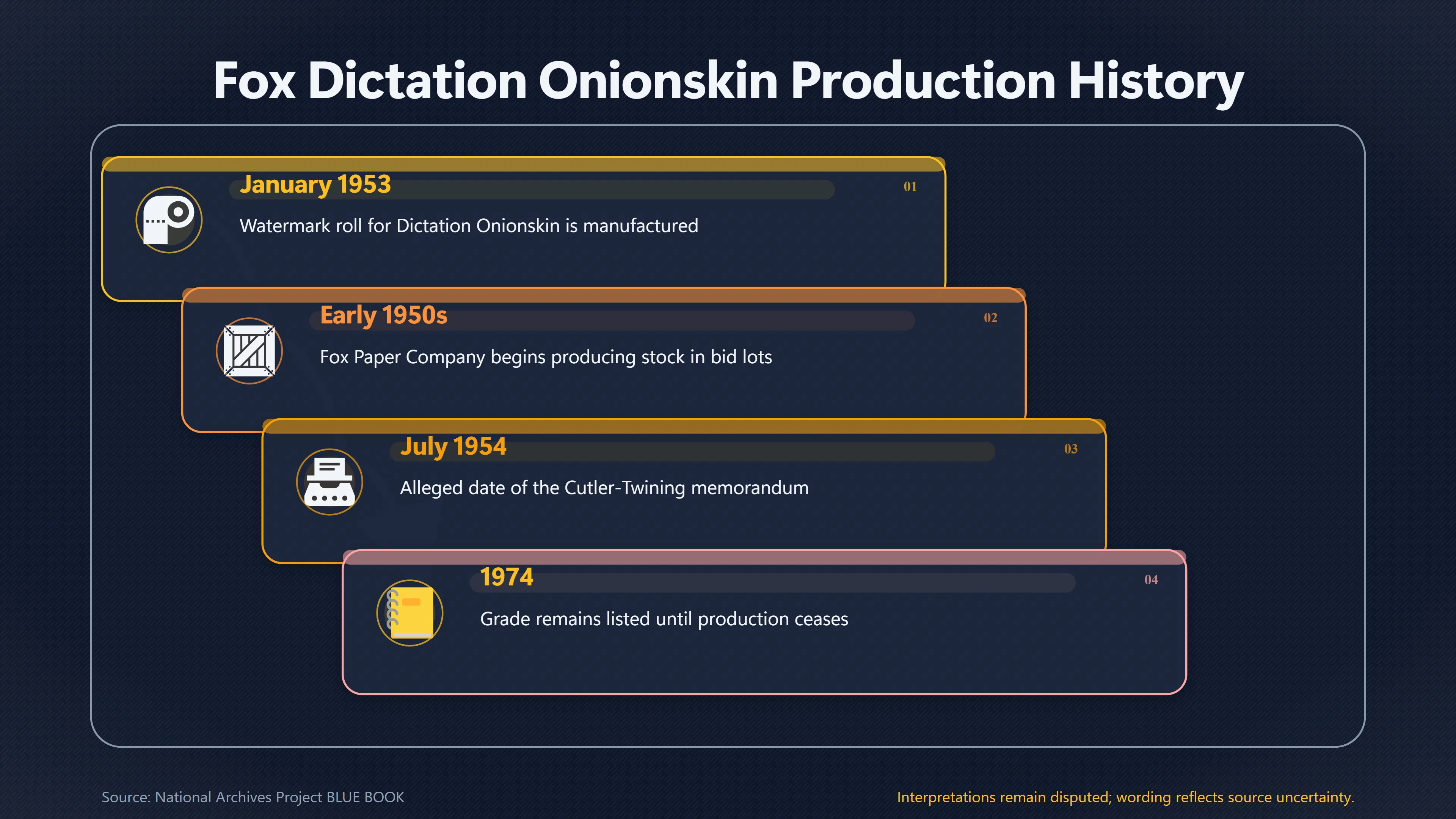
There is unusually useful supporting material for part of that claim. Notes preserved in William Moore-related research files record an October 1987 telephone enquiry to Fox River Paper Company. According to those notes, a company employee checked records and said that the “Dictation Onionskin” mark had been purchased in January 1953, with the relevant watermark roll made on 7 January 1953; the grade remained listed until 1974. The employee reportedly regarded government purchasing as possible or probable, while stopping short of confirming that the particular sheet had actually been supplied to a federal office.[Project Aquarius]projectaquarius.mufon.comProject Aquarius MSI PATCH SHEETProject Aquarius MSI PATCH SHEET
That evidence matters because it weakens a simple anachronism argument. If the identification and company information are correct, a Fox Dictation Onionskin sheet could have been available by July 1954. A purported 1954 memorandum on paper first manufactured in, say, 1960 would face an immediate material contradiction; this stock does not appear to create one.
But “available in 1954” is a much larger population than “normally used by Cutler’s office for this kind of memorandum in 1954”. Paper manufacturers sold stock to many customers, government departments held numerous grades for different purposes, and lightweight onionskin had obvious uses for duplicate typing and office copies. Dating the stock therefore supplies a terminus — it tells investigators something about when the physical medium could have existed — without identifying who used it, when this particular sheet was typed, or whether its use matched the administrative practice claimed by the document.
The government provenance claim also deserves careful wording. The Fox-related notes indicate that the company sold to government and considered government acquisition of this stock plausible. They do not establish an unbroken chain from Fox to the Executive Office of the President, the NSC staff or Cutler’s desk.[Project Aquarius]projectaquarius.mufon.comProject Aquarius MSI PATCH SHEETProject Aquarius MSI PATCH SHEET The distinction between government-available and Cutler-office-appropriate is precisely where the stationery comparison becomes useful.
Cutler’s office provides a narrower benchmark
The National Archives and Records Administration (NARA) did not limit its examination to asking whether onionskin existed in the Eisenhower era. The Eisenhower Presidential Library examined a representative sample of its Robert Cutler papers, creating a much more relevant comparison population: documents associated with the same official and office whose practices the disputed memo supposedly reflects.[National Archives]archives.govNational Archives Project BLUE BOOKNational ArchivesProject BLUE BOOK - Unidentified Flying Objects | National Archives
NARA’s current reference report records three pertinent findings. In the Library’s sample, Cutler documents created while he was serving on the NSC staff had an eagle watermark on the bond paper. Onionskin carbon copies showed either an eagle watermark or no watermark. Most correspondence sent out by the NSC was prepared on White House letterhead paper. NARA additionally noted that during a brief period when Cutler was away from the NSC, his carbon copies used “prestige onionskin”.[National Archives]archives.govNational Archives Project BLUE BOOKNational ArchivesProject BLUE BOOK - Unidentified Flying Objects | National Archives
Those categories are more informative than a binary watermark test because they connect paper to document function:
- Bond paper appears in the sampled Cutler originals and carried the eagle watermark.
- Onionskin appears among carbon-copy material, with watermarking that was not completely uniform.
- White House letterhead was the normal stock for most NSC material being sent outside the office.
- Prestige onionskin appears as a specifically identified carbon-copy stock during Cutler’s temporary absence from the NSC.
The questioned memorandum does not comfortably occupy any one of those categories. NARA says it has no official government letterhead and describes the surviving sheet as a ribbon copy prepared on dictation onionskin. A ribbon copy is significant because the typewriter ribbon struck that sheet directly. That is different from an onionskin sheet merely receiving transferred characters through carbon paper while a heavier or letterheaded original sat at the front of the typing set.[National Archives]archives.govNational Archives Project BLUE BOOKNational ArchivesProject BLUE BOOK - Unidentified Flying Objects | National Archives
This is where the office comparison becomes sharper than the paper-age argument. Plain onionskin would be unsurprising as a retained carbon if an outgoing original had been typed on White House letterhead. But NARA’s conservation finding identifies the questioned sheet itself as the directly typed ribbon sheet. If that interpretation is correct, the surviving document combines the role normally associated with the first typed sheet with stock that the comparative Cutler material more naturally associates with lightweight duplicate-copy practices.
There is a genuine dispute over that physical description. Friedman repeatedly called the document an original sheet of onionskin but characterised it as a carbon in some accounts, while NARA’s conservation specialist identified it as a ribbon copy. A 2019 inspection by MJ-12 researcher Tom Whitmore did not resolve the issue: he observed blue typing on onionskin and cautiously suggested either a carbon impression or a blue ribbon.[LUFORU]luforu.orgCutler-Twining memoCutler-Twining memoJuly 14, 1954… The safest conclusion is therefore not to pretend that the ribbon-versus-carbon question has been independently settled by every observer. It is to recognise that the official conservation assessment makes the stationery anomaly stronger, while the competing description remains part of the historical dispute.
The watermark dispute changes less than it seems
The word “watermark” has generated considerable confusion because different claims concern different things. NARA’s report says the questioned document does not bear the official government letterhead or watermark expected from its comparison, while Friedman said that holding the original to the light reveals a Fox “Dictation Onionskin” watermark.[National Archives]archives.govNational Archives Project BLUE BOOKNational ArchivesProject BLUE BOOK - Unidentified Flying Objects | National Archives These statements can appear flatly contradictory, but they also concern two conceptually different forms of identification: the eagle watermark associated with comparison samples from Cutler’s records and a manufacturer/product watermark identifying Dictation Onionskin.
The more important correction to simplistic sceptical accounts is that authentic Cutler onionskin was not invariably eagle-watermarked. NARA’s current wording explicitly says that onionskin carbon copies in the representative sample had either an eagle watermark or no watermark at all.[National Archives]archives.govNational Archives Project BLUE BOOKNational ArchivesProject BLUE BOOK - Unidentified Flying Objects | National Archives Friedman also said that he located Cutler carbon copies on other onionskin stock and challenged an earlier, broader claim that all such copies bore the eagle mark. His published criticism argues that the Library’s position was modified after these examples were brought to an archivist’s attention.[Medium]medium.comgovernment ufo lies 1 3 2dfeb22c4d19June 28, 2024…
Consequently, the proposition “no eagle watermark equals forgery” is too strong. Genuine office copies evidently displayed more variation than that rule allows.
Yet this concession does not make every period onionskin sheet equally characteristic of Cutler’s office. The better comparison is multivariable: paper grade, watermark, whether the sheet is an original or carbon, presence of letterhead, and intended administrative function. A genuine Cutler carbon lacking an eagle watermark demonstrates that watermark absence can occur. It does not demonstrate that a directly typed outgoing memorandum to the Air Force Chief of Staff would normally be prepared on the questioned stock without White House letterhead.
This is an important forensic lesson in population context. Finding an authentic exception to one characteristic defeats an absolute rule, but it does not necessarily defeat a statistical or habitual comparison. The relevant question becomes how closely the entire questioned document resembles the range of genuine comparable documents, rather than whether one can find any authentic Cutler sheet sharing one of its characteristics.
Why plausible vintage onionskin can remain anomalous
The Cutler–Twining paper evidence is strongest when treated as a problem of fit, not merely age. On the available evidence, three propositions can coexist without contradiction.
First, Fox Dictation Onionskin appears to have been a real paper stock whose introduction was early enough for a document dated July 1954. The surviving Fox-related research notes place the watermark roll in January 1953.[Project Aquarius]projectaquarius.mufon.comProject Aquarius MSI PATCH SHEETProject Aquarius MSI PATCH SHEET Second, onionskin itself was unquestionably compatible with Cutler-era office practice: the Eisenhower Library found authentic onionskin carbon copies, some without an eagle watermark.[National Archives]archives.govNational Archives Project BLUE BOOKNational ArchivesProject BLUE BOOK - Unidentified Flying Objects | National Archives Third, the questioned sheet can nevertheless be unusual for the specific role it purports to perform, because NARA identifies it as a ribbon copy without official letterhead while reporting that most outgoing NSC documents used White House letterhead.[National Archives]archives.govNational Archives Project BLUE BOOKNational ArchivesProject BLUE BOOK - Unidentified Flying Objects | National Archives
This resolves an apparent contradiction in the long-running argument. Advocates are on firmer ground when they say the paper is not demonstrably “too new” for 1954. Critics are on firmer ground when they shift the comparison from manufacturing date to office practice. Those claims address different levels of authentication.
The distinction can be expressed as a narrowing series of questions:
- Could this paper exist in July 1954? The available Fox information indicates that it could.
- Could onionskin occur in genuine Cutler records? Yes; the Eisenhower Library’s own comparison says it did.
- Could authentic Cutler onionskin lack an eagle watermark? Yes; NARA explicitly acknowledges watermark-free carbon copies.

- Was this particular paper-and-copy configuration normal for comparable outgoing Cutler/NSC correspondence? The archival comparison does not show that. Instead, it points towards watermarked bond for sampled Cutler originals and White House letterhead for most outgoing NSC material. National Archives
That fourth question is the one most easily lost when the debate is reduced to whether somebody could have obtained vintage paper. A hypothetical fabricator would not necessarily need paper manufactured in the 1980s; old office stock could survive for decades. Conversely, possession of genuine 1950s paper would not reproduce the document-production habits of a particular White House office. Material age and bureaucratic provenance are separate evidential problems.
What the stationery evidence can actually establish
The paper discrepancy should not be made to carry more weight than it can support. The Eisenhower Library described its Cutler examination as a representative sample, not an exhaustive census of every sheet produced by Cutler, his secretaries, James Lay, other NSC staff members or every White House typing operation. National Archives That matters because office practice contains exceptions. An unusual rush copy, a secretary using available stock, a draft, or a special handling procedure could produce something outside the dominant stationery pattern.
For that reason, the absence of the usual combination is not by itself proof of fabrication. Friedman’s discovery of genuine variation among Cutler onionskins is a useful warning against converting an archival tendency into an inflexible rule. Medium
But the reverse mistake is equally important. Showing that exceptions existed does not make the questioned configuration typical. To strengthen the authenticity case on this narrow issue, the most valuable comparator would not simply be another 1950s document on Fox onionskin. It would be an authenticated Cutler or NSC ribbon original, preferably an outgoing memorandum to a senior official, produced on Dictation Onionskin without White House letterhead under comparable circumstances. The sources located here establish period availability and authentic use of onionskin generally; they do not supply that close functional match.
The paper evidence therefore lands in an intermediate but meaningful position. It does not provide a simple materials-based proof that the Cutler–Twining memorandum was manufactured after 1954. The available evidence is actually consistent with its paper stock being period-correct. What remains unresolved in its favour is the narrower and more probative institutional question: why a memorandum supposedly emerging from Cutler’s NSC environment appears in a paper-and-copy format that differs from the dominant patterns found when archivists examined comparable Cutler material.
That is why “period-correct” and “office-correct” must remain separate categories. The first tells us that a physical ingredient was available. The second asks whether that ingredient was being used in the right place, by the right office, for the right kind of document. In the Cutler–Twining controversy, the first test is substantially less damaging to the document than sometimes claimed; the second is where the stationery anomaly persists.
Amazon book picks
Further Reading
Books and field guides related to Period Correct Paper Is Not the Same as Office Correct. Use these as the next step if you want deeper reading beyond the article.
Detecting Forgery: Forensic Investigation of Documents
Detecting Forgery reveals the complete arsenal of forensic techniques used to detect forged handwriting and alterations in documents and...
Forensic Document Examination: Principles and Practice
This book introduces the reader to the basic principles of handwriting and the factors that affect their development. The book discusses...
Scientific Examination of Questioned Documents
Disputed document inquiries encompass extensive and varied technical examinations, unique phases of investigation, and specialized legal...
Top Secret/Majic: Operation Majestic-12 and the United States...
Exposing the U.S. government's biggest-kept secret: a fifty-eight-year UFO cover-up. Top Secret/Majic is the result of nuclear physicist...
eBay marketplace picks
Marketplace Samples
Live-tested eBay searches with available results related to this page.
Selected fromUFO poster oneBay.co.uk.



Endnotes
2.
Source: medium.com
Link:https://medium.com/stanton-friedmans-articles/book-review-kevin-d-randles-case-mj-12-the-true-story-behind-the-government-s-ufo-conspiracies-9e06f4e82250
Source snippet
Book Review: Kevin D. Randle’s CASE MJ-12: THE TRUE STORY BEHIND THE GOVERNMENT’S UFO CONSPIRACIES | by Richard Geldreich, Jr. | Ph...
3.
Source: luforu.org
Title: Cutler-Twining memo
Link:https://luforu.org/cutler-twining-memo/
Source snippet
Cutler-Twining memoJuly 14, 1954...
Published: July 14, 1954
4.
Source: medium.com
Title: government ufo lies 1 3 2dfeb22c4d19
Link:https://medium.com/stanton-friedmans-articles/government-ufo-lies-1-3-2dfeb22c4d19
Source snippet
June 28, 2024...
Published: June 28, 2024
5.
Source: archives.gov
Title: National Archives Releases John Cutler Papers Online | National Archives
Link:https://www.archives.gov/press/press-releases/2011-346
6.
Source: archives.gov
Link:https://www.archives.gov/press/press-releases/2000/nr00-39
7.
Source: lelive.free.fr
Link:https://www.lelive.free.fr/kevindayanmarseille/kevindayanmarseille470.html
8.
Source: projectaquarius.mufon.com
Title: Project Aquarius MSI PATCH SHEET
Link:https://projectaquarius.mufon.com/wp-content/uploads/pcg-bill-moore-files-collection/CUTLER-TWINNING-MEMO.pdf
9.
Source: projectaquarius.mufon.com
Title: Project Aquarius MSI PATCH.SHEET
Link:https://projectaquarius.mufon.com/wp-content/uploads/pcg-bill-moore-files-collection/ARCHIVES-NATL.pdf
10.
Source: majesticdocuments.com
Title: National Archives & Records Administration | Majestic Documents
Link:https://majesticdocuments.com/documents/official-ufo-documents/national-archives-records-administration/
11.
Source: newyorker.com
Title: Three | The New Yorker
Link:https://www.newyorker.com/magazine/2008/09/29/three-fiction-andrea-lee
Additional References
12.
Source: tomwhitmoreblog.wordpress.com
Title: nara notes 09 09 2019 the cutler twining memo
Link:https://tomwhitmoreblog.wordpress.com/2019/09/10/nara-notes-09-09-2019-the-cutler-twining-memo/
Source snippet
TOM WHITMORE BLOGNARA NOTES 09/09/2019 THE CUTLER TWINING MEMO – TOM WHITMORE BLOG...
13.
Source: theblackvault.com
Title: The Black Vault Government UFO Lies
Link:https://www.theblackvault.com/casefiles/government-ufo-lies/
Source snippet
The Black VaultGovernment UFO Lies - The Black Vault Case Files...
14.
Source: youtube.com
Title: Karl Pflock
Link:https://www.youtube.com/watch?v=8g5tYfcQ9RQ
Source snippet
Rob Swiatek - FUFOR and "Final Report on Operation Majestic 12"...
15.
Source: youtube.com
Title: The MJ-12 Conspiracy Debunked
Link:https://www.youtube.com/watch?v=9dF-iggJusY
Source snippet
Stanton Friedman MJ-12 Cutler Twining memo Karl Pflock discusses The Cutler - Twining Memo...
16.
Source: researchgate.net
Link:https://www.researchgate.net/publication/360280377_Lime_Bast_Winning_Know-How_Labour_Input_and_Quantity_Needed_for_the_Production_of_Two_Selected_Neolithic_Finds
17.
Source: researchgate.net
Link:https://www.researchgate.net/publication/353866551_The_Letters_of_Elizabeth_Rigby_Lady_Eastlake
18.
Source: github.com
Link:https://github.com/raun/6.00x-PSet03/blob/master/words.txt
19.
Source: allinonefilms.com
Link:https://allinonefilms.com/transcripts/friedman.htm
20.
Source: agoodbook.de
Link:https://www.agoodbook.de/data/
21.
Source: listennotes.com
Link:https://www.listennotes.com/podcasts/occult-symbolism/disclosure-day-analysis-uc9ySI6mO-E/