Within Cooper Papers
Does the Burned Memo Letter Prove Anything?
The Burned Memo's dramatic cover letter cannot independently authenticate the document because its claims come from the same anonymous source chain.
On this page
- What the cover letter claims
- Why anonymous testimony cannot self authenticate
- How the S 1 source chain affects credibility
Page outline Jump by section
Introduction
The Burned Memo’s one-page cover letter is important because it supplies much of the story that makes the document seem extraordinary — but it does not independently authenticate that story. The letter, dated 23 June 1999 in surviving reproductions, presents its writer as a retired CIA counter-intelligence officer associated with James Jesus Angleton and says that the accompanying MJ-12 directives were rescued from destruction. It goes much further, alleging links between MJ-12 and John F. Kennedy’s murder, CIA manipulation of civilian UFO research, and a Nixon-era order to destroy the MJ-12 paper trail.[Auricmedia - Golden Wings Of Destiny]auricmedia.netOpen source on auricmedia.net.
The evidential difficulty is straightforward: the anonymous writer is simultaneously the source of the document and the source of the claims explaining why the document should be believed. No independently identified CIA officer has publicly established that chain of custody. Even the Majestic Documents authentication project acknowledges that provenance is its weakest area and that it cannot prove Timothy Cooper received the documents in the manner reported.[Majestic Documents]majesticdocuments.comOpen source on majesticdocuments.com.
That makes the cover letter useful as evidence about what Source S-1 claimed, but much weaker as evidence that those claims were true.
What the cover letter actually claims
The cover letter accompanied the nine-page object that became known as the Burned Memo. The Majestic Documents catalogue places both items in the collection attributed to anonymous “Source S-1”: it lists the cover letter separately from the “Original 9-page ‘Burned’ Memo”, alongside photographs, other alleged classified records and ordinary published material.[Majestic Documents]majesticdocuments.comOpen source on majesticdocuments.com. This separation matters because some of the most dramatic statements commonly associated with the Burned Memo come not from the purported early-1960s memorandum itself, but from the unidentified person writing decades later.
According to the published transcription and archive description, the letter identifies its author as a retired CIA counter-intelligence officer who had worked for Angleton. Portions identifying the writer more precisely were redacted when the document was published; the Majestic Documents site says those redactions were made by its own team to protect the author’s identity.[Majestic Documents]majesticdocuments.comOpen source on majesticdocuments.com.
The writer then constructs an unusually consequential provenance narrative. In summary, the letter claims that:
- the writer had access to highly sensitive files associated with Angleton;
- some material could connect MJ-12 with Kennedy’s murder;
- the accompanying directives never officially existed and had not previously been disclosed within the CIA;
- the writer personally rescued the directives from a fire;
- CIA counter-intelligence had monitored civilian UFO researchers and helped to keep that community occupied;
- a special classified executive order under President Richard Nixon required MJ-12 records to be purged;
- the surviving carbon copy escaped that destruction and represented the remaining paper link to MJ-12.[Scribd]scribd.comOpen source on scribd.com.
These claims dramatically increase the apparent significance of an otherwise unidentified damaged document. They explain its burn damage, its absence from government archives and the lack of corroborating MJ-12 records, while also giving the anonymous source an intelligence pedigree.
That combination is precisely why the cover letter needs to be treated separately from the physical document. It is not a CIA certification attached through an established records system. It is an anonymous correspondent’s account of where the accompanying document supposedly came from.
Why anonymous testimony cannot self-authenticate
The central problem is circularity. Suppose the Burned Memo is genuine. In that case, a former CIA counter-intelligence officer really might have removed it from sensitive files and later sent it to Cooper. But suppose instead that somebody fabricated, altered or misrepresented the memo. That person could just as easily write a cover letter saying that it came from Angleton’s files, was saved from destruction and could not be found in official archives.
The letter therefore cannot resolve the very provenance question that it creates.
This is particularly important because several of its claims make independent verification harder rather than easier. Saying that the document “did not exist officially”, that the other records had been destroyed and that there was no surviving paper trail effectively provides explanations in advance for why researchers should not expect normal archival corroboration.[Majestic Documents]majesticdocuments.comOpen source on majesticdocuments.com. Such explanations could conceivably be true, but their resistance to verification does not count as evidence in their favour.
The same distinction applies to the writer’s claimed CIA status. An intelligence officer could possess knowledge unavailable to outsiders, but the letter’s assertion that its writer was such an officer does not establish the writer’s identity. Later enthusiasts have attempted to infer possible identities from Angleton’s associates. One online investigation, for example, proposed former CIA officer Leonard McCoy because aspects of his career appeared to fit parts of the narrative. Yet that is an identification hypothesis constructed after the fact, not a demonstrated provenance linking McCoy — or another named officer — to the letter and Burned Memo.[Majestic 12 special studies project]wordpress.comOpen source on wordpress.com.
Robert Wood himself remained uncertain about the leaker’s identity in a published interview reproduced online. Discussing the 1999 letter, he characterised its writer as apparently senior within CIA counter-intelligence but, when asked who had been closest to Angleton, replied that he did not know and that this required further research. Wood likewise described his interpretation of another figure mentioned in the letter, “Salina”, explicitly as his opinion.[Scribd]scribd.comOpen source on scribd.com.
That is a significant evidential distinction. A plausible candidate is not an identified source; an inferred career match is not a chain of custody.
The letter also explains away missing evidence
The cover letter has another unusual characteristic: several of its assertions simultaneously advance the MJ-12 narrative and account for why conventional documentary confirmation might be unavailable.
The alleged Nixon destruction order is the clearest example. If virtually all MJ-12 documentation had really been purged, the absence of corresponding records in official archives would cease to look surprising. The assertion that the Burned Memo was personally rescued from that destruction then gives the document exceptional status: the absence of other records becomes part of the story supporting the survivor.
But historically evaluating a document requires keeping the propositions separate:
Claim one: an MJ-12 programme existed.
Claim two: Nixon secretly ordered its documentation destroyed.
Claim three: the anonymous writer participated in or witnessed circumstances surrounding that destruction.
Claim four: the Burned Memo survived because the writer removed it.
The cover letter supplies assertions for this sequence, not independent evidence for each step. No corroborating Nixon order establishing the alleged MJ-12 purge is supplied by the letter itself. The Majestic Documents catalogue repeats the Source S-1 account as a claim from the letter rather than pointing to an independently authenticated copy of the alleged order.[Majestic Documents]majesticdocuments.comOpen source on majesticdocuments.com.
The same issue affects the allegation that CIA counter-intelligence manipulated civilian UFO research. Intelligence agencies unquestionably conducted covert and counter-intelligence operations during the Cold War, but that broad historical fact cannot authenticate this specific statement about MJ-12. Here, the evidence for the specific allegation remains the unidentified Source S-1 writer saying that “we in CI” had monitored the UFO community.[Scribd]scribd.comOpen source on scribd.com.
A genuine-sounding explanation is still an explanation until it receives independent corroboration.
Physical age does not authenticate the cover story
Supporters of the Burned Memo have made a different argument based on its physical characteristics. Robert Wood reported forensic examination of the underlying document and argued that its paper, carbon typing and security-stamp inks were compatible with the claimed historical period. In a MUFON symposium paper, he described the Burned Memo’s materials as old and stated that its security stamps had likewise tested consistently with the period. A later Wood paper reported that its red stamp ink was consistent with the stated era and that its Courier typing was compatible with a typeface introduced by IBM in 1956.[Majestic Documents]majesticdocuments.comOpen source on majesticdocuments.com.
Those findings are relevant to the memo, but they do not authenticate the 1999 cover letter’s account of the memo.
A material test can potentially establish useful limits: a particular ink formulation existed by a certain date; a typeface was available; a sheet is consistent with an older period. That can expose anachronistic fabrication when something is too new. Conversely, failure to find an anachronism does not identify who typed a document, where it was stored, whether it belonged to the CIA, or whether an anonymous person really pulled it from Angleton-related files.
Even the Majestic Documents site’s description of the Burned Memo says that laboratories had been unable to trace its Eagle-watermarked paper.[Majestic Documents]majesticdocuments.comOpen source on majesticdocuments.com. “Compatible with the era” is consequently much narrower than “authenticated as a CIA record”.
This distinction becomes especially important when the physical object and provenance narrative originate through the same private source channel. Old paper and period-compatible ink could strengthen an argument that an artefact is not an obvious modern printout. They cannot transform an anonymous accompanying story into independently corroborated testimony.
How the S-1 chain affects credibility
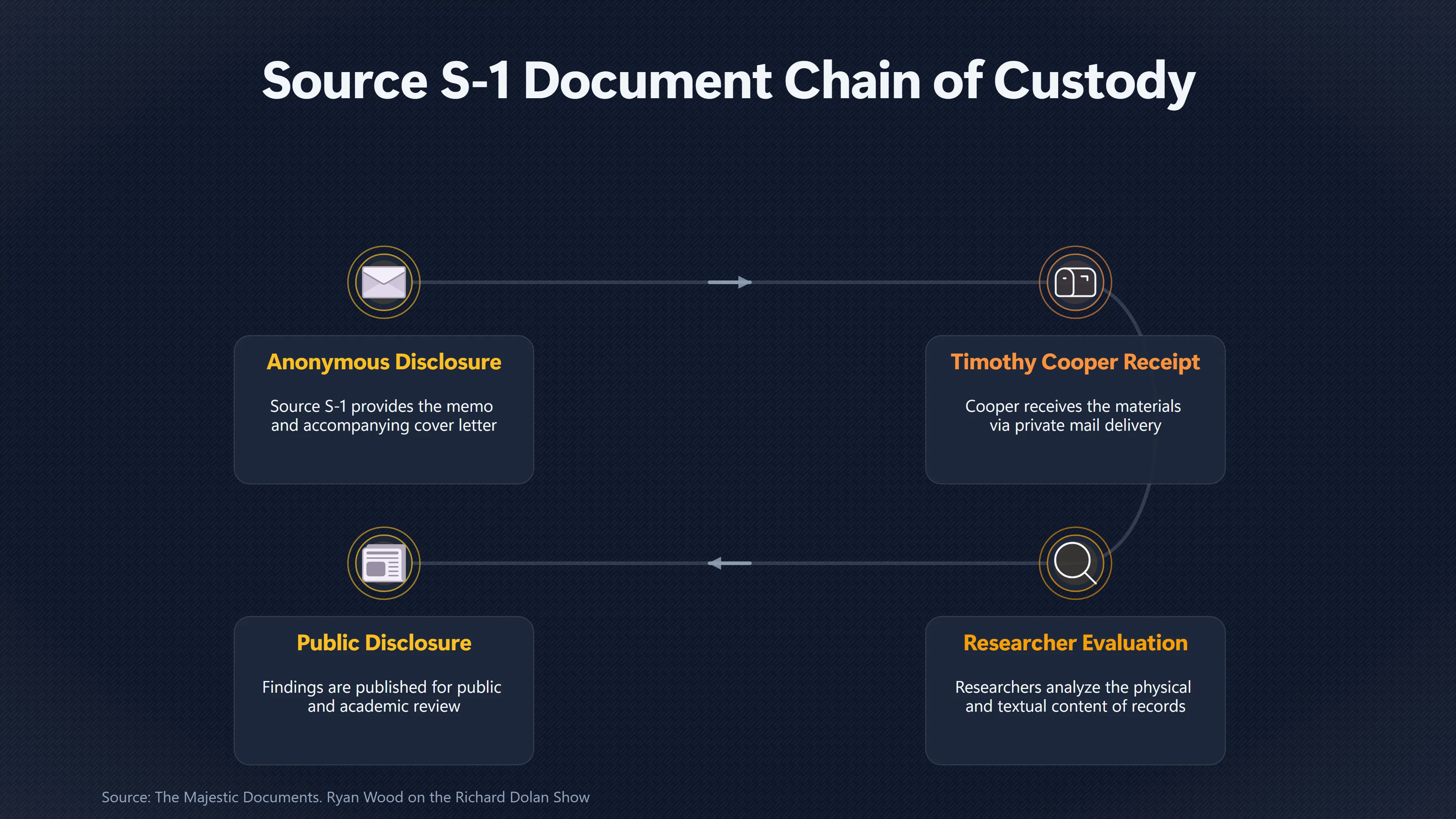
The Source S-1 catalogue shows that the Burned Memo was not an isolated archival discovery. S-1 was credited with a collection that included photographs, the cover letter, the nine-page memo, technical material, other purported MJ-12 documents and an essay attributed to S-1.[Majestic Documents]majesticdocuments.comOpen source on majesticdocuments.com. The relevant provenance therefore runs through a private disclosure channel: anonymous source → Timothy Cooper → researchers who evaluated and publicised the material.
That is materially different from finding a record in a government archival box with accession information, file-series context and neighbouring records whose custody can be reconstructed.
The Majestic Documents project’s own authentication discussion is unusually useful on this point. Although the site generally argues in favour of the documents, it explicitly calls provenance its “weakest link” because it cannot prove that Cooper obtained the papers from his mailbox as he said. The same page also acknowledges the broader principle that authenticity cannot simply be assumed even when an original physical document exists.[Majestic Documents]majesticdocuments.comOpen source on majesticdocuments.com.
There are additional reasons to avoid treating Cooper’s role as a substitute for the missing source. Cooper later repudiated the MJ-12 material. In an April 2009 email published by researcher Robert Hastings, Cooper described himself as having been taken in by the MJ-12 story and rejected the documents as a hoax.[The UFO Chronicles]theufochronicles.comOpen source on theufochronicles.com. That later judgement does not itself prove who manufactured the Burned Memo, and it should not be exaggerated into forensic proof of forgery. It does, however, make it particularly difficult to argue that Cooper’s personal confidence in his anonymous correspondents can authenticate the S-1 chain.
Earlier efforts to strengthen Cooper’s credibility had also produced ambiguous results. Kevin Randle reports that a polygraph arranged by Robert and Ryan Wood indicated deception in some answers. The Woods interpreted this as possibly reflecting Cooper’s attempt to protect confidential sources rather than fabrication. Randle correctly notes the underlying limitation: polygraph evidence is itself disputed and proves little about whether a particular document is authentic.[Scribd]scribd.comOpen source on scribd.com.
Neither outcome solves the central problem. If Cooper was protecting a real intelligence source, independent identification and records could potentially strengthen the chain. If he was protecting somebody else, mistaken about his correspondent, or being deliberately deceived, the same secrecy prevents investigators from distinguishing among those possibilities.

Does the Burned Memo letter prove anything?
Yes, but considerably less than its contents imply.
It establishes that a person presenting themselves as an intelligence insider supplied Cooper with a detailed narrative about the Burned Memo. It records what that person wanted Cooper and subsequent readers to believe: that the document came from the world of James Angleton’s counter-intelligence files, that it escaped deliberate destruction, that MJ-12 had been concealed through extraordinary measures, and that its history intersected with Kennedy’s assassination and intelligence management of UFO researchers. Those claims are historically relevant to understanding the S-1 document stream.[Majestic Documents]majesticdocuments.comOpen source on majesticdocuments.com.
What the letter does not establish is that its unidentified author was a CIA officer, worked for Angleton, witnessed destruction of MJ-12 records, possessed genuine MJ-12 files, or accurately described the origin of the accompanying document. Those propositions require evidence external to the anonymous source’s own assertions.
The fairest assessment therefore separates three evidential questions that are sometimes collapsed into one. The Burned Memo’s physical characteristics can be investigated independently. Its text can be checked for historical consistency and anachronisms. Its provenance must separately establish how it travelled from an alleged government setting into Timothy Cooper’s possession. The cover letter belongs primarily to that third question — but because the author remains anonymous and the extraordinary chain of custody is supplied by the same person asking readers to accept it, it does not close the provenance gap.
Within the wider Timothy Cooper collection, that is the lasting significance of the Burned Memo letter. Its dramatic detail makes the document’s alleged history more elaborate, not more independently verified. Until the S-1 identity and custody trail can be corroborated from evidence outside the S-1 material itself, the letter is best treated as a provenance claim requiring authentication, rather than authentication of the provenance.
Amazon book picks
Further Reading
Books and field guides related to Does the Burned Memo Letter Prove Anything?. Use these as the next step if you want deeper reading beyond the article.
Top Secret/Majic
Exposing the U.S. government's biggest-kept secret: a fifty-eight-year UFO cover-up. Top Secret/Majic is the result of nuclear physicist...
Majic Eyes Only: Earth's Encounters with Extraterrestrial Tec...
"MAJIC EYES ONLY is the most authoritative and comprehensive chronicle ever published on the subject of worldwide UFO crashes and subsequ...
Legacy of Ashes: The History of the CIA
Traces the history of the CIA from the end of World War II to Iraq, in a study that condemns the organization for its record, its inabili...

The CIA and the Cult of Intelligence
First published 1974. Subjects: United States, United States. Central Intelligence Agency, CIA, Inlichtingendiensten, Spionage.
eBay marketplace picks
Marketplace Samples
Live-tested eBay searches with available results related to this page.
Selected fromUFO poster oneBay.co.uk.
Endnotes
1.
Source: majesticdocuments.com
Link:https://majesticdocuments.com/documents/document-sources/
2.
Source: majesticdocuments.com
Link:https://majesticdocuments.com/documents/document-authentication/
Additional References
3.
Source: youtube.com
Title: The Majestic Documents. Ryan Wood on the Richard Dolan Show
Link:https://www.youtube.com/watch?v=s_ymJcmeEDc
Source snippet
"Burned Memo" "MJ-12" OR "Majestic 12" Military Resistance (3/5) #Shorts...
Published: June 10, 2019
4.
Source: youtube.com
Link:https://www.youtube.com/watch?v=PeULVsP-jEQ
Source snippet
The Majestic-12 Documents [With Ryan S. Wood]...
5.
Source: youtube.com
Title: The Majestic Documents: Origins and Impact Today
Link:https://www.youtube.com/watch?v=lEMmfWrz_O0
Source snippet
Watergate, the JFK assassination and a UFO secret at the center of it all | Reality Check...
6.
Source: youtube.com
Title: The Majestic-12 Documents [With Ryan S. Wood]
Link:https://www.youtube.com/watch?v=vzB87RJkQVU
Source snippet
The Majestic Documents. Ryan Wood on the Richard Dolan Show. June 10, 2019...
Published: June 10, 2019
7.
Source: youtube.com
Title: JFK’s UFOs: The Leaked CIA Documents that Could Change History
Link:https://www.youtube.com/watch?v=N4c4VBRQcOg
Source snippet
The Majestic Documents: Origins and Impact Today...
8.
Source: theblackvault.com
Link:https://www.theblackvault.com/casefiles/update-on-operation-majestic-12-documents/
9.
Source: cufon.org
Link:https://www.cufon.org/cufon/marshall.htm