Within Majestic 12
Could James Lay Explain the Unsigned Memo?
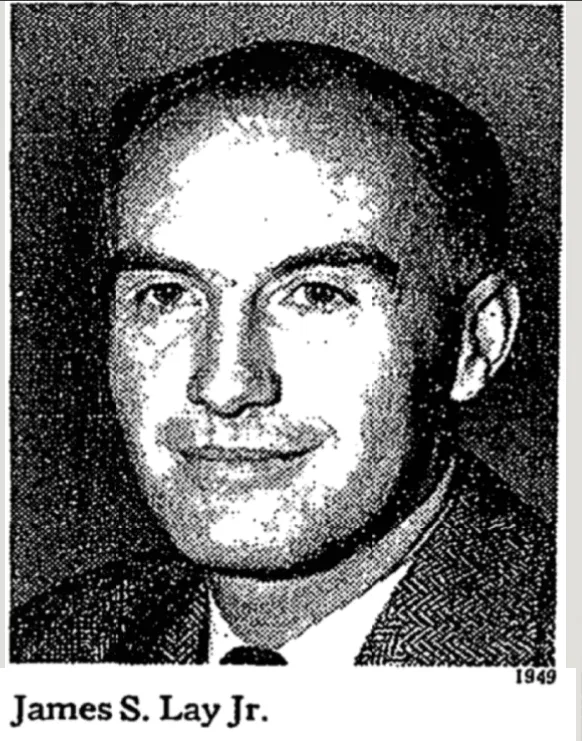
Supporters argue James Lay could have handled National Security Council business in Cutler's name while Cutler was overseas.
On this page
- Cutler's delegated responsibilities
- Why the unsigned memo matters
- What the explanation does not prove
Page outline Jump by section
Introduction
The James Lay explanation addresses one narrow but important objection to the alleged Cutler–Twining MJ-12 memorandum: Robert Cutler was outside the United States on 14 July 1954, the date typed on the memo. Supporters, most prominently MJ-12 researcher Stanton Friedman, argued that James S. Lay Jr., Executive Secretary of the National Security Council (NSC), could have handled routine NSC business in Cutler’s absence and issued the short scheduling note in Cutler’s name.
There is genuine historical evidence behind part of that mechanism. Cutler had left instructions for Lay and J. Patrick Coyne to handle NSC administrative matters while he was away, and President Dwight Eisenhower’s appointment book confirms that Lay was at the White House briefing the President on NSC matters on 14 July.[National Archives]archives.govOpen source on archives.gov. But this does not authenticate the MJ-12 memo. The central unresolved question is more specific: if Lay prepared it, why does the surviving document identify Cutler rather than Lay, when an authenticated Lay memorandum from that same day was issued under Lay’s own name?[Skeptical Inquirer]skepticalinquirer.orgOpen source on skepticalinquirer.org.
Cutler’s delegated responsibilities
Cutler’s absence is not disputed. The National Archives reports that he was visiting military installations in Europe and North Africa from 3 to 15 July 1954 on President Eisenhower’s instructions. That creates an immediate problem for a document dated 14 July and presented as a memorandum “for General Twining” from Robert Cutler.[National Archives]archives.govOpen source on archives.gov.
Yet the archival record also makes the situation less simple than saying Cutler was abroad and therefore no Cutler business could have been conducted. The National Archives found a memorandum dated 3 July in the NSC Staff Papers in which Cutler gave James Lay and J. Patrick Coyne instructions for handling administrative matters during his absence.[National Archives]archives.govOpen source on archives.gov. Friedman highlighted the particularly relevant instruction to keep matters moving out of Cutler’s “basket” while he was away.[The Black Vault]theblackvault.comOpen source on theblackvault.com.
Lay was not an incidental White House employee. Contemporary government records identify him as Executive Secretary of the NSC, and State Department historical records show him performing substantive NSC functions, including presiding over a senior NSC staff meeting in 1953.[Office of the Historian]state.govOpen source on state.gov. In other words, the proposition that Lay possessed the institutional position to process sensitive NSC business is historically reasonable even without accepting anything in the alleged MJ-12 material.
The timing on 14 July adds another piece to Friedman’s argument. Eisenhower’s official appointment book records Lay and Deputy Executive Secretary S. Everett Gleason meeting with the President that afternoon “OFF THE RECORD” and briefing him on NSC matters.[Eisenhower Presidential Library]eisenhowerlibrary.govOpen source on eisenhowerlibrary.gov. Friedman later argued that Lay also spoke with Eisenhower by telephone later that day and suggested that the President could therefore have instructed Lay to communicate a scheduling change to Air Force Chief of Staff Nathan Twining.[Project Aquarius]mufon.comOpen source on mufon.com. The documented White House meeting is strong primary evidence; the proposed conversation about an MJ-12 briefing is Friedman’s reconstruction, not something established by the appointment book.
This distinction is crucial. The records establish that Cutler delegated work and that Lay was actively conducting NSC business while Cutler was overseas. They do not establish that the delegated work included an “NSC/MJ-12 Special Studies Project”.
Why the unsigned memo matters
The disputed memorandum’s lack of a signature is central to the James Lay theory. Friedman reasoned that if a forger had mistakenly believed Cutler was in Washington on 14 July, adding Cutler’s signature or even an “/s/” notation for a signature would have made the chronological mistake more obvious once Cutler’s travel was discovered. Instead, the surviving memorandum is unsigned. He therefore interpreted that feature as compatible with someone such as Lay preparing an administrative note for Cutler while Cutler himself was unavailable.[The Black Vault]theblackvault.comOpen source on theblackvault.com.
The argument becomes more interesting because, according to Friedman, the evidence about Cutler’s delegation was discovered after the Cutler–Twining memorandum had been found. He credited sceptical researcher Robert Todd with locating evidence of Cutler’s absence and subsequently pointed to the Cutler–Lay instructions as evidence that official business could nevertheless continue. Friedman also reported obtaining a 16 July memorandum from Lay to Cutler while Cutler was still abroad, which he interpreted as confirmation that Lay was indeed keeping Cutler’s workload moving.[The Black Vault]theblackvault.comOpen source on theblackvault.com.
That argument answers one objection better than it answers another. It supplies a plausible administrative mechanism by which a memorandum connected with Cutler’s responsibilities might have been prepared in Washington while Cutler was abroad. It therefore weakens the simplistic claim that Cutler’s physical absence, by itself, makes any 14 July document bearing his typed name impossible.
The National Archives itself effectively framed the harder question. Its MJ-12 reference report noted the 3 July delegation memorandum but concluded that, if the Twining memorandum were genuine, one would expect Lay or Coyne to have signed it.[National Archives]archives.govOpen source on archives.gov. The same historical fact — Cutler’s delegation — can therefore be read in opposite directions. Supporters see a mechanism for producing the document without Cutler; archival investigators saw reason to expect the acting official’s identity to appear on it.
The same-day Lay memorandum complicates the theory
The sharpest challenge to the delegation explanation comes from another memorandum dated precisely 14 July 1954. A declassified NSC document concerning the Aircraft Nuclear Propulsion Program was sent to the Secretary of Defense and the Chairman of the Atomic Energy Commission under James S. Lay Jr.’s own name as Executive Secretary.[UFO Magazine Archive]ufomagazines.comOpen source on ufomagazines.com.
Sceptic Philip Klass used this comparison against Friedman’s explanation. If Lay was issuing classified NSC communications that day under his own name, Klass argued, why would a memorandum to Twining instead appear under Cutler’s name?[Skeptical Inquirer]skepticalinquirer.orgOpen source on skepticalinquirer.org. This is a stronger objection than merely observing that Cutler was abroad because it tests the proposed mechanism against an example of Lay’s actual documented practice on the very same date.
Friedman’s response was essentially that the two communications need not have been administratively equivalent. The authenticated Lay document concerned substantive government business involving the Defense Department and Atomic Energy Commission, whereas the alleged Cutler–Twining memorandum is extremely brief and purports only to alter arrangements for an already planned briefing. Friedman argued that Lay, working closely with Cutler and acting on presidential instructions, could reasonably have sent such a routine scheduling notification in Cutler’s name.[Project Aquarius]mufon.comOpen source on mufon.com.
That is possible, but possibility is not documentary confirmation. To establish the explanation convincingly, researchers would ideally need authentic examples showing Lay sending comparable short memoranda under Cutler’s typed name, without Lay’s own signature, during Cutler’s absence. The sources located here demonstrate Lay’s authority and activity but do not provide such a close procedural parallel.
The White House chronology helps only so far
The presidential appointment books allow some of the theory to be checked independently. On 14 July, Eisenhower’s schedule explicitly records Lay and Gleason briefing the President on NSC matters. On 15 July, Lay appears again among those attending the National Security Council meeting, alongside senior officials including Allen Dulles and J. Patrick Coyne.[Eisenhower Presidential Library]eisenhowerlibrary.govOpen source on eisenhowerlibrary.gov. This confirms that Lay occupied exactly the sort of operational position that Friedman’s explanation requires.
The appointment records also illustrate a weakness in attempts to infer too much from an undocumented meeting. The National Archives reported that Eisenhower’s appointment books contain no entry for a special meeting on 16 July 1954 that might correspond to the briefing mentioned in the alleged Cutler–Twining memo. It further found no NSC meeting on that date and no mention of “MJ-12” or “Majestic” in the July 1954 NSC meeting minutes.[National Archives]archives.govOpen source on archives.gov.
The alleged memo itself refers to a briefing occurring “during” an already scheduled White House meeting, rather than explicitly identifying an NSC meeting. Friedman therefore argued that the absence of a 16 July NSC meeting does not directly contradict its wording.[Project Aquarius]mufon.comOpen source on mufon.com. Even so, the surviving official record provides no independent trace of the alleged MJ-12 briefing.
The most defensible chronology is consequently quite limited: Cutler was overseas; he had delegated administrative responsibilities; Lay was working on NSC matters in Washington; and Lay met Eisenhower on 14 July. Those facts make the proposed chain of action conceivable. The crucial final step — Eisenhower or somebody else instructing Lay to send the alleged Twining notice — remains hypothetical.
What the explanation does not prove
Even a fully persuasive James Lay explanation would solve only the authorship problem created by Cutler’s absence. It would not resolve the wider anomalies that led the National Archives to treat the Cutler–Twining memorandum cautiously.
The National Archives found no other “NSC/MJ-12” material in the folder containing the memorandum and no supporting information after searches of records from the Secretary of Defense, Joint Chiefs of Staff, Air Force and National Security Council. Its searches of NSC indices and July 1954 meeting minutes likewise produced no reference to MJ-12 or Majestic.[National Archives]archives.govOpen source on archives.gov.
There were also physical and records-management questions. The memorandum was found in a series filed by Top Secret register number but lacks such a number. The Archives reported that it had neither official government letterhead nor a watermark, while representative Cutler documents examined by the Eisenhower Library followed different paper practices.[National Archives]archives.govOpen source on archives.gov. None of these points is answered simply by substituting Lay for Cutler as the person who prepared the page.
Most importantly, the National Archives stresses that custody is not authentication. Its certification can establish that a reproduction accurately represents a document in its holdings; it does not certify that the document was genuinely created by the official named on it or that its contents are true.[National Archives]archives.govOpen source on archives.gov. The fact that the Cutler–Twining memorandum was physically discovered in federal records is therefore significant provenance evidence, but not conclusive evidence of origin.
The James Lay theory is consequently best understood as a rebuttal to one specific argument rather than as proof of MJ-12. Cutler’s overseas trip does not make the memorandum administratively impossible, because contemporary records show that Lay had responsibility for keeping NSC work moving and was briefing Eisenhower in Washington on the date in question.[Eisenhower Presidential Library]eisenhowerlibrary.govOpen source on eisenhowerlibrary.gov. But no cited primary record identifies Lay as the author of the Cutler–Twining memorandum, records an MJ-12 instruction to him, or independently confirms the briefing described in it.
That leaves the unsigned memorandum in an awkward evidential position. The Lay explanation provides a historically plausible mechanism for how a Cutler-related scheduling note could have originated while Cutler was abroad. The authenticated same-day memorandum bearing Lay’s own name, the absence of a close example of Lay issuing an equivalent note under Cutler’s name, and the broader archival anomalies prevent that mechanism from becoming an authentication. The distinction between “could have happened” and “is documented to have happened” is the central point of the James Lay dispute.

Amazon book picks
Further Reading
Books and field guides related to Could James Lay Explain the Unsigned Memo?. Use these as the next step if you want deeper reading beyond the article.
Top Secret/Majic: Operation Majestic-12 and the United States...
Top Secret/Majic is the result of nuclear physicist and renowned UFO investigator Stanton T. Friedman's twenty-one year search for the tr...
UFOs and the National Security State: Chronology of a Cover-U...
Included in this volume are the records of more than fifty military bases relating to innumerable violations of sensitive airspace by unk...
The Report on Unidentified Flying Objects
The Report on Unidentified Flying Objects, written by Captain Edward Ruppelt in 1956, was the first serious, unbiased account written abo...
The UFO Experience: A Scientific Inquiry
The author belives that a number of UFO siting are still to be explained.
eBay marketplace picks
Marketplace Samples
Live-tested eBay searches with available results related to this page.
Selected fromUFO poster oneBay.co.uk.

Endnotes
1.
Source: theblackvault.com
Link:https://www.theblackvault.com/casefiles/update-on-operation-majestic-12-documents/
2.
Source: archives.gov
Link:https://www.archives.gov/research/military/air-force/ufos
Additional References
3.
Source: youtube.com
Title: Top Secret / MAJIC By Stanton T. Friedman
Link:https://www.youtube.com/watch?v=-Je48I-xNjY
Source snippet
The Majestic-12 Documents [With Ryan S. Wood]...
4.
Source: youtube.com
Title: Karl Pflock
Link:https://www.youtube.com/watch?v=8g5tYfcQ9RQ
Source snippet
Top Secret / MAJIC By Stanton T. Friedman - A Detailed Investigation into the MJ-12 UFO Documents...
5.
Source: youtube.com
Title: The Majestic-12 Documents [With Ryan S. Wood]
Link:https://www.youtube.com/watch?v=vzB87RJkQVU
Source snippet
Stanton Friedman Cutler Twining memo Karl Pflock discusses The Cutler - Twining Memo...
6.
Source: youtube.com
Title: The Nathan Twining Memo, And Why It’s Important
Link:https://www.youtube.com/watch?v=l-h7GXBm0iU
Source snippet
Karl Pflock - The creation of the MJ-12 documents...
7.
Source: youtube.com
Title: Karl Pflock discusses The Cutler
Link:https://www.youtube.com/watch?v=I6smHEhd9MI
Source snippet
The Nathan Twining Memo, And Why It's Important...
8.
Source: vault.fbi.gov
Link:https://vault.fbi.gov/search?SearchableText=Majestic