Within James Lay Theory
Did Eisenhower Tell Lay to Contact Twining?
Friedman's reconstruction requires a presidential instruction to Lay that the documented White House chronology does not itself establish.
On this page
- What is documented about Lay and Eisenhower that day
- The reported telephone contact and Friedman's reconstruction
- Why contact with the President does not establish an MJ 12 instruction
Page outline Jump by section
Introduction
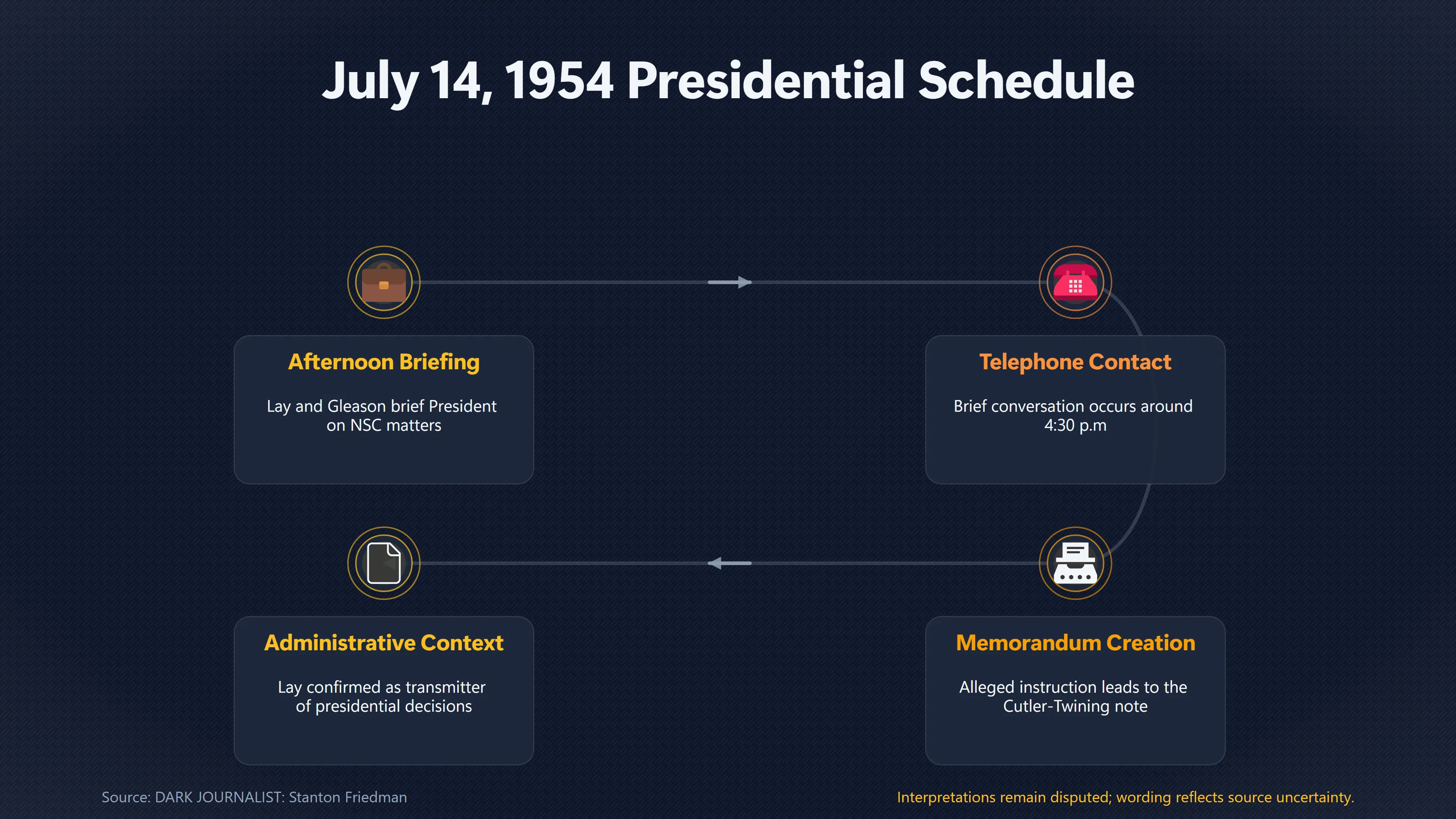
The strongest documentary point behind Stanton Friedman’s James Lay explanation is real but limited: on 14 July 1954, Lay was conducting National Security Council business directly with President Dwight D. Eisenhower. Eisenhower’s official appointment book records Lay and Deputy Executive Secretary S. Everett Gleason briefing the President on NSC matters that afternoon. Friedman additionally reported finding evidence of a brief telephone conversation between Eisenhower and Lay after about 4:30 p.m.[Eisenhower Presidential Library]eisenhowerlibrary.govOpen source on eisenhowerlibrary.gov.
The difficulty is the next step. Friedman reconstructed the telephone call as the likely occasion on which Eisenhower told Lay to notify Air Force Chief of Staff Nathan Twining that an alleged “MJ-12” briefing had been rescheduled. But Friedman described that instruction as something he “suspects” or could “envision”; the surviving White House chronology does not document such an instruction.[Medium]medium.comOpen source on medium.com.
That distinction is decisive. Evidence that Eisenhower and Lay communicated establishes an opportunity for an instruction. It does not establish what Eisenhower said, whether Twining was discussed, or whether “MJ-12” entered the conversation at all.
What is documented about Lay and Eisenhower that day
The Eisenhower Presidential Library’s appointment book provides unusually useful contemporary evidence for 14 July. It records the President’s public and private schedule, including meetings explicitly labelled “OFF THE RECORD”. During the afternoon, James S. Lay and S. Everett Gleason appear together in an off-the-record appointment whose purpose is stated plainly: they “Briefed the President on N.S.C.”[Eisenhower Presidential Library]eisenhowerlibrary.govOpen source on eisenhowerlibrary.gov.
This matters because it removes one potentially speculative link from Friedman’s argument. Lay did not merely occupy an office from which he might have communicated with Eisenhower. He actually had direct presidential access on the date of the disputed Cutler–Twining memorandum, and that access concerned National Security Council business.
Such access was entirely consistent with Lay’s office. As Executive Secretary of the NSC, he was an important part of the machinery through which presidential national-security decisions were circulated. Other declassified records show Lay transmitting NSC material and presidential decisions in precisely that administrative capacity. For example, later Foreign Relations of the United States documentation records Lay informing the NSC of decisions made by Eisenhower and circulating material for Council consideration.[Office of the Historian]state.govOpen source on state.gov.
The appointment record therefore strengthens the administrative plausibility of the Lay hypothesis. If Eisenhower wanted an NSC-related message passed to a senior official while Robert Cutler was overseas, Lay was a credible person through whom to do it.
What the appointment book does not say is equally important. Its description is simply that Lay and Gleason briefed Eisenhower on the NSC. There is no reference to Twining, a special briefing, unidentified flying objects, “Majestic”, “MJ-12”, or an instruction to prepare a memorandum.[Eisenhower Presidential Library]eisenhowerlibrary.govOpen source on eisenhowerlibrary.gov.
That absence cannot prove that those matters were not discussed in a private meeting. But it prevents the documented meeting from serving as affirmative evidence that they were.
Friedman’s telephone reconstruction
Friedman pushed the chronology one step further. In his published defence of the MJ-12 documents, he said that after the afternoon meeting Eisenhower and Lay also had a brief telephone conversation at about 4:30 p.m. Friedman treated the combination — an NSC briefing followed by a presidential telephone call — as a plausible route by which the disputed instruction could have reached Lay.[The Black Vault]theblackvault.comOpen source on theblackvault.com.
His reconstruction was quite specific. In one later account, Friedman wrote that he could “envision” Eisenhower telling Lay that there had been a slight change in plans and directing him to notify Twining that the briefing would occur during the planned White House meeting rather than afterwards. That hypothetical instruction closely reproduces the administrative substance of the disputed Cutler–Twining memorandum.[Medium]medium.comOpen source on medium.com.
This is an important point about the status of the evidence: the reconstructed dialogue is not a quotation from a presidential telephone transcript. Friedman himself presented it as what he could envision Eisenhower saying. In another published formulation, he said that because Eisenhower had met Lay and subsequently spoken with him by telephone, “one suspects” that Eisenhower told Lay to notify Twining.[Center for UFO Studies]cufos.orgOpen source on cufos.org.
Those formulations make the inferential step unusually visible. The argument runs roughly as follows: Lay was handling NSC business; Lay met Eisenhower on 14 July; Friedman reported a later telephone contact; the disputed memorandum says “The President has decided” to alter arrangements; therefore Eisenhower could have communicated that decision to Lay, who could then have prepared the note associated with Cutler’s office.
As a reconstruction of how the memorandum could have been produced despite Cutler’s absence, that is coherent. As evidence that this sequence did occur, it is incomplete.
Friedman also invoked former White House aide George Elsey, saying Elsey believed Lay would naturally have prepared such a short notification for Cutler. Friedman used Elsey’s assessment to reinforce the procedural plausibility of the reconstruction.[The Black Vault]theblackvault.comOpen source on theblackvault.com. But an informed judgement about how Lay would probably have handled an instruction is still different from evidence that Eisenhower actually issued the particular instruction attributed to him.

The missing presidential instruction
The central evidential gap can be stated very narrowly: the Cutler–Twining memorandum attributes a decision to Eisenhower, while the independently documented 14 July chronology does not identify that decision.
That matters because the disputed memorandum does not merely imply routine clerical action. Its crucial sentence attributes the scheduling change directly to the President. The question is therefore not simply whether Lay possessed enough authority to type or dispatch a short message. It is whether there is independent evidence that Eisenhower made the alleged decision and communicated it to Lay.
The National Archives’ investigation found no corroborating record of the alleged project in the records it searched. Its MJ-12 reference report states that researchers checked records of the Secretary of Defense, Joint Chiefs of Staff, Air Force headquarters and related files without finding further information about the subject. Searches of NSC meeting minutes and indices likewise produced no reference to “MJ-12” or “Majestic”.[National Archives]archives.govOpen source on archives.gov.
The Eisenhower Library also reported that the President’s appointment books contained no entry for a special meeting on 16 July 1954 that might have included an MJ-12 briefing. The Library emphasised that even off-the-record presidential meetings normally appeared in the appointment books with their time and participants — a point illustrated by the surviving 14 July schedule itself, which openly records Lay’s off-the-record NSC briefing.[National Archives]archives.govOpen source on archives.gov.
This does not make the absence of an explicit MJ-12 entry conclusive. The disputed memorandum speaks of a briefing occurring “during” an already scheduled White House meeting, so a hypothetical briefing need not necessarily have appeared as a separately scheduled event. Friedman specifically stressed that distinction.[Medium]medium.comOpen source on medium.com.
But it leaves the presidential instruction uncorroborated. A diary entry saying Lay briefed Eisenhower about NSC business cannot be read backwards as proof that Eisenhower discussed the subject named in an independently disputed document. The same applies to a telephone contact: establishing that two people spoke establishes neither the content of the conversation nor the existence of a particular presidential order.
Why presidential contact is not MJ-12 corroboration
The most useful way to assess Friedman’s phone-call claim is to separate three propositions that are sometimes allowed to blur together.
First, Lay had access to Eisenhower. This is firmly documented. On 14 July he and Gleason briefed the President on NSC affairs.[Eisenhower Presidential Library]eisenhowerlibrary.govOpen source on eisenhowerlibrary.gov.
Second, Eisenhower could have given Lay an instruction concerning Twining. That is historically plausible. Lay’s position placed him in the normal administrative chain for NSC business, and surviving records from the period demonstrate that he transmitted presidential decisions.[Office of the Historian]state.govOpen source on state.gov.
Third, Eisenhower actually told Lay to alter an MJ-12 briefing involving Twining. This is the proposition that the available independent records do not establish. Friedman supplied a reconstruction connecting the documented contacts to the language of the Cutler–Twining memorandum, but his published wording acknowledges the inferential character of that connection.[Medium]medium.comOpen source on medium.com.
The distinction becomes especially significant because 14 July was demonstrably an active working day for Lay. Declassified-document catalogues list other NSC material under his name on that date, and a surviving memorandum concerning the Aircraft Nuclear Propulsion Program shows him communicating a genuine presidential decision through normal NSC channels.[UFO Magazine Archive]ufomagazines.comOpen source on ufomagazines.com. This confirms that Eisenhower–Lay communication on official matters was ordinary enough that its mere existence cannot uniquely point towards MJ-12.
In evidential terms, therefore, the 14 July contact is compatible with Friedman’s hypothesis but not corroborative of its distinctive claim. To become strong independent corroboration, the record would need something tying the contact specifically to Twining, the alleged special-studies project, the 16 July briefing, or the scheduling change described by the disputed memorandum.
No such link appears in the National Archives’ reported searches. The Archives found no additional documentation on the alleged project and noted that inquiries to the Air Force, Joint Chiefs and National Security Council likewise produced no further information.[National Archives]archives.govOpen source on archives.gov.

What the phone-call claim actually changes
Friedman’s reconstruction does have a legitimate, limited effect on the Cutler-absence problem. Because Cutler was overseas, a simplistic argument that “Cutler was absent, therefore no memorandum associated with his office could have been generated” goes too far. Lay was in Washington, was carrying out NSC duties, and was briefing Eisenhower on the very date in question. The institutional mechanism Friedman proposed was therefore possible.[Eisenhower Presidential Library]eisenhowerlibrary.govOpen source on eisenhowerlibrary.gov.
But possibility is where the strongest documentary case stops. Friedman effectively supplied a missing scene between two established facts: Eisenhower and Lay communicated, and the disputed memorandum claims that the President changed the arrangements for a Twining briefing. The archival record presently available on the web does not independently supply that scene.
That makes the telephone claim useful for understanding the debate but insufficient to resolve it. It answers “How could Lay have received such an instruction?” with a plausible route. It does not answer “Do we know Eisenhower gave him that instruction?”
For the James Lay delegation explanation, this is the critical evidential boundary. Lay’s access to Eisenhower on 14 July 1954 is documented. Friedman’s reported telephone contact adds another opportunity for communication. The specific presidential direction that would connect those contacts to Twining and the alleged MJ-12 briefing, however, remains a reconstruction rather than an independently documented event.
Amazon book picks
Further Reading
Books and field guides related to Did Eisenhower Tell Lay to Contact Twining?. Use these as the next step if you want deeper reading beyond the article.
Top Secret/Majic: Operation Majestic-12 and the United States...
Top Secret/Majic is the result of nuclear physicist and renowned UFO investigator Stanton T. Friedman's twenty-one year search for the tr...
Eisenhower in War and Peace
NAMED ONE OF THE BEST BOOKS OF THE YEAR BY The Christian Science Monitor • St. Louis Post-Dispatch “Magisterial.”—The New York Times In t...
UFOs and the National Security State: Chronology of a Cover-U...
Included in this volume are the records of more than fifty military bases relating to innumerable violations of sensitive airspace by unk...
The Presidency of Dwight D. Eisenhower
"The best single volume available on the Eisenhower presidency". -- Stephen E. Ambrose, author of Eisenhower.
eBay marketplace picks
Marketplace Samples
Live-tested eBay searches with available results related to this page.
Selected fromUFO poster oneBay.co.uk.


Endnotes
1.
Source: archives.gov
Link:https://www.archives.gov/research/military/air-force/ufos
2.
Source: history.state.gov
Link:https://history.state.gov//historicaldocuments/frus1952-54v02p2/d80fn5
3.
Source: theblackvault.com
Link:https://www.theblackvault.com/casefiles/update-on-operation-majestic-12-documents/
Additional References
4.
Source: youtube.com
Title: DARK JOURNALIST: Stanton Friedman
Link:https://www.youtube.com/watch?v=cxXuw763O_U
Source snippet
Stanton Friedman MJ-12 documents Top Secret / MAJIC By Stanton T. Friedman - A Detailed Investigation into the MJ-12 UFO Documents...
5.
Source: youtube.com
Title: Flying Saucers Are Real
Link:https://www.youtube.com/watch?v=ZWyV6Go15-c
Source snippet
Top Secret / MAJIC By Stanton T. Friedman - A Detailed Investigation into the MJ-12 UFO Documents...
6.
Source: youtube.com
Title: Top Secret / MAJIC By Stanton T. Friedman
Link:https://www.youtube.com/watch?v=-Je48I-xNjY
Source snippet
Karl Pflock discusses The [Cutler - Twining Memo]({{ 'cutler-memo/' | relative_url }})...
7.
Source: youtube.com
Title: The Majestic-12 Documents [With Ryan S. Wood]
Link:https://www.youtube.com/watch?v=vzB87RJkQVU
Source snippet
DARK JOURNALIST: Stanton Friedman - UFO Cover Up Revelations! MJ12 & ET Quarantine...
8.
Source: youtube.com
Title: Karl Pflock discusses The Cutler
Link:https://www.youtube.com/watch?v=I6smHEhd9MI
Source snippet
The Majestic-12 Documents [With Ryan S. Wood]...