Within Cutler Twining
Does the Memo Use a Classification Marking Too Late?
NARA says the memo's exact security phrase was not used by the National Security Council until years after 1954.
On this page
- The exact security wording printed on the memorandum
- NARA's chronology for National Security Council usage
- Why similar period phrases do not settle the institutional question
Page outline Jump by section
Introduction
The classification language on the Cutler-Twining memorandum is one of the document’s most specific dating problems. The sheet dated 14 July 1954 bears wording rendered by the National Archives and Records Administration (NARA) as “Top Secret Restricted Information”. NARA says the National Security Council’s own Freedom of Information Office told archivists that this particular marking did not come into use at the NSC until the Nixon administration, which began in 1969. The Eisenhower Presidential Library likewise told NARA that the marking was not used during Eisenhower’s administration.[National Archives]archives.govNational Archives Project BLUE BOOKNational ArchivesProject BLUE BOOK - Unidentified Flying Objects | National ArchivesJune 25, 2024
That does not mean that every component of the phrase was unknown in the early 1950s. In fact, authentic documents from the period used closely related expressions such as “Top Secret; Security Information”, while an earlier classification regime recognised “Restricted” as a separate category. The crucial question is therefore narrower: would the NSC in July 1954 have put these words together in the form appearing on this memorandum? On the archival evidence published by NARA, the answer is no.
The exact security wording printed on the memorandum
The disputed marking is important because classification stamps were not simply decorative indications that a document was sensitive. They belonged to administrative systems whose terminology changed under presidential orders and departmental regulations. Those changes can provide chronological evidence in much the same way that an obsolete form, office title or filing convention can help date a government record.
NARA’s 1987 reference report records the phrase at issue as “Top Secret Restricted Information”. More importantly, the report identifies the source of its objection: the Acting Director of the NSC Freedom of Information Office informed NARA that this marking did not come into use at the National Security Council until the Nixon administration. NARA also reported confirmation from the Eisenhower Presidential Library that this particular marking was not used during the Eisenhower administration.[Ronald Reagan Presidential Library]reaganlibrary.archives.govOpen source on archives.gov.
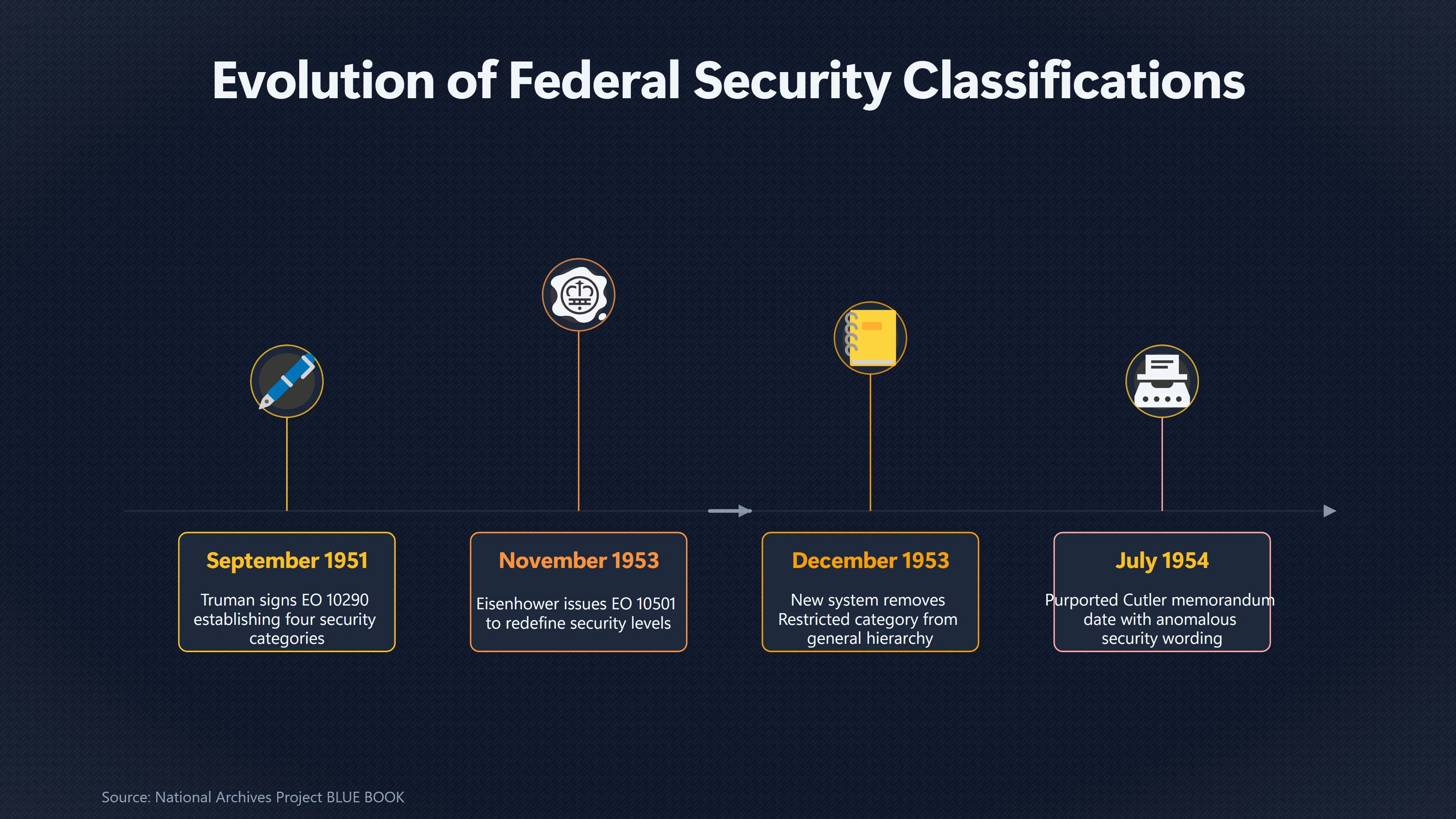
The distinction between the exact combination and its individual words matters. Earlier federal documents unquestionably contain similar terminology. Under President Harry Truman’s Executive Order 10290 of 24 September 1951, classified security information could be placed in four categories: Top Secret, Secret, Confidential and Restricted. The order directed that classifications below Top Secret be combined with the identification “Security Information”. Thus “Restricted Security Information” was legitimate terminology under that earlier system.[Truman Library]trumanlibrary.govexecutive order 10290Truman LibraryEXECUTIVE ORDER 10290 | Harry S. TrumanSeptember 24, 1951…
Authentic documents demonstrate the practice. A March 1953 Psychological Strategy Board memorandum preserved in CIA records carries “TOP SECRET SECURITY INFORMATION” markings. State Department historical records likewise describe 1953 NSC-related material as “Top Secret; Security Information”, while other records were “Secret; Security Information”.[CIA]cia.govMEMORANDUM OF INFORMAL PSB MEETING, 19 MARCH 1953 | CIA FOIA (foia.cia.gov)March 19, 1953…
Those examples are significant because they show both why the Cutler-Twining marking can initially look plausible and why superficial resemblance is insufficient. “Top Secret”, “Restricted” and “Security Information” all belonged to the vocabulary of early-1950s secrecy administration. The issue is their particular combination, institutional use and date.
NARA’s chronology for National Security Council usage
The most important change occurred before the memorandum’s purported date. On 5 November 1953, President Dwight Eisenhower issued Executive Order 10501, replacing Truman’s Executive Order 10290. The new order became effective on 15 December 1953, seven months before the purported Cutler memorandum. It reduced the general national-defence classification system to three categories: Top Secret, Secret and Confidential.[Wikisource]en.wikisource.orgExecutive Order 10501Executive Order 10501 - Wikisource, the free online libraryNovember 5, 1953…
That change removed “Restricted” as a classification category. Contemporary federal implementation records make the point explicitly. A 1954 Federal Register notice explained that Executive Order 10501 and the Department of Defense’s implementing directive had “eliminated the category ‘Restricted’ from the classification system”. An Army disposition form from December 1953 similarly stated that Executive Order 10501 eliminated the Restricted Security Information classification effective 15 December 1953 and ordered existing Restricted material to be reviewed and, where necessary, upgraded.[Wikimedia Commons]upload.wikimedia.orgWikimedia CommonsFederal Register 1954-05-19: Vol 19 Iss 97August 22, 2020…
There was also a change involving the words “Security Information”. Later Department of Defense documentation explaining implementation of Executive Order 10501 stated that this expression, required under the preceding system, was no longer to be used as an integral part of the three classification categories. The same documentation explicitly described “Restricted-Security Information” as a category eliminated by Executive Order 10501.[NSA]nsa.govREPORT OF REVIEW OF NATIONAL SECURITY AGENCY SECURITY PROCEDURES AND STATUSMarch 26, 2018…
This creates a particularly awkward chronology for a memorandum supposedly produced by Robert Cutler’s National Security Council office in July 1954. Its wording resembles terminology associated with the pre-15 December 1953 system, yet NARA’s institutional enquiry found that the particular “Top Secret Restricted Information” combination was not an NSC marking of the Eisenhower period at all. According to the NSC information supplied to NARA, that precise usage arrived only during the Nixon administration.[Ronald Reagan Presidential Library]reaganlibrary.archives.govOpen source on archives.gov.
The distinction prevents an overstatement sometimes made in discussions of the document. It is too broad to say that “Restricted” or “Security Information” could never appear on genuine material encountered in the 1950s. Old records did not vanish when classification regulations changed, and archival collections naturally contain documents created under previous systems. The stronger criticism is that a new NSC memorandum purportedly created on 14 July 1954 should be assessed against the marking practices then applicable to that office and date.
Why similar period phrases do not settle the institutional question
Defenders of the Cutler-Twining memorandum have pointed to variations in historical security markings as a reason for caution. That general caution is reasonable: government markings were not perfectly uniform, and surviving records show numerous combinations of classification levels, handling instructions and administrative stamps. A document should not be condemned merely because somebody cannot find its typography in a modern classification manual.
But the Cutler-Twining problem is more specific than typography. Authentic records provide useful controls against which the disputed wording can be compared. For example, an April 1953 White House-related memorandum reproduced in the Pentagon Papers carries “TOP SECRET – SECURITY INFORMATION”, and contemporary Foreign Relations of the United States records identify numerous 1953 documents as “Top Secret; Security Information”.[Wikisource]en.wikisource.orgPage:Pentagon-Papers-Part V. B. 3. a.djvu/98Page:Pentagon-Papers-Part V. B. 3. a.djvu/98 These examples establish that “Security Information” genuinely appeared alongside “Top Secret” shortly before the Cutler-Twining memo’s alleged creation.
They do not, however, establish that “Top Secret Restricted Information” was an interchangeable variant. Under Executive Order 10290, “Top Secret” and “Restricted” were different classification levels rather than two adjectives normally intended to be stacked into a single level. Then Executive Order 10501 replaced that four-level system with Top Secret, Secret and Confidential before the alleged memorandum was written.[Truman Library]trumanlibrary.govexecutive order 10290Truman LibraryEXECUTIVE ORDER 10290 | Harry S. TrumanSeptember 24, 1951…
There is a further reason not to treat every occurrence of “Restricted” as equivalent. Some specialised secrecy terminology existed outside the ordinary executive-order classification ladder. Executive Order 10501 expressly preserved the separate statutory regime for “Restricted Data” under the Atomic Energy Act. That was a defined category for atomic information, not evidence that the discarded general classification “Restricted” remained freely combinable with “Top Secret” on ordinary NSC correspondence.[The American Presidency Project]presidency.ucsb.eduOpen source on ucsb.edu. Modern Department of Energy terminology still illustrates the conceptual distinction between a classification level such as Top Secret and a statutory classification category such as Restricted Data.[Department of Energy Portal]pir.doe.govDepartment of Energy Portal PIRDepartment of Energy Portal PIR
This is why finding an authentic 1952 or early-1953 document marked “Restricted Security Information”, or another marked “Top Secret Security Information”, would not by itself rebut NARA’s finding. Such examples prove that the component vocabulary is period-authentic. To answer NARA’s objection directly, the stronger comparison would be an authenticated Eisenhower-era NSC document, created under the post-December-1953 regime, carrying the same “Top Secret Restricted Information” marking in comparable institutional use.
Does the marking prove the memorandum was forged?
Not by itself. Classification practice is strong comparative evidence, but a single anomalous marking cannot logically establish who made a document, when it entered an archival folder or whether an unusual exception might once have existed. NARA itself uses appropriately restrained language: its reference report says the Cutler-Twining document “poses problems”, rather than treating the classification wording alone as a conclusive forensic verdict.[National Archives]archives.govNational Archives Project BLUE BOOKNational ArchivesProject BLUE BOOK - Unidentified Flying Objects | National ArchivesJune 25, 2024
The marking nevertheless carries more evidential weight than a vague claim that the document simply “looks wrong”. Three chronological observations reinforce one another. Before December 1953, the federal system genuinely used “Security Information” terminology and recognised Restricted as a classification category. Executive Order 10501 then eliminated Restricted from the ordinary classification hierarchy and limited it to Top Secret, Secret and Confidential. Finally, NARA’s enquiry to the institution most relevant to the purported author — the National Security Council — produced the more specific finding that “Top Secret Restricted Information” was not an Eisenhower-era NSC marking and appeared there only later, during the Nixon administration.[trumanlibrary.gov]trumanlibrary.govexecutive order 10290Truman LibraryEXECUTIVE ORDER 10290 | Harry S. TrumanSeptember 24, 1951…
That sequence is what makes the anomaly significant in the Cutler-Twining authenticity dispute. The criticism does not depend on claiming that the words themselves were historically impossible. Rather, the memorandum appears to combine security vocabulary in a way that does not fit the documented classification regime and NSC marking practice of its claimed July 1954 origin.
For the alleged MJ-12 documents more broadly, that is an unusually testable point. Claims about secret projects can often be insulated by arguing that missing records were destroyed, withheld or compartmented. A classification marking is different: it can be compared with surviving administrative rules and contemporary documents. In this instance, those comparisons do not authenticate the Cutler-Twining memorandum. They leave its security marking as a substantive chronological anomaly — and one for which NARA’s published archival assessment has supplied a specific institutional explanation rather than merely a stylistic objection.[Ronald Reagan Presidential Library]reaganlibrary.archives.govOpen source on archives.gov.

Amazon book picks
Further Reading
Books and field guides related to Does the Memo Use a Classification Marking Too Late?. Use these as the next step if you want deeper reading beyond the article.
Top Secret/Majic
Top Secret/Majic is the result of nuclear physicist and renowned UFO investigator Stanton T. Friedman's twenty-one year search for the tr...
UFOs and the National Security State: Chronology of a Cover-U...
Included in this volume are the records of more than fifty military bases relating to innumerable violations of sensitive airspace by unk...
The Puzzle Palace: A Report on America's Most Secret Agency
In this remarkable tour de force of investigative reporting, James Bamford exposes the inner workings of America's largest, most secretiv...
Archives: Principles and Practices
This new and extensively revised second edition offers an international perspective on archives management, providing authoritative guida...
eBay marketplace picks
Marketplace Samples
Live-tested eBay searches with available results related to this page.
Selected fromUFO poster oneBay.co.uk.


Endnotes
1.
Source: archives.gov
Title: National Archives Project BLUE BOOK
Link:https://www.archives.gov/research/military/[air-force
Source snippet
National ArchivesProject BLUE BOOK - Unidentified Flying Objects | National ArchivesJune 25, 2024...
Published: June 25, 2024
2.
Source: reaganlibrary.archives.gov
Link:https://reaganlibrary.archives.gov/public/2021-06/40-654-209237726-004-008-2021.pdf
3.
Source: cia.gov
Link:https://www.cia.gov/readingroom/document/cia-rdp80-01065a000600040115-1
Source snippet
MEMORANDUM OF INFORMAL PSB MEETING, 19 MARCH 1953 | CIA FOIA (foia.cia.gov)March 19, 1953...
Published: March 19, 1953
4.
Source: history.state.gov
Title: Historical Documents
Link:https://history.state.gov/historicaldocuments/frus1950-55Intel/ch1?start=121
Source snippet
Office of the Historian...
5.
Source: en.wikisource.org
Title: Executive Order 10501
Link:https://en.wikisource.org/wiki/Executive_Order_10501
Source snippet
Executive Order 10501 - Wikisource, the free online libraryNovember 5, 1953...
Published: November 5, 1953
6.
Source: upload.wikimedia.org
Link:https://upload.wikimedia.org/wikipedia/commons/d/d2/Federal_Register_1954-05-19-Vol_19_Iss_97%28IA_sim_federal-register-find_1954-05-19_19_97%29.pdf
Source snippet
Wikimedia CommonsFederal Register 1954-05-19: Vol 19 Iss 97August 22, 2020...
Published: August 22, 2020
7.
Source: nsa.gov
Link:https://www.nsa.gov/Portals/70/documents/news-features/declassified-documents/friedman-documents/panel-committee-board/FOLDER_380/41764399080352.pdf
Source snippet
REF ID:A58004...
8.
Source: nsa.gov
Link:https://www.nsa.gov/Portals/75/documents/news-features/declassified-documents/friedman-documents/reports-research/FOLDER_051/41708959074831.pdf
Source snippet
REPORT OF REVIEW OF NATIONAL SECURITY AGENCY SECURITY PROCEDURES AND STATUSMarch 26, 2018...
Published: March 26, 2018
9.
Source: en.wikisource.org
Title: Page:Pentagon-Papers-Part V. B. 3. a.djvu/98
Link:https://en.wikisource.org/wiki/Page%3APentagon-Papers-Part_V._B._3._a.djvu/98
10.
Source: history.state.gov
Title: Historical Documents
Link:https://history.state.gov/historicaldocuments/frus1950-55Intel/ch1?start=151
11.
Source: uscode.house.gov
Link:https://uscode.house.gov/view.xhtml?edition=prelim&req=granuleid%3AUSC-prelim-title18-section795
12.
Source: uscode.house.gov
Link:https://uscode.house.gov/view.xhtml?edition=prelim&num=0&req=granuleid%3AUSC-prelim-title22-section8161
13.
Source: archives.gov
Title: Electronic Records | National Archives
Link:https://www.archives.gov/research/order/electronic-records
14.
Source: archives.gov
Title: ER A Video FAQs | National Archives
Link:https://www.archives.gov/era/records-mgmt/video-faqs.html
15.
Source: archives.gov
Link:https://www.archives.gov/records-mgmt/grs/faqs-for-grs
16.
Source: archives.gov
Title: Classes of FBI Records in the National Archives | National Archives
Link:https://www.archives.gov/research/investigations/fbi/classifications
17.
Source: archives.gov
Link:https://www.archives.gov/records-mgmt/accessioning/annual-move-laws-and-regulations
18.
Source: library.by
Link:https://library.by/portalus/modules/medecine/readme.php?archive=1690460923&id=1613589585&start_from=&subaction=showfull&ucat=
19.
Source: archives.gov
Title: 2020 quarter 2
Link:https://www.archives.gov/research/accessions/2020-quarter-2
20.
Source: archives.gov
Title: Classification 116: Atomic Energy Act
Link:https://www.archives.gov/research/investigations/fbi/classifications/116-atomic-energy-applicant.html
21.
Source: archives.gov
Title: General Information about Restricted Records | National Archives
Link:https://www.archives.gov/declassification/ndc/restricted-records.html
22.
Source: archives.gov
Title: Recommendations | National Archives
Link:https://www.archives.gov/research/jfk/select-committee-report/part-3-recommendations.html
23.
Source: uscode.house.gov
Link:https://uscode.house.gov/view.xhtml?edition=2010&num=0&req=granuleid%3AUSC-2010-title18-section795
24.
Source: cia.gov
Link:https://www.cia.gov/readingroom/document/loc-hak
25.
Source: history.state.gov
Link:https://history.state.gov/historicaldocuments/frus1951-54Iran/ch3?start=31
26.
Source: uscode.house.gov
Link:https://uscode.house.gov/view.xhtml?edition=prelim&path=%2Fprelim%40title18%2Fpart1%2Fchapter37
27.
Source: uscode.house.gov
Link:https://uscode.house.gov/view.xhtml?edition=prelim&path=%2Fprelim%40title44%2Fchapter35
28.
Source: uscode.house.gov
Link:https://uscode.house.gov/view.xhtml?edition=prelim&path=%2Fprelim%40title50%2Fchapter44%2Fsubchapter6
29.
Source: en.wikisource.org
Title: Opinion of the Court
Link:https://en.wikisource.org/wiki/EPA_v._Mink/Opinion_of_the_Court
30.
Source: archives.gov
Link:https://www.archives.gov/research/guide-fed-records/groups/082.html
31.
Source: obamalibrary.archives.gov
Title: electronic records guide
Link:https://obamalibrary.archives.gov/research/electronic-records-guide
32.
Source: cia.gov
Title: FREEDO M OF INFORMATION LAW, P. L. 89-487 | CIA FOIA (foia.cia.gov)
Link:https://www.cia.gov/readingroom/document/cia-rdp80m01048a000300200011-7
33.
Source: cia.gov
Title: cia rdp82m00097r000300070008 4
Link:https://www.cia.gov/readingroom/document/cia-rdp82m00097r000300070008-4
34.
Source: en.wikisource.org
Title: Executive Order 10964
Link:https://en.wikisource.org/wiki/Executive_Order_10964
35.
Source: cia.gov
Title: cia rdp82m00097r000300070010 1
Link:https://www.cia.gov/readingroom/document/cia-rdp82m00097r000300070010-1
36.
Source: history.state.gov
Link:https://history.state.gov/historicaldocuments/frus1958-60v03mSupp/d380
37.
Source: cia.gov
Link:https://www.cia.gov/readingroom/document/cia-rdp78-03921a000300220001-0
38.
Source: cia.gov
Link:https://www.cia.gov/readingroom/document/cia-rdp78-04718a000600330028-1
39.
Source: cia.gov
Link:https://www.cia.gov/readingroom/document/cia-rdp78-04718a000800290033-8
40.
Source: cia.gov
Title: CHINES E ANNOTATED BIBLIOGRAPHY, ITEM 442 (ECONOMIC) | CIA FOIA (foia.cia.gov)
Link:https://www.cia.gov/readingroom/document/cia-rdp80-00809a000700140076-1
41.
Source: cia.gov
Link:https://www.cia.gov/readingroom/document/cia-rdp80-00809a000700130246-3
42.
Source: cia.gov
Link:https://www.cia.gov/readingroom/document/cia-rdp80-00809a000700130088-9
43.
Source: en.wikisource.org
Title: Page:Pentagon Papers Part V. B. 3. a.djvu
Link:https://en.wikisource.org/wiki/Page%3APentagon-Papers-Part_V._B._3._a.djvu/120
44.
Source: cia.gov
Title: GENERA L CONDITIONS AT DANUBE-BLACK SEA CANAL PROJECT | CIA FOIA (foia.cia.gov)
Link:https://www.cia.gov/readingroom/document/cia-rdp80-00809a000700110330-1
45.
Source: cia.gov
Title: PROGRES S OF CONSERVATION PROJECTS IN CHINA | CIA FOIA (foia.cia.gov)
Link:https://www.cia.gov/readingroom/document/cia-rdp80-00809a000700110131-2
46.
Source: history.state.gov
Link:https://history.state.gov/historicaldocuments/frus1952-54v01p2/d209
47.
Source: cia.gov
Link:https://www.cia.gov/readingroom/document/cia-rdp80-01065a000600040116-0
48.
Source: history.state.gov
Link:https://history.state.gov//historicaldocuments/frus1950-55Intel/d145fn19
49.
Source: en.wikisource.org
Title: Page:Pentagon Papers Part V. B. 2. b.djvu
Link:https://en.wikisource.org/wiki/Page%3APentagon-Papers-Part_V._B._2._b.djvu/270
50.
Source: history.state.gov
Link:https://history.state.gov/historicaldocuments/frus1951v01/d49
51.
Source: en.wikisource.org
Title: Executive Order 10290
Link:https://en.wikisource.org/wiki/Executive_Order_10290
52.
Source: trumanlibrary.gov
Title: executive order 10290
Link:https://www.trumanlibrary.gov/library/executive-orders/10290/executive-order-10290
Source snippet
Truman LibraryEXECUTIVE ORDER 10290 | Harry S. TrumanSeptember 24, 1951...
Published: September 24, 1951
53.
Source: presidency.ucsb.edu
Link:https://www.presidency.ucsb.edu/documents/executive-order-10501-safeguarding-official-information-the-interests-the-defense-the
54.
Source: pir.doe.gov
Title: Department of Energy Portal PIR
Link:https://pir.doe.gov/glossary
55.
Source: govinfo.gov
Title: Federal Register | Gov Info
Link:https://www.govinfo.gov/help/fr
56.
Source: presidency.ucsb.edu
Link:https://www.presidency.ucsb.edu/documents/executive-order-11652-classification-and-declassification-national-security-information
57.
Source: presidency.ucsb.edu
Title: written presidential orders
Link:https://www.presidency.ucsb.edu/documents/app-categories/presidential/written-presidential-orders?items_per_page=40&page=397
58.
Source: presidency.ucsb.edu
Title: executive orders
Link:https://www.presidency.ucsb.edu/documents/app-attributes/executive-orders?items_per_page=20&page=211
59.
Source: presidency.ucsb.edu
Title: executive orders
Link:https://www.presidency.ucsb.edu/documents/app-categories/written-presidential-orders/presidential/executive-orders?items_per_page=60&page=65
60.
Source: presidency.ucsb.edu
Link:https://www.presidency.ucsb.edu/documents/executive-order-11097-amendment-executive-order-no-10501-amended-relating-authority-for
61.
Source: presidency.ucsb.edu
Link:https://www.presidency.ucsb.edu/documents/executive-order-10985-amendment-executive-order-no-10501-relating-safeguarding-official
62.
Source: presidency.ucsb.edu
Link:https://www.presidency.ucsb.edu/documents/executive-order-10964-amendment-executive-order-10501-safeguarding-official-information
63.
Source: presidency.ucsb.edu
Link:https://www.presidency.ucsb.edu/documents/executive-order-10901-amendment-executive-order-10501-relating-safeguarding-official
64.
Source: presidency.ucsb.edu
Link:https://www.presidency.ucsb.edu/documents/executive-order-10816-amendment-executive-order-no-10501-november-5-1953-relating
65.
Source: luforu.org
Title: Cutler-Twining memo
Link:https://luforu.org/cutler-twining-memo/
66.
Source: presidency.ucsb.edu
Title: statement the president proposed executive order entitled safeguarding official
Link:https://www.presidency.ucsb.edu/documents/statement-the-president-proposed-executive-order-entitled-safeguarding-official
67.
Source: presidency.ucsb.edu
Title: proclamation 3004 control persons leaving or entering the united states
Link:https://www.presidency.ucsb.edu/documents/proclamation-3004-control-persons-leaving-or-entering-the-united-states
68.
Source: presidency.ucsb.edu
Link:https://www.presidency.ucsb.edu/documents/executive-order-10290-prescribing-regulations-establishing-minimum-standards-for-the
Additional References
69.
Source: youtube.com
Title: Watergate, the JFK assassination and a UFO secret at the center of it all
Link:https://www.youtube.com/watch?v=PeULVsP-jEQ
Source snippet
UAP researcher: Lue Elizondo's new role is a 'controlled narrative'...
70.
Source: youtube.com
Title: A secret history: Inside shadow intelligence, the MJ-12 documents
Link:https://www.youtube.com/watch?v=ogJplVuElLs
Source snippet
Watergate, the JFK assassination and a UFO secret at the center of it all...
71.
Source: govinfo.gov
Link:https://www.govinfo.gov/collection/monthly-catalog
72.
Source: govinfo.gov
Link:https://www.govinfo.gov/app/details/GOVPUB-D-0bf053ef7e374f88426f9f81f45abab6
73.
Source: govinfo.gov
Link:https://www.govinfo.gov/app/details/GOVPUB-D-0bf053ef7e374f88426f9f81f45abab6/related
74.
Source: govinfo.gov
Link:https://www.govinfo.gov/app/details/GOVPUB-D-3d53c846aad4f5ccdf1107a5cf9acb29
75.
Source: govinfo.gov
Link:https://www.govinfo.gov/app/details/GOVPUB-D-3d53c846aad4f5ccdf1107a5cf9acb29/related
76.
Source: eisenhowerlibrary.gov
Link:https://www.eisenhowerlibrary.gov/research/finding-aids/white-house-office-office-special-assistant-national-security-affairs-robert
77.
Source: eisenhowerlibrary.gov
Link:https://www.eisenhowerlibrary.gov/research/online-documents/world-war-one
78.
Source: youtube.com
Title: UAP researcher: Lue Elizondo’s new role is a ‘controlled narrative’
Link:https://www.youtube.com/watch?v=HZiEFA2h79U
Source snippet
Ross Coulthart asks: Did JFK know about UFOs?...