Within James Lay Theory
What Would Convincing Evidence for Lay Authorship Look Like?
A convincing Lay explanation needs authenticated examples of deputies issuing comparable short notes under Cutler's name during his absence.
On this page
- The procedural parallel researchers would need
- Which archives could contain comparable Cutler office correspondence
- How positive matches would differ from mere administrative possibility
Page outline Jump by section
Introduction
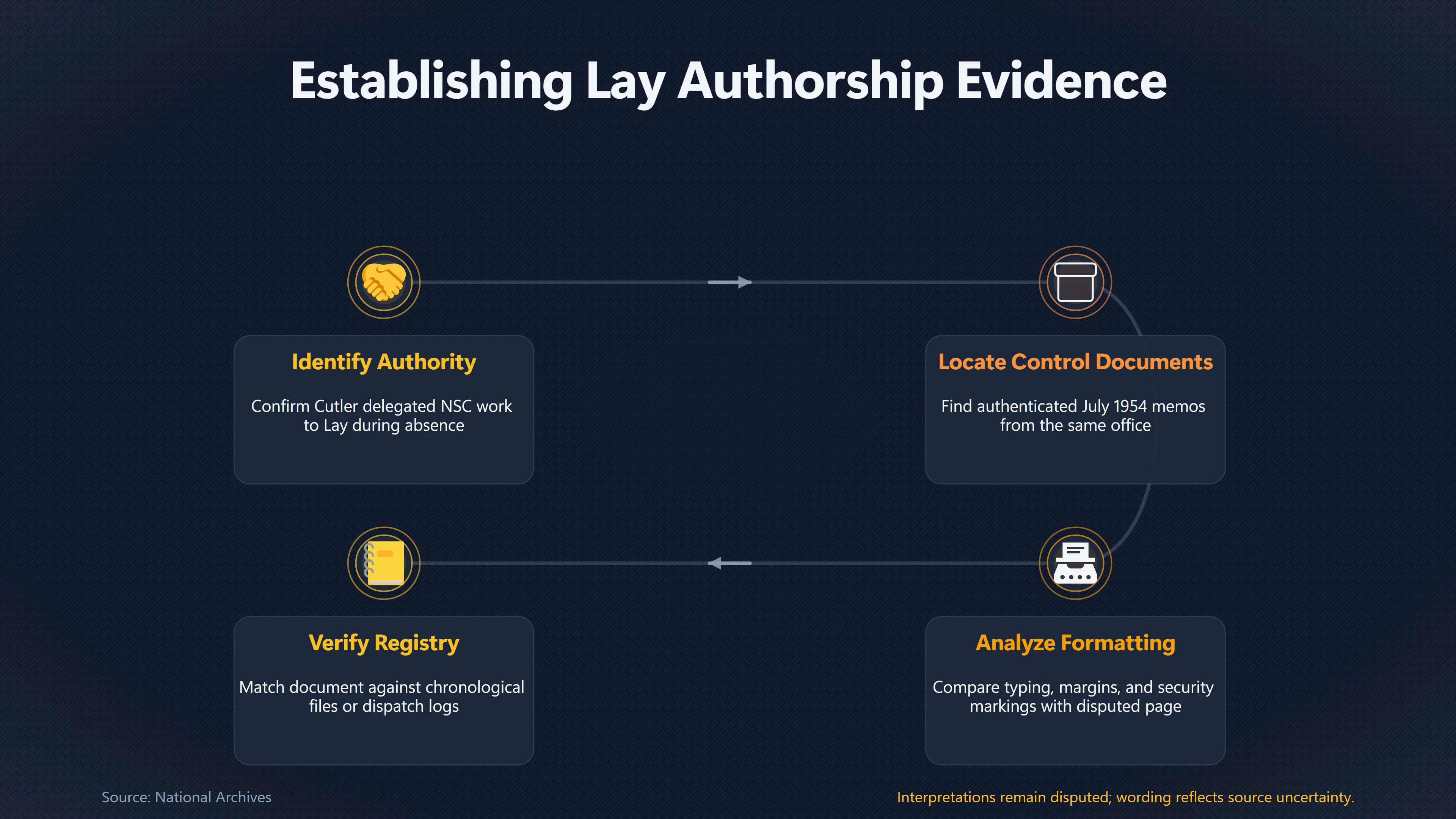
The evidence needed to show that James S. Lay Jr. wrote the disputed 14 July 1954 Cutler–Twining memorandum is much more specific than evidence that he could have written it. Cutler’s delegation of National Security Council (NSC) work to Lay while Cutler was overseas establishes administrative possibility. It does not establish authorship. The convincing case would require authenticated 1954 records showing that Lay routinely prepared comparable short communications in Cutler’s name during Cutler’s absences — preferably with the same formatting, attribution, signature practice, distribution route and filing pattern as the disputed memorandum.
That distinction matters because the National Archives reached almost the opposite procedural inference: given Cutler’s absence and his instructions to subordinates, archivists reasoned that a genuine memorandum should have borne Lay’s or J. Patrick Coyne’s signature. The archival question is therefore testable. Instead of asking whether Lay had enough authority, researchers need to establish what Lay actually did when exercising that authority.[National Archives]archives.govThat distinction matters because the National Archives reached almost the opposite procedural inference: given Cutler's absence and his i…
The procedural parallel researchers would need
The strongest evidence would be an authenticated memorandum from the same office and period that reproduces the disputed document’s unusual administrative situation. Ideally, it would date from Cutler’s 3–15 July 1954 trip itself and show Lay issuing a brief communication that was presented as coming from Robert Cutler even though Cutler was absent.
Several features would make such a comparison especially powerful. The document should be an original archival record with an independently traceable provenance; it should concern business falling within Cutler’s responsibilities; and it should show how Lay represented delegated authorship. Did he sign his own name? Add “for Robert Cutler”? Leave the document unsigned beneath Cutler’s typed name? Use an “/s/” notation? Did the registry record Lay as the originating official even when the page named Cutler? Those are the details capable of turning the delegation hypothesis into an evidence-based reconstruction.
This standard follows directly from the National Archives’ objection. NARA confirms that Cutler was visiting military installations in Europe and North Africa from 3 to 15 July and that a 3 July memorandum instructed Lay and Coyne how to handle NSC administrative matters while he was away. But NARA then states that one would expect Lay or Coyne to have signed a genuine communication.[National Archives]archives.govThat distinction matters because the National Archives reached almost the opposite procedural inference: given Cutler's absence and his i… A genuine example showing Lay doing precisely what the disputed memorandum does — leaving Cutler’s name in the attribution without identifying himself — would therefore answer one of the archive’s most specific objections.
The reverse would also be important. If a substantial sample showed that delegated memoranda were consistently signed by Lay or Coyne, or explicitly marked as being issued for Cutler, the Lay-authorship explanation would become harder to sustain. The question is not whether one can imagine an exception. It is whether the surviving office record establishes a normal procedure into which the disputed document fits.
There is already a potentially valuable control document. A declassified NSC memorandum dated 14 July 1954 concerning the Aircraft Nuclear Propulsion Program is attributed to James S. Lay Jr. as Executive Secretary. A contemporary reproduction of that document has circulated in archival research literature.[UFO Magazine Archive]ufomagazines.comThere is already a potentially valuable control document. A declassified NSC memorandum dated 14 July 1954 concerning the Aircraft Nuclea… Its significance is methodological rather than decisive: a genuine Lay document from the same day offers a particularly strong basis for comparing stationery, typing conventions, headings, security markings, routing and the treatment of authorship. What it cannot do merely by existing is demonstrate that Lay also produced the Cutler–Twining memorandum.
Where a real authorship trail should appear
The best opportunity for resolving the question is not another general search for “MJ-12”. It is a document-by-document reconstruction of Lay’s and Cutler’s office practices around July 1954. The Eisenhower Presidential Library’s holdings are unusually well suited to that task.
Most importantly, the White House Office, National Security Council Staff papers contain an Executive Secretary’s Chronological File Series. Its finding aid identifies a folder covering 1–29 July 1954 in Box 2.[Eisenhower Presidential Library]eisenhowerlibrary.govMost importantly, the White House Office, National Security Council Staff papers contain an Executive Secretary's Chronological File Seri… This is almost tailor-made for the authorship question. Researchers could establish what communications Lay issued immediately before, during and after 14 July and compare them with the disputed page.
A useful investigation would not search that folder only for the words “MJ-12”. It would catalogue the ordinary outgoing documents. The relevant variables include addressee wording, subject-line format, margins and spacing, security markings, letterhead and paper, whether Lay signed documents prepared under another official’s authority, and whether administrative scheduling changes were handled through the Executive Secretary’s office. An authenticated run of mundane correspondence can be more probative here than another sensational document because it supplies the procedural baseline.
A second important collection is the Executive Secretary’s Subject File Series. The Eisenhower Library’s finding aids identify ten folders of “Special Assistant (Cutler) – Memoranda, 1954” in Box 17, covering subjects including atomic energy, defence mobilisation, continental defence, Korea, Formosa, Guatemala and foreign economic policy.[Eisenhower Presidential Library]eisenhowerlibrary.govA second important collection is the Executive Secretary's Subject File Series. The Eisenhower Library's finding aids identify ten folder… Those files could provide the broader comparison set needed to determine how Cutler memoranda were prepared, copied, routed and preserved.
The Library also holds the records of the Office of the Special Assistant for National Security Affairs, including NSC administrative, briefing-note, policy, chronological, presidential and subject files.[Eisenhower Presidential Library]eisenhowerlibrary.govThe Library also holds the records of the Office of the Special Assistant for National Security Affairs, including NSC administrative, br… Robert Cutler’s personal papers constitute another substantial collection, although personal papers and official office files should not automatically be assumed to preserve identical recordkeeping practices.[Eisenhower Presidential Library]eisenhowerlibrary.govThe Library also holds the records of the Office of the Special Assistant for National Security Affairs, including NSC administrative, br…
Finally, the National Archives’ Record Group 273 contains the institutional records of the NSC, including records of the Office of the Executive Secretary and Secretariat. NARA also points researchers towards Eisenhower-era White House files and Cutler’s papers as related collections.[National Archives]archives.govFinally, the National Archives' Record Group 273 contains the institutional records of the NSC, including records of the Office of the Ex… Taken together, these collections offer the possibility of reconstructing not merely what Lay was authorised to do, but how his office documented what he actually did.
A positive match needs more than similar wording
Some arguments for Lay authorship rely on circumstantial similarities. Stanton Friedman, for example, argued that Cutler had explicitly told Lay to keep work moving during his absence; that Lay subsequently reported handling matters; and that the absence of either a signature or “/s/” on the Cutler–Twining memorandum made sense if Lay had prepared it for Cutler. Friedman also reported evidence of contact between Lay and Eisenhower on 14 July.[The Black Vault]theblackvault.comSome arguments for Lay authorship rely on circumstantial similarities. Stanton Friedman, for example, argued that Cutler had explicitly t… These points make Lay a conceivable intermediary. They are not an authorship identification.
Even stylistic similarities would have limited weight on their own. Friedman drew attention to underlining in both the Cutler–Lay material and the disputed memorandum.[The Black Vault]theblackvault.comSome arguments for Lay authorship rely on circumstantial similarities. Stanton Friedman, for example, argued that Cutler had explicitly t… But underlining, stock bureaucratic phrases and similar layouts can be office conventions rather than individual habits. A White House secretary or typist could also produce the physical page while Lay supplied or authorised its substance. “Lay wrote it” therefore needs to be divided into separate propositions: Lay drafted the wording, Lay authorised its transmission, Lay’s office typed it, or Lay merely had the institutional authority to deal with the matter. Those propositions require different evidence.
A much stronger attribution would combine several independent matches:
- Delegated-authority match: a genuine Cutler instruction covering the relevant dates and class of business.
- Authorship-practice match: authenticated examples showing how Lay sent communications under Cutler’s authority while Cutler was unavailable.
- Physical-format match: stationery, typing, headings, spacing and security markings consistent with documents demonstrably generated by the same office at that time.
- Registry or file match: an entry in a chronological file, dispatch log, routing slip, recipient file or other contemporary control record connecting the communication to Lay’s office.
- Recipient-side match: a Twining, Joint Chiefs, Air Force or White House file preserving another copy or recording receipt of the message.
- Meeting-context match: independent records showing that the referenced 16 July meeting or schedule change existed.
No single item necessarily has to satisfy every criterion. Several independent records converging on the same administrative chain could establish Lay’s involvement far more persuasively than one superficially similar memorandum.
The disputed memo has unusually serious provenance problems
Any proposed Lay comparison also has to account for the document’s existing archival anomalies. The fact that the Cutler–Twining page was found in the National Archives is not itself authentication. NARA explicitly says that certification establishes only that a reproduction is a true copy of a document in its custody; it does not authenticate either the document or the information in it.[National Archives]archives.govThat distinction matters because the National Archives reached almost the opposite procedural inference: given Cutler's absence and his i…
The surrounding record raises several problems. The memorandum was found in Air Force Record Group 341, Entry 267, in a series organised by Top Secret register number, yet the page has no such number. Its folder contains no other “NSC/MJ-12” documents. Searches of Secretary of Defense, Joint Chiefs, Air Force and NSC records found no corroborating material. NARA also reported that one of its security markings was not used at the NSC until the Nixon administration.[National Archives]archives.govThat distinction matters because the National Archives reached almost the opposite procedural inference: given Cutler's absence and his i…
Physical comparison matters as well. A NARA conservation specialist found the page to be a ribbon copy on “diction onionskin”, without official government letterhead or watermark. The Eisenhower Library’s sample of Cutler material found that Cutler’s NSC documents on bond paper carried an eagle watermark, while onionskin carbon copies either had an eagle watermark or none; NARA also noted that most outgoing NSC documents used White House letterhead.[National Archives]archives.govThat distinction matters because the National Archives reached almost the opposite procedural inference: given Cutler's absence and his i… None of those observations alone identifies a forger, but they raise the evidential threshold for claiming that the page came through Lay’s office.
There is an equally important contextual gap. The memorandum refers to a White House meeting on 16 July, yet NARA found no NSC meeting that day and no July 1954 NSC minutes mentioning MJ-12 or Majestic. The Eisenhower Library reported no presidential appointment-book entry for a special 16 July meeting of the kind implied by the document.[National Archives]archives.govThat distinction matters because the National Archives reached almost the opposite procedural inference: given Cutler's absence and his i… A genuine Lay-authored scheduling note would become substantially more credible if an independent diary, appointment book, telephone log or Twining file established the meeting it was supposedly rescheduling.
What would change the assessment?
There is a useful hierarchy between evidence of possibility and evidence of authorship.
At the weakest level is administrative possibility: Lay was Executive Secretary of the NSC, Cutler was abroad, and Cutler had left instructions for Lay and Coyne to handle administrative business. That is enough to show that government work did not stop because Cutler left Washington. It is not enough to attach Lay’s name to an unsigned page.[National Archives]archives.govThat distinction matters because the National Archives reached almost the opposite procedural inference: given Cutler's absence and his i…
More persuasive would be procedural similarity: several authenticated July 1954 documents demonstrating that Lay routinely prepared short memoranda in Cutler’s name without signing them himself. That would directly challenge NARA’s expectation that Lay or Coyne should have signed the Twining memorandum.
Stronger still would be documentary linkage: a July 1954 chronological-file copy, registry notation, routing sheet, stenographer’s file, recipient copy or diary entry independently connecting Lay with the specific communication. The existence of the Executive Secretary’s chronological folder for 1–29 July 1954 makes this a concrete archival test rather than a hypothetical one.[Eisenhower Presidential Library]eisenhowerlibrary.govMost importantly, the White House Office, National Security Council Staff papers contain an Executive Secretary's Chronological File Seri…
The strongest realistic result would be convergent provenance: matching copies in independent originating and recipient files, with period-correct administrative markings and a contemporaneous record of the meeting or schedule change mentioned in the text. Such evidence would not merely show that Lay was capable of acting for Cutler; it would reconstruct the actual transmission path of the memorandum.
That standard is especially appropriate because broader official searches have not supplied corroboration. In 1995 the US General Accounting Office reported that the National Archives, Air Force and Information Security Oversight Office had found no evidence that the publicly circulated MJ-12 material constituted documents originating in the executive branch, while Truman and Eisenhower Library archivists had found no records corroborating MJ-12.[Government Accountability Office]gao.govThat standard is especially appropriate because broader official searches have not supplied corroboration. In 1995 the US General Account…
The proof standard
The James Lay explanation therefore remains a hypothesis about administrative mechanism, not demonstrated authorship. It answers the narrow objection that Cutler’s physical absence made it impossible for his office to issue anything on 14 July 1954. It does not answer the more important forensic question: is there evidence that Lay’s office actually produced this particular page in this particular way?
The decisive comparison would be surprisingly mundane: genuine July 1954 office correspondence showing Lay handling Cutler’s delegated business, especially short scheduling memoranda sent to senior defence officials. If those records repeatedly show unsigned memoranda carrying Cutler’s typed attribution while Lay acted behind the scenes, the Lay explanation would gain substantial evidential weight. If they instead show Lay signing his own name, marking himself as acting for Cutler, using different stationery and security conventions, and leaving chronological or registry traces absent from the disputed memorandum, the explanation would lose weight.
For now, the archival record establishes the mechanism by which Lay could have acted. It does not establish that he did. That gap — between delegated authority and a positive documentary match — is the central proof problem that any convincing Lay-authorship case still has to overcome.
Amazon book picks
Further Reading
Books and field guides related to What Would Convincing Evidence for Lay Authorship Look Like?. Use these as the next step if you want deeper reading beyond the article.
Top Secret/Majic: Operation Majestic-12 and the United States...
Top Secret/Majic is the result of nuclear physicist and renowned UFO investigator Stanton T. Friedman's twenty-one year search for the tr...

The Craft of Research
Rating: 4.3/5 from 6 Google Books ratings
Since 1995, students, researchers, and professionals have turned to The Craft of Research for clear and helpful guidance on how to conduc...
UFOs and the National Security State: Chronology of a Cover-U...
Included in this volume are the records of more than fifty military bases relating to innumerable violations of sensitive airspace by unk...
Forensic Document Examination: Principles and Practice
This book introduces the reader to the basic principles of handwriting and the factors that affect their development. The book discusses...
eBay marketplace picks
Marketplace Samples
Live-tested eBay searches with available results related to this page.
Selected fromUFO memorabilia oneBay.co.uk.
Endnotes
1.
Source: archives.gov
Title: National Archives
Link:https://www.archives.gov/research/military/air-force/ufos
Source snippet
That distinction matters because the National Archives reached almost the opposite procedural inference: given Cutler's absence and his i...
2.
Source: ufomagazines.com
Title: UFO Magazine Archive
Link:https://www.ufomagazines.com/just-cause-new-series-just-cause-1988-03-no-15-new-series/
Source snippet
There is already a potentially valuable control document. A declassified NSC memorandum dated 14 July 1954 concerning the Aircraft Nuclea...
Published: July 1954
3.
Source: eisenhowerlibrary.gov
Title: Eisenhower Presidential Library
Link:https://www.eisenhowerlibrary.gov/sites/default/files/finding-aids/pdf/who-nsc/executive-secretary-chronological-file-series.pdf
Source snippet
Most importantly, the White House Office, National Security Council Staff papers contain an Executive Secretary's Chronological File Seri...
4.
Source: eisenhowerlibrary.gov
Title: Eisenhower Presidential Library
Link:https://www.eisenhowerlibrary.gov/sites/default/files/finding-aids/pdf/who-nsc/executive-secretary-subject-file-series.pdf
Source snippet
A second important collection is the Executive Secretary's Subject File Series. The Eisenhower Library's finding aids identify ten folder...
5.
Source: eisenhowerlibrary.gov
Title: Eisenhower Presidential Library
Link:https://www.eisenhowerlibrary.gov/research/finding-aids/white-house-office-office-special-assistant-national-security-affairs-robert
Source snippet
The Library also holds the records of the Office of the Special Assistant for National Security Affairs, including NSC administrative, br...
6.
Source: eisenhowerlibrary.gov
Title: Eisenhower Presidential Library
Link:https://www.eisenhowerlibrary.gov/research/finding-aids/cutler-robert
Source snippet
The Library also holds the records of the Office of the Special Assistant for National Security Affairs, including NSC administrative, br...
7.
Source: archives.gov
Title: National Archives
Link:https://www.archives.gov/research/guide-fed-records/groups/273.html
Source snippet
Finally, the National Archives' Record Group 273 contains the institutional records of the NSC, including records of the Office of the Ex...
8.
Source: theblackvault.com
Title: The Black Vault
Link:https://www.theblackvault.com/casefiles/update-on-operation-majestic-12-documents/
Source snippet
Some arguments for Lay authorship rely on circumstantial similarities. Stanton Friedman, for example, argued that Cutler had explicitly t...
9.
Source: gao.gov
Title: Government Accountability Office
Link:https://www.gao.gov/products/154832
Source snippet
That standard is especially appropriate because broader official searches have not supplied corroboration. In 1995 the US General Account...
Additional References
10.
Source: youtube.com
Link:https://www.youtube.com/watch?v=ogJplVuElLs
Source snippet
The Roswell Incident and Majestic 12: Fever Dreams or Authentic? | Michael Heiser...
11.
Source: youtube.com
Link:https://www.youtube.com/watch?v=rGSJcLIpRKM
Source snippet
UFO Crash Retrieval Expert on CIA Alien Files & Majestic 12 | Ryan Wood...
12.
Source: youtube.com
Title: UFOs and MJ-12
Link:https://www.youtube.com/watch?v=zHqIXLOqRak
Source snippet
[Cutler Twining memo]({{ 'cutler-memo/' | relative_url }}) Majestic 12 Ep 020: A Full Reading of the MJ-12 Eisenhower Briefing Document...
13.
Source: youtube.com
Title: UFO Crash Retrieval Expert on CIA Alien Files & Majestic 12 | Ryan Wood
Link:https://www.youtube.com/watch?v=8JeoxrJ0mI4
Source snippet
UFOs and MJ-12 - Stanton Friedman LIVE - FEATURE LENGTH...
14.
Source: youtube.com
Title: Karl Pflock discusses The Cutler
Link:https://www.youtube.com/watch?v=I6smHEhd9MI
Source snippet
A secret history: Inside shadow intelligence, the MJ-12 documents | Reality Check...