Within Archive Provenance
Why One Archival Sheet Is Not Enough
A document gains stronger provenance when neighboring files, related correspondence, indexes, and copies independently explain why it belongs where it was
On this page
- What surrounding records can corroborate
- Why an isolated memo is harder to place
- How folder context differs from physical custody
Page outline Jump by section
Introduction
For the alleged MJ-12 documents, the strongest feature of the Cutler-Twining memorandum is also easy to overstate: unlike the anonymously circulated MJ-12 papers, a physical copy was found in the US National Archives among genuine Air Force records. That gives the sheet a real archival location. It does not, however, establish the more important historical fact — that the memorandum entered those files through normal government business in 1954.
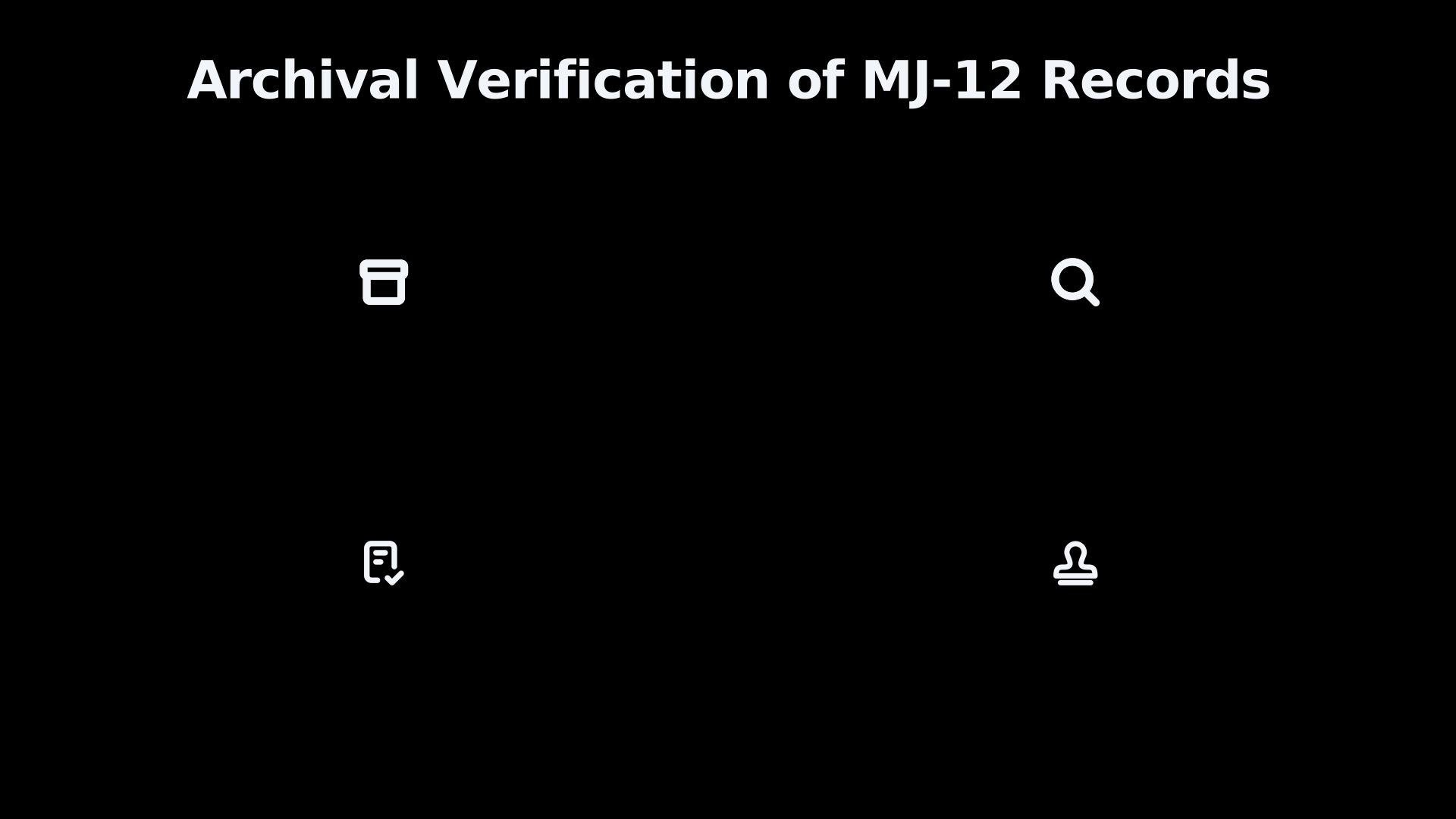
Archivists therefore look beyond the sheet itself. Related correspondence, file numbers, indexes, meeting records, administrative copies and records held by other offices can independently explain why a document exists and why it belongs in a particular file. The National Archives’ investigation of the Cutler-Twining memo found unusually little of that surrounding support: no other MJ-12 material in its folder, no expected Top Secret register number, and no corroborating MJ-12 trail in several related record systems.[National Archives]archives.govNational Archives Project BLUE BOOKNational ArchivesProject BLUE BOOK - Unidentified Flying Objects | National ArchivesJune 25, 2024…
That absence does not by itself prove who made or placed the memorandum. It does explain why finding one intriguing sheet in an authentic archive is weaker evidence than finding a coherent population of records around it.
What surrounding records can corroborate
Government records are normally produced as parts of processes rather than as isolated historical exhibits. A memorandum may be received by another office, entered into a registry, placed in a numbered file, answered by its recipient, copied to additional officials, mentioned in minutes or appointment books, or reflected in later correspondence. Those relationships are precisely why archival practice places so much weight on provenance and original order.
The US National Archives explains that its record groups follow provenance: records are attributed to the agency that created or maintained them and arranged according to how they were filed during active use. A series, meanwhile, consists of records accumulated and used together for a particular purpose, normally according to an identifiable arrangement. The Society of American Archivists similarly stresses that original order preserves relationships between documents and the evidential value inherent in those relationships.[National Archives]archives.govNational Archives Record Group Concept | National ArchivesNational ArchivesRecord Group Concept | National ArchivesFebruary 5, 2018…
This makes neighbouring records potentially more informative than the appearance of a single page. They can answer questions that the page cannot answer for itself:
- Does it obey the filing system? A classified memorandum found in a series arranged by security-register numbers is more readily explained if it carries the kind of number used by neighbouring records.
- Does the subject recur naturally? Related letters, memoranda, routing slips or replies can show that the document formed part of continuing official business rather than appearing as a solitary item.
- Do other offices leave matching traces? A communication between senior White House, National Security Council and Air Force officials might reasonably generate records in more than one administrative system.
- Do indexes and calendars agree with it? Registers, meeting minutes, appointment books and indexes can independently corroborate the people, dates and activities mentioned on the page.
- Do copies behave like contemporary copies? Duplicate or recipient copies in independently maintained files can be especially valuable because their survival does not depend upon the history of the disputed sheet alone.
This is not a demand that every genuine secret document must leave all of those traces. Records can be lost, destroyed, misfiled, withheld or never created. Rather, corroborating traces are cumulative evidence. The more independent features of the records system agree with a document’s claimed history, the less authentication depends upon trusting the document’s own assertions.
The principle is particularly important for an extraordinary claim such as MJ-12 because the disputed memorandum itself supplies very little explanatory information. It refers to an “NSC/MJ-12 Special Studies Project” and a briefing but does not explain what MJ-12 was or what the briefing concerned. The National Archives’ searches therefore tested whether the wider records environment supplied the missing context. It largely did not.[National Archives]archives.govNational Archives Project BLUE BOOKNational ArchivesProject BLUE BOOK - Unidentified Flying Objects | National ArchivesJune 25, 2024…
Why the Cutler-Twining memo is harder to place
The Cutler-Twining sheet was found in Record Group 341, entry 267, folder T4-1846. That location is meaningful: it establishes that the disputed physical document was present among records of Headquarters, US Air Force. But when National Archives staff examined how the page related to that setting, they identified a basic mismatch. The series was filed by Top Secret register number, while the Cutler-Twining memorandum had no such number. More strikingly for the question of folder context, archivists reported that no other document in folder T4-1846 concerned “NSC/MJ-12”.[National Archives]archives.govNational Archives Project BLUE BOOKNational ArchivesProject BLUE BOOK - Unidentified Flying Objects | National ArchivesJune 25, 2024…
The distinction matters. Imagine two hypothetical discoveries. In the first, researchers find a memorandum announcing a secret briefing, accompanied by the recipient’s reply, an earlier scheduling note, a later reference to the meeting and register entries matching the sequence used throughout the folder. In the second, researchers find only the announcing memorandum, without the expected register number, in a folder otherwise silent about the purported project. Both sheets may occupy genuine archival boxes, but the first has a much stronger internal explanation for being there.
The Cutler-Twining case resembles the second pattern. The problem grows when the search expands beyond the immediate folder. National Archives staff reported searches of records belonging to the Secretary of Defense, Joint Chiefs of Staff, Headquarters US Air Force and related files without finding further information about MJ-12. Inquiries to the Air Force, Joint Chiefs and National Security Council likewise produced no supporting documentation. Searches of National Security Council indexes found no entries for MJ-12 or Majestic, while a search of the NSC’s July 1954 meeting minutes found no mention of either term.[National Archives]archives.govNational Archives Project BLUE BOOKNational ArchivesProject BLUE BOOK - Unidentified Flying Objects | National ArchivesJune 25, 2024…
Those negative searches are not equivalent to proof that no highly classified activity could ever have existed. They are significant for a narrower reason: the archival neighbourhood does not independently reconstruct the administrative story told by the memo.
The scheduled briefing mentioned on the sheet provides a particularly useful test. The memo says the President had decided that the MJ-12 briefing should occur during an already scheduled White House meeting on 16 July 1954. Yet the National Archives found no NSC meeting on that date, and the Eisenhower Presidential Library reported that Eisenhower’s appointment books contained no entry for a special meeting that might have included such a briefing. The Library added that even “off the record” presidential meetings were represented in the appointment books by entries giving times and participants.[National Archives]archives.govNational Archives Project BLUE BOOKNational ArchivesProject BLUE BOOK - Unidentified Flying Objects | National ArchivesJune 25, 2024…
There is also contextual evidence about the purported sender. Robert Cutler was travelling through military installations in Europe and North Africa between 3 and 15 July 1954. Before leaving, he gave two NSC subordinates instructions for handling administrative matters during his absence. The National Archives consequently noted that a genuine memorandum dispatched in Cutler’s name while he was away might be expected to show the involvement of one of those staff members. Again, this is not a stand-alone proof of fabrication. Its importance comes from its fit with the broader pattern: instead of neighbouring records resolving an apparent anomaly, they create additional questions about how the page was supposedly produced.[National Archives]archives.govNational Archives Project BLUE BOOKNational ArchivesProject BLUE BOOK - Unidentified Flying Objects | National ArchivesJune 25, 2024…
The comparison that matters is population against outlier
This is why the archival question should not be reduced to whether the Cutler-Twining memo has one feature compatible with the 1950s. Defenders of its authenticity have disputed some individual criticisms. For example, Stanton Friedman argued that the paper type and watermark evidence was less damaging than initially suggested, pointing to other Cutler-era carbon copies without the supposedly expected watermark.[Medium]medium.comgovernment ufo lies 1 3 2dfeb22c4d19June 28, 2024…
Such disputes are useful because they prevent weak arguments from being treated as decisive. If genuine contemporary documents show that a particular paper stock, format or marking varied in practice, then that particular objection deserves less weight.
But resolving one physical-feature dispute does not create the missing archival population. The harder provenance question remains: what other records independently place this particular memorandum within the administrative process it claims to document?
That is where indexes, correspondence and related files have an advantage over arguments about typography or paper. They provide independent points of comparison. The National Archives’ own guidance on arrangement says that government records are most intelligible when kept with the records generated by related official actions, and warns that an individual document’s significance can be obscured when separated from related material. The UK National Archives makes the same practical point: catalogue hierarchy allows researchers to see where a record sits and to explore related records in the same set or series.[National Archives]archives.govOpen source on archives.gov.
Applied to MJ-12, this changes the evidential question. Instead of asking only, “Can this sheet be made consistent with 1954?”, the researcher asks, “Does the surviving 1954 records system behave as though this sheet belonged to it?”
For the Cutler-Twining memorandum, the available answer is problematic. Its archival location supplies one positive contextual fact, but several expected forms of surrounding corroboration are absent or discordant. That imbalance is more consequential than any single disputed forensic detail.
Folder context is not the same as physical custody
The final distinction is between custody and context. Physical custody tells us where an object is held. Folder context asks how convincingly that object belongs to the records structure surrounding it.
The National Archives makes the distinction unusually explicit in its MJ-12 reference material. When it certifies a reproduction under its seal, it is attesting that the reproduction is a true copy of a document in its custody. It is not authenticating the document itself or the information it contains.[National Archives]archives.govNational Archives Project BLUE BOOKNational ArchivesProject BLUE BOOK - Unidentified Flying Objects | National ArchivesJune 25, 2024…
That warning matters because “found in the National Archives” can otherwise sound stronger than it is. The National Archives preserves enormous bodies of material accumulated by government agencies. Its own definition of provenance includes both the archival principle of keeping records from the same records-keeping unit together and information about the chain of ownership and custody of particular records. Merely identifying the repository therefore does not reconstruct the earlier chain by which a disputed item was created, handled, filed and ultimately transferred.[National Archives]archives.govNational ArchivesArchives and Records Management Resources | National ArchivesAugust 15, 2016…
Nor should “original order” be understood as a guarantee that every sheet now in a folder was necessarily placed there correctly by its purported author in the year printed on it. The Society of American Archivists notes that original order is not simply the order in which an archive received material: files may have been disturbed before transfer, and clearly misfiled items can exist.[Society of American Archivists]www2.archivists.orgSociety of American Archivistsoriginal order | Society of American ArchivistsSociety of American Archivistsoriginal order | Society of American Archivists
That qualification is crucial in the MJ-12 dispute. The Cutler-Twining memo’s presence in an authentic Air Force archival series is real evidence about its later location. What remains poorly established is the earlier causal history that would turn location into strong provenance: creation within the claimed office, contemporary transmission, registration or filing through ordinary channels, and corroboration by independently maintained records.
Why one archival sheet is not enough
The Cutler-Twining memorandum therefore occupies an awkward middle ground. It has more evidential weight than an anonymously supplied photocopy because researchers can point to an actual archival object in an identifiable federal record group. Yet its surroundings fail to provide the kind of mutually reinforcing documentary network that would make that discovery much more persuasive.
A genuinely strong archival case for such a memorandum would not depend primarily on the disputed page authenticating itself. Its file number would make sense within its series; nearby papers would illuminate its function; correspondence elsewhere would reflect the same transaction; indexes or registers would supply independent entries; and administrative records would fit the meeting or activity it describes. None of those features would necessarily prove the substantive claim that MJ-12 was an extraterrestrial-recovery organisation, but together they could establish a far stronger foundation for saying that the memorandum genuinely arose from government business at the claimed time.
With the Cutler-Twining memo, the surrounding record instead supplies a mixture of silence and anomalies: no matching Top Secret register number, no other MJ-12 papers in its folder, no corroborating material found across several relevant agencies’ files, no MJ-12 or Majestic entries in the searched NSC indexes or July 1954 minutes, and no corresponding special meeting in Eisenhower’s appointment books.[National Archives]archives.govNational Archives Project BLUE BOOKNational ArchivesProject BLUE BOOK - Unidentified Flying Objects | National ArchivesJune 25, 2024…
That is the central lesson of the document’s archival discovery. A genuine archive can contain a document whose own provenance remains uncertain. The strongest authentication comes not from the prestige of the building or the label on the box, but from a population of independent records that collectively explains why the document is there.
Amazon book picks
Further Reading
Books and field guides related to Why One Archival Sheet Is Not Enough. Use these as the next step if you want deeper reading beyond the article.
The Historian's Craft
This work, by the co-founder of the "Annales School" deals with the uses and methods of history. It is useful for students of history, te...
Archives: Principles and Practices
This new and extensively revised second edition offers an international perspective on archives management, providing authoritative guida...
The Landscape of History: How Historians Map the Past
What is history and why should we study it? Is there such a thing as historical truth? Is history a science? One of the most accomplished...
eBay marketplace picks
Marketplace Samples
Live-tested eBay searches with available results related to this page.
Selected fromUFO poster oneBay.co.uk.




Endnotes
1.
Source: archives.gov
Title: National Archives Project BLUE BOOK
Link:https://www.archives.gov/research/military/air-force/ufos
Source snippet
National ArchivesProject BLUE BOOK - Unidentified Flying Objects | National ArchivesJune 25, 2024...
Published: June 25, 2024
2.
Source: archives.gov
Link:https://www.archives.gov/research/alic/reference/archives-resources/principles-of-arrangement.html
3.
Source: archives.gov
Title: National Archives Record Group Concept | National Archives
Link:https://www.archives.gov/research/guide-fed-records/index-numeric/concept.html
Source snippet
National ArchivesRecord Group Concept | National ArchivesFebruary 5, 2018...
Published: February 5, 2018
4.
Source: archives.gov
Title: National Archives How Records are Grouped | National Archives
Link:https://www.archives.gov/research/start/how-records-grouped.html
5.
Source: www2.archivists.org
Link:https://www2.archivists.org/news/2002/statement-of-principles-for-the-custard-project
6.
Source: medium.com
Title: government ufo lies 1 3 2dfeb22c4d19
Link:https://medium.com/stanton-friedmans-articles/government-ufo-lies-1-3-2dfeb22c4d19
Source snippet
June 28, 2024...
Published: June 28, 2024
7.
Source: archives.gov
Link:https://www.archives.gov/research/alic/reference/archives-resources/terminology.html
Source snippet
National ArchivesArchives and Records Management Resources | National ArchivesAugust 15, 2016...
Published: August 15, 2016
8.
Source: www2.archivists.org
Title: Society of American Archivistsoriginal order | Society of American Archivists
Link:https://www2.archivists.org/node/12714/backlinks
9.
Source: archives.gov
Title: Arrangement | National Archives
Link:https://www.archives.gov/research/catalog/lcdrg/elements/arrangement
10.
Source: archives.gov
Title: Research Room Rules | National Archives
Link:https://www.archives.gov/research/research-room-rules
11.
Source: prologue.blogs.archives.gov
Title: the origins of the record group
Link:https://prologue.blogs.archives.gov/2024/10/23/the-origins-of-the-record-group/
12.
Source: archives.gov
Title: Scope and Content Note | National Archives
Link:https://www.archives.gov/research/catalog/lcdrg/elements/scope-and-content-note
13.
Source: archives.gov
Link:https://www.archives.gov/research/catalog/lcdrg/introduction-archival-materials-related-elements
14.
Source: archives.gov
Title: General Note | National Archives
Link:https://www.archives.gov/research/catalog/lcdrg/elements/general-note
15.
Source: archives.gov
Title: Archival Materials and Related Elements | National Archives
Link:https://www.archives.gov/research/catalog/lcdrg/archival-materials
16.
Source: archives.gov
Title: Creating Organization | National Archives
Link:https://www.archives.gov/research/catalog/lcdrg/elements/creating-organization
17.
Source: medium.com
Link:https://medium.com/stanton-friedmans-articles/book-review-kevin-d-randles-case-mj-12-the-true-story-behind-the-government-s-ufo-conspiracies-9e06f4e82250
18.
Source: archives.gov
Title: World War II Japanese Americans Incarceration: Adjudication | National Archives
Link:https://www.archives.gov/research/aapi/ww2/adjudication
19.
Source: archives.gov
Title: Reformatting Approaches by Original Record Type | National Archives
Link:https://www.archives.gov/preservation/products/definitions/original
20.
Source: archives.gov
Title: Our Archival Collections FAQs | National Archives
Link:https://www.archives.gov/chicago/archives/faqs/collections.html
21.
Source: archives.gov
Link:https://www.archives.gov/preservation/technical/vendor-training.html
22.
Source: archives.gov
Title: Gather Information about your Topic | National Archives
Link:https://www.archives.gov/research/start/gather-information
23.
Source: archives.gov
Link:https://www.archives.gov/publications/general-info-leaflets/57-research-room-guidelines.html
24.
Source: archives.gov
Title: Finding Aids: Holocaust-Era Assets
Link:https://www.archives.gov/research/holocaust/finding-aid/introduction.html
25.
Source: archives.gov
Title: Executive Orders Disposition Tables | National Archives
Link:https://www.archives.gov/federal-register/executive-orders/1954.html
26.
Source: archives.gov
Title: Executive Orders Disposition Tables | National Archives
Link:https://www.archives.gov/federal-register/executive-orders/1957.html
27.
Source: archives.gov
Link:https://www.archives.gov/federal-register/codification/executive-orders-07.html
28.
Source: dictionary.archivists.org
Title: original order
Link:https://dictionary.archivists.org/entry/original-order.html
29.
Source: www2.archivists.org
Link:https://www2.archivists.org/glossary/citation/the-principle-of-provenance-has-two-components-records-of-the-same-provenance-shou
30.
Source: dictionary.archivists.org
Link:https://dictionary.archivists.org/entry/provenance.html
31.
Source: www2.archivists.org
Link:https://www2.archivists.org/node/14804
32.
Source: www2.archivists.org
Link:https://www2.archivists.org/glossary/citation/the-archival-community-has-not-traditionally-used-the-term-collection-to-label-the
33.
Source: www2.archivists.org
Title: original order
Link:https://www2.archivists.org/search/saasearch_glossary/original-order
34.
Source: archives.gov
Title: poh logical order
Link:https://www.archives.gov/publications/prologue/2013/summer/poh-logical-order
35.
Source: archives.gov
Link:https://www.archives.gov/publications/prologue/2011/spring/tully-papers
36.
Source: archives.gov
Title: catalog tv interviews 1951 to 1955
Link:https://www.archives.gov/research/guides/catalog-tv-interviews-1951-to-1955.html
37.
Source: medium.com
Link:https://medium.com/%40kevin.bergin1958/majestic-12-ufo-files-that-shook-and-divided-the-world-of-disclosure-8bc3cdbe4ed5
38.
Source: archive.org
Title: Full text of “Maji
Link:https://archive.org/stream/majiall337/Maji%20all_djvu.txt
39.
Source: archives.gov
Title: and Records Management Resources | National Archives
Link:https://www.archives.gov/research/alic/reference/archives-resources/archival-arrangement.html
40.
Source: nationalarchives.gov.uk
Title: National Archives Understanding your search results
Link:https://www.nationalarchives.gov.uk/help-with-your-research/discovery-help/understanding-your-search-results/
Source snippet
National ArchivesUnderstanding your search results - The National Archives...
41.
Source: nationalarchives.gov.uk
Title: Knowing what you have
Link:https://www.nationalarchives.gov.uk/archives-sector/advice-and-guidance/managing-your-collection/archive-basics/gaining-control/knowing-what-you-have/
42.
Source: nationalarchives.gov.uk
Title: Our digital cataloguing practices
Link:https://www.nationalarchives.gov.uk/professional-guidance-and-services/cataloguing-practices/digital-cataloguing-practices/
43.
Source: nationalarchives.gov.uk
Title: Citing records in The National Archives
Link:https://www.nationalarchives.gov.uk/help-with-your-research/discovery-help/citing-records-national-archives/
44.
Source: nationalarchives.gov.uk
Title: Step 4: Cataloguing and preparation of records
Link:https://www.nationalarchives.gov.uk/information-management/manage-information/selection-and-transfer/cataloguing-and-preparation-of-records/
45.
Source: discovery.nationalarchives.gov.uk
Link:https://discovery.nationalarchives.gov.uk/Content/includes/help.htm
46.
Source: thegreatbear.co.uk
Link:https://thegreatbear.co.uk/wp-content/uploads/2015/05/provenance
47.
Source: findingaids.loc.gov
Link:https://findingaids.loc.gov/repositories/29/resources/6479
48.
Source: cia.gov
Link:https://www.cia.gov/readingroom/document/01333876
49.
Source: luforu.org
Title: Cutler-Twining memo
Link:https://luforu.org/cutler-twining-memo/
Additional References
50.
Source: youtube.com
Title: Provenance & Original Order: Archival Principles in Practice
Link:https://www.youtube.com/watch?v=guYUhfy-3Mg
Source snippet
Off The Record Episode 3: The Principle of Provenance - Respect des Fonds and Original Order...
51.
Source: youtube.com
Title: Off The Record Episode 3: The Principle of Provenance
Link:https://www.youtube.com/watch?v=gwgYIzFCD_4
Source snippet
The Majestic-12 Documents [With Ryan S. Wood]...
52.
Source: fbi.gov
Link:https://www.fbi.gov/investigate/violent-crime/art-crime/art-crime-news
53.
Source: loc.gov
Link:https://www.loc.gov/ead/practices/lcpractices.html
54.
Source: fbi.gov
Link:https://www.fbi.gov/feeds/email-alerts/miami-news/RSS
55.
Source: loc.gov
Link:https://www.loc.gov/research-centers/manuscript/researcher-resources/finding-aids/using-finding-aids/
56.
Source: eisenhowerlibrary.gov
Link:https://www.eisenhowerlibrary.gov/research/finding-aids/white-house-office-office-special-assistant-national-security-affairs-robert
57.
Source: eisenhowerlibrary.gov
Link:https://www.eisenhowerlibrary.gov/research/online-documents/world-war-one
58.
Source: fbi.gov
Link:https://www.fbi.gov/contact-us/field-offices/miami/news/press-releases/defendants-charged-in-separate-fraud-schemes-that-resulted-in-thousands-of-identities-stolen-and-used-to-commit-fraud-schemes
59.
Source: fbi.gov
Link:https://www.fbi.gov/contact-us/field-offices/miami/news/durable-medical-equipment-owner-sentenced-to-12-years-for-61-million-medicare-fraud-scheme