Within Security Markings
When Did 'Restricted' Stop Being a Classification?
Restricted had once been a normal classification label, but Eisenhower's 1953 system eliminated it from ordinary defense classification use.
On this page
- How Restricted was used before 1953
- What changed under the new classification system
- Why its appearance in a 1954 memo draws scrutiny
Page outline Jump by section
Introduction
“Restricted” was not an inherently suspicious word on an American security document. Before late 1953 it was an ordinary, formally recognised classification, below Confidential, and government regulations explicitly paired classifications with the words “Security Information”. The problem is timing. President Dwight D. Eisenhower’s Executive Order 10501 replaced that system from 15 December 1953 and limited ordinary defence classification to Top Secret, Secret and Confidential. It also said that, unless a statute provided otherwise, no other designation was to be used for classified defence information.[trumanlibrary.gov]trumanlibrary.govexecutive order 10290Truman LibraryEXECUTIVE ORDER 10290 | Harry S. TrumanSeptember 24, 1951…
That change makes “Restricted” particularly important when assessing the alleged Cutler–Twining MJ-12 memorandum dated 14 July 1954. Its markings resemble terminology that had been entirely normal under the immediately preceding Truman-era system, but which had been deliberately removed seven months before the memorandum’s purported date. Contemporary implementation records show that agencies understood the change and were actively dealing with its practical consequences.[National Archives]archives.govtransforming classificationNational ArchivesTRANSFORMINGMarch 26, 2026…
How “Restricted” was used before 1953
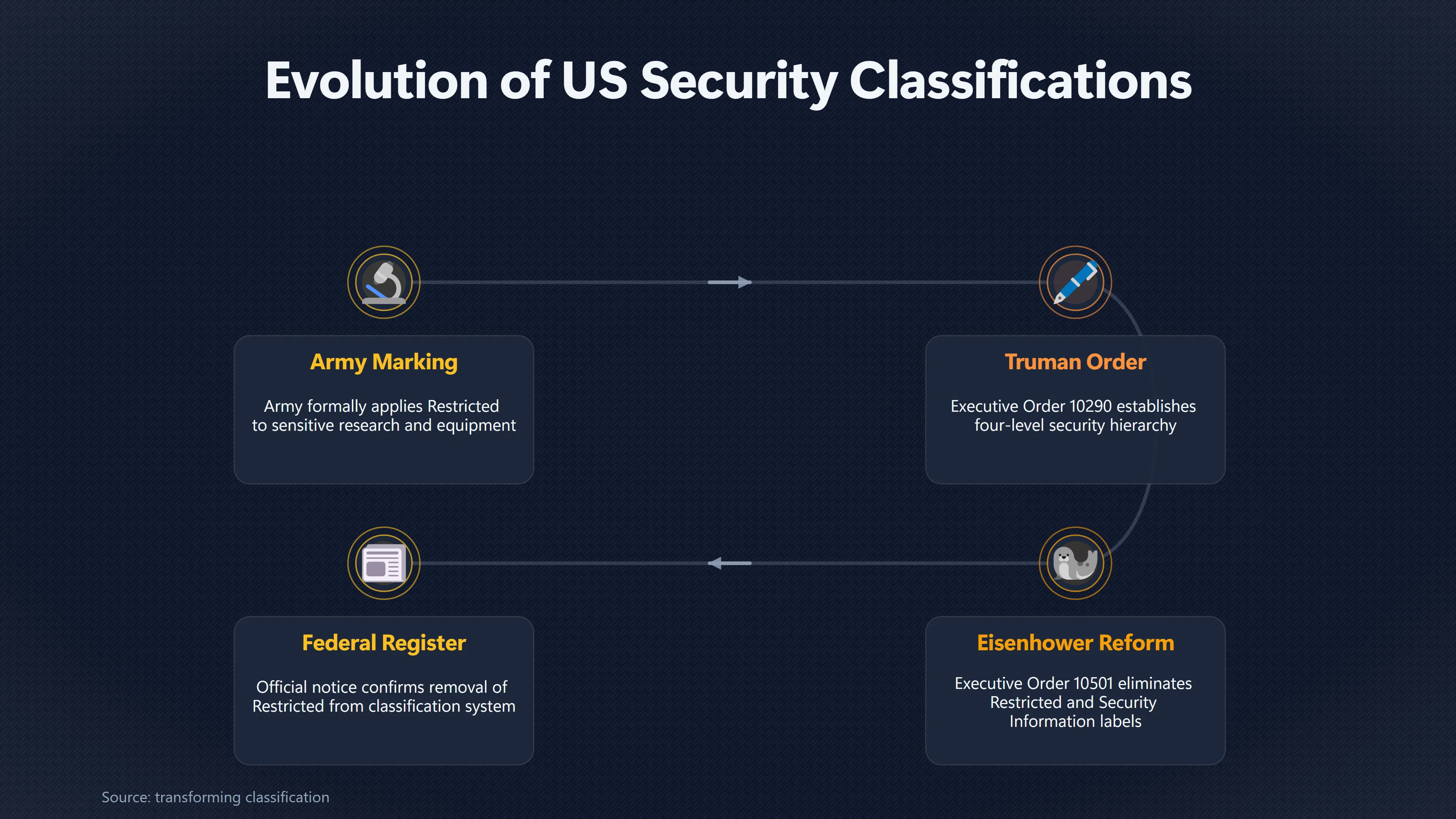
The immediate predecessor to Eisenhower’s system was President Harry Truman’s Executive Order 10290 of 24 September 1951. It established four categories of classified security information, in descending order: Top Secret, Secret, Confidential and Restricted. Classified material was additionally to be identified as “Security Information”.[Truman Library]trumanlibrary.govTruman LibraryStatement by the President Upon Signing Executive Order Prescribing Regulations for Classifying and Protecting Security Inf…
Restricted therefore had a precise place in the hierarchy. Executive Order 10290 assigned it to information whose connection with national security required protection against unauthorised use or disclosure, particularly material that ought to be limited to official use. Handling rules reflected its relatively low position: Restricted material sent outside an agency needed a sealed wrapper or envelope, for example, but unlike higher classifications it did not require a receipt.[The American Presidency Project]presidency.ucsb.eduThe American Presidency ProjectExecutive Order 10290—Prescribing Regulations Establishing Minimum Standards for the Classification, Trans…
The category was older than Truman’s 1951 order. A historical study of US classification practices by classification specialist Arvin S. Quist traces the Army’s formal “Restricted” marking to 1935, when it was applied particularly to sensitive research, equipment and technical information. The important point for the MJ-12 question is therefore not that “Restricted” sounds historically implausible. Quite the opposite: by the early 1950s it had considerable bureaucratic history behind it.[FAS Project on Government Secrecy]sgp.fas.orgFAS Project on Government SecrecySecurity Classification of Information, volume 1 (Quist), Chapter Two…
That history helps explain why a marking containing words such as “TOP SECRET”, “RESTRICTED” and “SECURITY INFORMATION” can look convincingly period-like. Under the 1951 rules, both “Restricted” and “Security Information” belonged to the official vocabulary. The difficulty arises when terminology appropriate to that system appears on a document supposedly produced after its replacement.
What changed in December 1953
Eisenhower signed Executive Order 10501 on 5 November 1953, with the new rules taking effect on 15 December. Section 1 made the central change explicit: defence information requiring classification was to be confined to Top Secret, Secret or Confidential, and “no other designation” could be used for that purpose except where expressly provided by statute.[The American Presidency Project]presidency.ucsb.eduThe American Presidency ProjectExecutive Order 10501—Safeguarding Official Information in the Interests of the Defense of the United Stat…
The reform did more than quietly omit Restricted from a list. Contemporary government records show officials interpreting the order as an affirmative elimination of the old category. A surviving implementation document reproduced by the National Archives states that the President had eliminated both the use of the “RESTRICTED” classification and the “SECURITY INFORMATION” notation, effective 15 December 1953.[National Archives]archives.govtransforming classificationNational ArchivesTRANSFORMINGMarch 26, 2026…
That second change is especially relevant to the MJ-12 wording. Under Truman’s Executive Order 10290, classified material had been specifically identified as “Security Information”. Eisenhower’s order shifted the terminology towards “defense information” and abandoned the requirement for that accompanying label. Quist’s history of the classification system identifies both changes: EO 10501 eliminated Restricted and replaced the previous four-level structure with the three classifications that remained standard thereafter.[Truman Library]trumanlibrary.govexecutive order 10290Truman LibraryEXECUTIVE ORDER 10290 | Harry S. TrumanSeptember 24, 1951…
The transition also produced real administrative difficulties, which confirms that the disappearance of Restricted was not merely theoretical. In November 1953, CIA records discussing the forthcoming order reported that the Army was troubled by the omission and was expected to argue for Restricted to be restored. Many Army training and technical manuals were then Restricted: officials believed they did not justify upgrading to Confidential, but did not want them made freely public either. Raising them to Confidential would also impose additional storage, accountability and destruction requirements. Industrial-security arrangements involving large numbers of contracts posed another problem.[CIA]cia.govCONSIDERATION BY IAC ON TUESDAY, 24 NOVEMBER 1953, OF EXECUTIVE ORDER NO. 10501 | CIA FOIA (foia.cia.gov)…
This contemporary debate is useful authentication evidence because it establishes a bureaucratic transition happening at exactly the relevant moment. Officials were not casually continuing to treat Restricted as a fourth ordinary classification. They were confronting the consequences of its removal.
The change also reached formal government contracting practice. A May 1954 Federal Register notice amended military-security requirements specifically to conform to Executive Order 10501 and the Department of Defense implementing directive, stating that those measures had eliminated “Restricted” from the classification system. That notice appeared roughly two months before the date on the alleged Cutler–Twining memorandum.[Wikimedia Commons]upload.wikimedia.orgOpen source on wikimedia.org.
“Restricted Data” was a different category
One qualification is essential. Eisenhower’s order did not make every appearance of the word “restricted” after December 1953 impossible. Most importantly, Restricted Data survived as a statutory term for protected atomic-energy information.
The distinction already existed under Truman. Executive Order 10290 expressly warned that its classification “Restricted” was not to be confused with “Restricted Data” under the Atomic Energy Act. Restricted Data covered specified information concerning atomic weapons, fissile material and atomic-energy production and operated under statutory authority rather than simply as the bottom rung of the executive classification ladder.[Truman Library]trumanlibrary.govexecutive order 10290Truman LibraryEXECUTIVE ORDER 10290 | Harry S. TrumanSeptember 24, 1951…
That distinction continued after 1953. Restricted Data could coexist with an ordinary classification level: nuclear material might, for example, carry a Top Secret, Secret or Confidential level while also being identified as Restricted Data. Government guidance continues to distinguish RD from ordinary national-security classification for precisely this reason.[Department of Justice]justice.govOpen source on justice.gov.
Consequently, a sound authenticity argument cannot be reduced to “the word Restricted could never appear after 1953”. It could. The narrower and much stronger proposition is that Restricted had ceased to be an ordinary fourth defence-classification level. A genuine post-December-1953 document would need some other historically appropriate explanation for the term, such as a statutory Restricted Data marking, rather than simply reproducing the superseded classification vocabulary.
Why a July 1954 marking draws scrutiny
This chronology places the alleged Cutler–Twining memorandum on the wrong side of a unusually clear administrative boundary. The memorandum is dated 14 July 1954, approximately seven months after Executive Order 10501 became effective. The National Archives says the document refers to an “NSC/MJ-12 Special Studies Project” and records several difficulties discovered when archivists investigated it.[National Archives]archives.govNational Archives Project BLUE BOOKNational Archives Project BLUE BOOK
Among those problems was its security marking. According to the National Archives, the National Security Council’s Freedom of Information Office reported that “Top Secret Restricted Information” did not come into use at the NSC until the Nixon administration. The Eisenhower Presidential Library likewise reported that this particular marking was not used during Eisenhower’s presidency.[National Archives]archives.govNational Archives Project BLUE BOOKNational Archives Project BLUE BOOK
There are therefore two related but distinct historical tests.
First is the government-wide classification rule. By July 1954, Restricted was no longer one of the normal classifications authorised by Executive Order 10501. Contemporary implementation material confirms that agencies regarded it as eliminated, rather than merely renamed or discouraged.[ucsb.edu]presidency.ucsb.eduThe American Presidency ProjectExecutive Order 10501—Safeguarding Official Information in the Interests of the Defense of the United Stat…
Second is the office-specific practice identified by archivists. Even where individual words might have other meanings, the National Archives’ enquiries found that the particular combined marking attributed to the Cutler–Twining document was not an Eisenhower-era NSC convention.[National Archives]archives.govNational Archives Project BLUE BOOKNational Archives Project BLUE BOOK
Those tests reinforce each other. The problem is not simply that somebody typed an obsolete word. The disputed document appears to combine elements strongly associated with the previous classification regime — including “Restricted” and “Security Information” — on an NSC-related memorandum supposedly produced after that regime had been formally superseded.

What the anomaly can and cannot prove
The Restricted problem is strong evidence for scrutiny, but it should not be made to carry more weight than it can support. Old terminology sometimes survives administrative reforms. Existing forms, stamps, manuals and documents do not disappear overnight, and historical records can retain obsolete markings because they were created under earlier rules. The Army’s November 1953 complaints themselves demonstrate how much pre-existing Restricted material agencies had to manage.[CIA]cia.govCONSIDERATION BY IAC ON TUESDAY, 24 NOVEMBER 1953, OF EXECUTIVE ORDER NO. 10501 | CIA FOIA (foia.cia.gov)…
That explanation is much less straightforward for a newly created July 1954 memorandum, however. By then the replacement system had been effective for seven months, Department of Defense rules had implemented it, and government regulations were being revised explicitly because Restricted had been eliminated.[National Archives]archives.govtransforming classificationNational ArchivesTRANSFORMINGMarch 26, 2026…
Nor does the existence of Restricted Data automatically solve the problem. Restricted Data was a specialised statutory category, not the continuation of the old Restricted classification. The Truman-era order itself made that distinction explicit, and later federal guidance continues to treat Restricted Data as a category that accompanies an actual classification level rather than replacing one.[Truman Library]trumanlibrary.govexecutive order 10290Truman LibraryEXECUTIVE ORDER 10290 | Harry S. TrumanSeptember 24, 1951…
For the alleged MJ-12 memorandum, then, the historically significant date is 15 December 1953. Before it, “Restricted” plus “Security Information” belonged naturally to the federal classification vocabulary. After it, ordinary defence classification was supposed to use Top Secret, Secret or Confidential, while genuinely specialised uses such as Restricted Data remained separate. A purported July 1954 NSC document displaying the older vocabulary therefore carries a genuine period-authenticity anomaly.
That anomaly does not, by itself, prove who produced the Cutler–Twining memorandum or when. But it changes the evidential question in an important way. Rather than asking whether “Restricted” existed somewhere in US government security practice, the relevant test is whether this particular use of Restricted fits the rules and documented NSC practice in force on 14 July 1954. On the available official record, that fit is poor.[National Archives]archives.govNational Archives Project BLUE BOOKNational Archives Project BLUE BOOK
Amazon book picks
Further Reading
Books and field guides related to When Did 'Restricted' Stop Being a Classification?. Use these as the next step if you want deeper reading beyond the article.
Top Secret/Majic: Operation Majestic-12 and the United States...
Top Secret/Majic is the result of nuclear physicist and renowned UFO investigator Stanton T. Friedman's twenty-one year search for the tr...

Secrecy: The American Experience
Senator Daniel Patrick Moynihan, the late senior U.S. Senator from N.Y., here presents an eloquent & fascinating account of the developme...
UFOs and Government: A Historical Inquiry
Governments around the world have had to deal with the UFO phenomenon for a good part of a century. How and why they did so is the subjec...
The UFO Files: The Inside Story of Real-life Sightings
'What does all this stuff about flying saucers amount to? What can it mean? What is the truth?' Winston Churchill, prime minister's perso...
eBay marketplace picks
Marketplace Samples
Live-tested eBay searches with available results related to this page.
Selected fromUFO patch oneBay.co.uk.



Endnotes
1.
Source: sgp.fas.org
Link:https://sgp.fas.org/library/quist/chap_3.html
Source snippet
FAS Project on Government SecrecySecurity Classification of Information, volume 1 (Quist), Chapter Three...
2.
Source: archives.gov
Title: transforming classification
Link:https://www.archives.gov/files/declassification/pidb/recommendations/transforming-classification.pdf
Source snippet
National ArchivesTRANSFORMINGMarch 26, 2026...
Published: March 26, 2026
3.
Source: cia.gov
Link:https://www.cia.gov/readingroom/document/cia-rdp78-04718a000800290034-7
Source snippet
CONSIDERATION BY IAC ON TUESDAY, 24 NOVEMBER 1953, OF EXECUTIVE ORDER NO. 10501 | CIA FOIA (foia.cia.gov)...
Published: NOVEMBER 1953
4.
Source: sgp.fas.org
Link:https://sgp.fas.org/library/quist/chap_2.html
Source snippet
FAS Project on Government SecrecySecurity Classification of Information, volume 1 (Quist), Chapter Two...
5.
Source: upload.wikimedia.org
Link:https://upload.wikimedia.org/wikipedia/commons/d/d2/Federal_Register_1954-05-19-Vol_19_Iss_97%28IA_sim_federal-register-find_1954-05-19_19_97%29.pdf
6.
Source: justice.gov
Link:https://www.justice.gov/archives/open/declassification/declassification-faq
7.
Source: archives.gov
Title: National Archives Project BLUE BOOK
Link:https://www.archives.gov/research/military/[air-force
8.
Source: archives.gov
Title: Marking | National Archives
Link:https://www.archives.gov/isoo/faqs/marking
9.
Source: archives.gov
Title: e o 13526 and 32 cfr part 2001
Link:https://www.archives.gov/isoo/faqs/e-o-13526-and-32-cfr-part-2001
10.
Source: history.com
Title: top secret classification documents
Link:https://www.history.com/articles/top-secret-classification-documents
11.
Source: irp.fas.org
Link:https://irp.fas.org/offdocs/eo/index.html
12.
Source: archives.gov
Title: isoo implementing directive
Link:https://www.archives.gov/isoo/policy-documents/isoo-implementing-directive.html
13.
Source: cia.gov
Title: NATIONA L SECURITY INFORMATION | CIA FOIA (foia.cia.gov)
Link:https://www.cia.gov/readingroom/document/cia-rdp87b01034r000200050009-9
14.
Source: sgp.fas.org
Link:https://sgp.fas.org/othergov/doe/history.html
15.
Source: irp.fas.org
Link:https://irp.fas.org/doddir/dod/ai26.htm
16.
Source: cia.gov
Title: cia rdp85b00236r000100050002 7
Link:https://www.cia.gov/readingroom/document/cia-rdp85b00236r000100050002-7
17.
Source: archives.gov
Title: Executive Orders | National Archives
Link:https://www.archives.gov/federal-register/codification/executive-order/12356.html
18.
Source: cia.gov
Title: LETTE R TO WILLIAM J. CASEY FROM EDWARD P. BOLAND | CIA FOIA (foia.cia.gov)
Link:https://www.cia.gov/readingroom/document/cia-rdp84b00148r000200570006-7
19.
Source: cia.gov
Title: DRAF T EXECUTIVE ORDER RESPONSIVE TO PRM-29 | CIA FOIA (foia.cia.gov)
Link:https://www.cia.gov/readingroom/document/cia-rdp82m00591r000500030011-3
20.
Source: cia.gov
Title: DRAF T EXECUTIVE ORDER RESPONSIVE TO PRM-29 | CIA FOIA (foia.cia.gov)
Link:https://www.cia.gov/readingroom/document/cia-rdp83m00171r002300040004-5
21.
Source: irp.fas.org
Title: appendix c
Link:https://irp.fas.org/doddir/dod/5200-1r/appendix_c.htm
22.
Source: irp.fas.org
Title: chapter 5
Link:https://irp.fas.org/doddir/dod/5200-1r/chapter_5.htm
23.
Source: sgp.fas.org
Title: chap 5
Link:https://sgp.fas.org/library/quist/chap_5.html
24.
Source: cia.gov
Link:https://www.cia.gov/readingroom/docs/CIA-RDP86-00674R000300120010-3.pdf
25.
Source: energy.gov
Link:https://www.energy.gov/ehss/statutes-regulations-and-directives-classification-program
26.
Source: cia.gov
Title: cia rdp82m00097r000300070008 4
Link:https://www.cia.gov/readingroom/document/cia-rdp82m00097r000300070008-4
27.
Source: irp.fas.org
Link:https://irp.fas.org/offdocs/EO10964.htm
28.
Source: cia.gov
Title: cia rdp82m00097r000300070010 1
Link:https://www.cia.gov/readingroom/document/cia-rdp82m00097r000300070010-1
29.
Source: cia.gov
Title: CURREN T INTELLIGENCE WEEKLY | CIA FOIA (foia.cia.gov)
Link:https://www.cia.gov/readingroom/document/cia-rdp79-00927a000200040001-7
30.
Source: cia.gov
Title: NI S COMMITTEE MEETING NO. 158 | CIA FOIA (foia.cia.gov)
Link:https://www.cia.gov/readingroom/document/cia-rdp78-05597a000400030043-3
31.
Source: cia.gov
Title: (UNTITLED) | CIA FOIA (foia.cia.gov)
Link:https://www.cia.gov/readingroom/document/cia-rdp78-04718a000800290037-4
32.
Source: irp.fas.org
Link:https://irp.fas.org/offdocs/eo10501.htm
33.
Source: cia.gov
Link:https://www.cia.gov/readingroom/document/cia-rdp78-04718a000800290033-8
34.
Source: cia.gov
Link:https://www.cia.gov/readingroom/document/cia-rdp78-04718a000800290035-6
35.
Source: archives.gov
Title: Executive Orders | National Archives
Link:https://www.archives.gov/federal-register/codification/executive-order/10450.html
36.
Source: trumanlibrary.gov
Title: executive order 10290
Link:https://www.trumanlibrary.gov/library/executive-orders/10290/executive-order-10290
Source snippet
Truman LibraryEXECUTIVE ORDER 10290 | Harry S. TrumanSeptember 24, 1951...
Published: September 24, 1951
37.
Source: presidency.ucsb.edu
Link:https://www.presidency.ucsb.edu/documents/executive-order-10501-safeguarding-official-information-the-interests-the-defense-the
Source snippet
The American Presidency ProjectExecutive Order 10501—Safeguarding Official Information in the Interests of the Defense of the United Stat...
38.
Source: trumanlibrary.gov
Link:https://www.trumanlibrary.gov/library/public-papers/233/statement-president-upon-signing-executive-order-prescribing-regulations
Source snippet
Truman LibraryStatement by the President Upon Signing Executive Order Prescribing Regulations for Classifying and Protecting Security Inf...
39.
Source: presidency.ucsb.edu
Link:https://www.presidency.ucsb.edu/documents/executive-order-10290-prescribing-regulations-establishing-minimum-standards-for-the
Source snippet
The American Presidency ProjectExecutive Order 10290—Prescribing Regulations Establishing Minimum Standards for the Classification, Trans...
40.
Source: trumanlibrary.gov
Link:https://www.trumanlibrary.gov/library/public-papers?page=48
41.
Source: presidency.ucsb.edu
Link:https://www.presidency.ucsb.edu/documents/executive-order-10964-amendment-executive-order-10501-safeguarding-official-information
42.
Source: en.wikisource.org
Title: Executive Order 10501
Link:https://en.wikisource.org/wiki/Executive_Order_10501
43.
Source: presidency.ucsb.edu
Link:https://www.presidency.ucsb.edu/documents/memorandum-the-executive-order-prescribing-regulations-for-classifying-and-protecting
44.
Source: en.wikisource.org
Title: Executive Order 10290
Link:https://en.wikisource.org/wiki/Executive_Order_10290
Additional References
45.
Source: youtube.com
Title: Top Secret / MAJIC By Stanton T. Friedman
Link:https://www.youtube.com/watch?v=-Je48I-xNjY
Source snippet
Flying Saucers Are Real - Volume 2 | Top Secret Majic | Stanton T. Friedman | Betty Hill | UFOTV...
46.
Source: youtube.com
Title: Flying Saucers Are Real
Link:https://www.youtube.com/watch?v=ZWyV6Go15-c
Source snippet
Karl Pflock - The creation of the MJ-12 documents...
47.
Source: youtube.com
Title: [Stanton Friedman]({{ ‘friedman-s-case/’ | relative_url }}) | Majestic 12, Project Blue Book, Roswell | EODR 38
Link:https://www.youtube.com/watch?v=TU1eq5WK0Tw
Source snippet
"Executive Order 10501" classification Sovereignty and Executive Powers Act...
48.
Source: youtube.com
Title: Karl Pflock discusses The Cutler
Link:https://www.youtube.com/watch?v=I6smHEhd9MI
Source snippet
Top Secret / MAJIC By Stanton T. Friedman - A Detailed Investigation into the MJ-12 UFO Documents...
49.
Source: acquisition.gov
Link:https://www.acquisition.gov/node/62617/printable/print
50.
Source: congress.gov
Link:https://www.congress.gov/event/109th-congress/house-event/LC12556/text
51.
Source: gao.gov
Link:https://www.gao.gov/assets/a250725.html
52.
Source: uscode.house.gov
Link:https://uscode.house.gov/view.xhtml?edition=prelim&path=%2Fprelim%40title42%2Fchapter23%2FdivisionA%2Fsubchapter11
53.
Source: youtube.com
Title: Karl Pflock
Link:https://www.youtube.com/watch?v=8g5tYfcQ9RQ
Source snippet
Stanton Friedman | Majestic 12, Project Blue Book, Roswell | EODR 38...
54.
Source: intelligence.senate.gov
Title: hearings disclosure classified information congress february 4 and 11 1998
Link:https://www.intelligence.senate.gov/1998/02/11/hearings-disclosure-classified-information-congress-february-4-and-11-1998/