Within Cutler Twining
Could Someone Have Planted the Memo in the Files?
Because its route into the files is undocumented, later insertion remains a possible explanation for the memo's otherwise puzzling archival presence.
On this page
- What is known about the memo before its 1985 discovery
- Why the surrounding filing context leaves room for later insertion
- What evidence would distinguish insertion from ordinary archival misfiling
Page outline Jump by section
Introduction
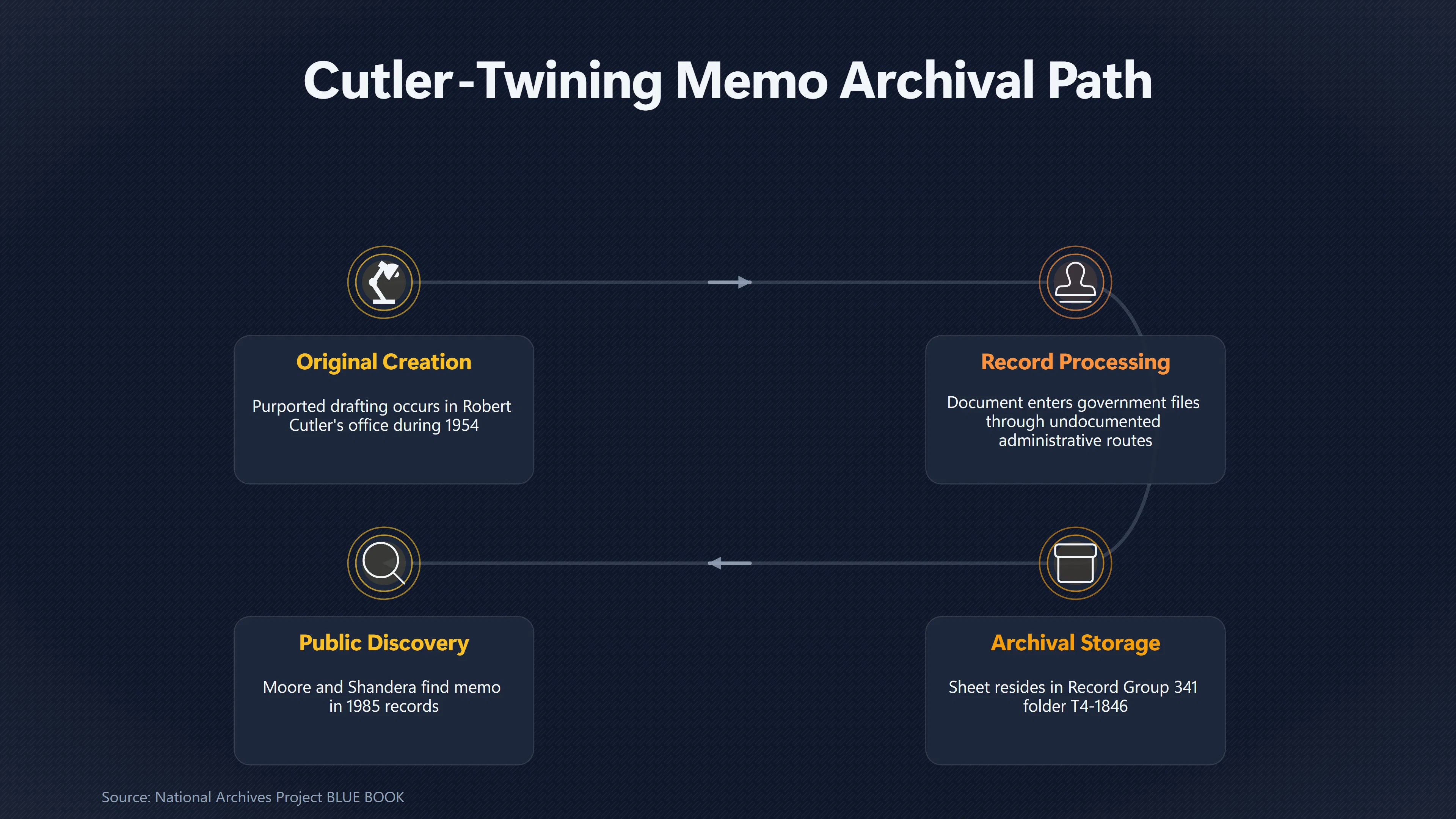
Yes. Later insertion is a plausible explanation for the Cutler-Twining memorandum’s presence in the US National Archives, because the surviving archival evidence establishes where the sheet was found in 1985 but does not establish when or by what route it entered that file. That distinction is crucial. The National Archives and Records Administration (NARA) says the memo was in Record Group 341, Entry 267, folder T4-1846, yet it lacked the Top Secret register number by which that series was organised and had no companion papers about “NSC/MJ-12”. NARA also explicitly warns that custody of a document does not amount to authentication of it.[National Archives]archives.govNational Archives Project BLUE BOOKNational ArchivesProject BLUE BOOK - Unidentified Flying Objects | National Archives…
None of this proves that somebody planted the sheet. Ordinary misfiling, disruption during records processing or another undocumented administrative route remain possibilities. But because the document does not sit naturally within its archival context, its discovery cannot by itself supply the continuous provenance that the other alleged MJ-12 documents conspicuously lack.
What is known before the 1985 discovery?
The firm evidential starting point is surprisingly late. William Moore and Jaime Shandera reported finding the Cutler-Twining memo among recently declassified Air Force records in 1985. Accounts associated with MJ-12 advocate Stanton Friedman identify the location as Box 189 of Entry 267, Record Group 341.[The Black Vault]theblackvault.comThe Black Vault Update on Operation Majestic 12 DocumentsThe Black VaultUpdate on Operation Majestic 12 Documents - The Black Vault Case FilesJanuary 17, 2024… The important limitation is that the available evidence does not provide a documented item-level trail taking this particular sheet backwards from that discovery to Robert Cutler’s office in 1954.
That gap matters because archival provenance has a more demanding meaning than mere physical location. NARA defines provenance in part as information about the “chain of ownership and custody” of records, while its guidance on custodial history specifically notes that breaks in government chain of custody can affect assessments of authenticity and integrity.[National Archives]archives.govNational ArchivesArchives and Records Management Resources | National ArchivesAugust 15, 2016… In other words, finding a paper in a federal records box establishes a fact about custody at the time it was encountered; it does not automatically establish the circumstances of the paper’s creation or its entire journey into that box.
NARA’s own MJ-12 reference report carefully preserves that distinction. It identifies the Cutler-Twining memorandum as the exceptional MJ-12-related item found in its holdings, but after detailing numerous problems states that when NARA certifies a copy it is certifying that the reproduction matches a document in its custody: “We do not authenticate documents or the information contained in a document.”[National Archives]archives.govNational Archives Project BLUE BOOKNational ArchivesProject BLUE BOOK - Unidentified Flying Objects | National Archives…
There is therefore no secure basis for saying simply that the memo “had been in government files since 1954”. What can safely be said is narrower: the physical sheet was present in the archival material when Moore and Shandera encountered it in 1985. The publicly available record cited by NARA does not establish the date on which that individual sheet entered folder T4-1846.
Why the filing context leaves room for later insertion
The insertion hypothesis derives most of its force from the relationship between the memo and its surroundings. Archives are not normally treated as miscellaneous collections of interesting pieces of paper. Federal records are preserved according to provenance and, where possible, their original filing order because those relationships help show how an agency created, received and used its records. NARA’s archival guidance explains that the context of documents is part of their evidential significance: records arbitrarily removed from that context can lose information about their origins and administrative relationships.[National Archives]archives.govNational ArchivesArchives and Records Management Resources | National ArchivesAugust 15, 2016…
Against that standard, the Cutler-Twining memo is conspicuously awkward.[luforu.org]luforu.orgCutler-Twining memoCutler-Twining memo
NARA reports that Entry 267 was filed according to Top Secret register numbers, but the memo has no such register number. It was nevertheless sitting in folder T4-1846. No other document in that folder mentions “NSC/MJ-12”. Searches by National Archives staff through records of the Secretary of Defense, Joint Chiefs of Staff, Headquarters US Air Force and related holdings found no further documentation on the purported project, while inquiries to the Air Force, Joint Chiefs and National Security Council likewise produced nothing corroborating it.[National Archives]archives.govNational Archives Project BLUE BOOKNational ArchivesProject BLUE BOOK - Unidentified Flying Objects | National Archives…
This does not mathematically prove insertion. Real archives contain misplaced papers, incomplete files and records separated from their original companions. NARA’s own historical guidance acknowledges that original order can be disturbed or lost and that archivists sometimes have to reconstruct it.[National Archives]archives.govNational ArchivesArchives and Records Management Resources | National ArchivesAugust 15, 2016… The relevant point is instead comparative: an ordinary, correctly filed classified memorandum should normally have some intelligible relationship to the recordkeeping system around it. The Cutler-Twining sheet has unusually little.
Its isolation becomes more consequential because the document itself contains anomalies. NARA found that its “Top Secret Restricted Information” marking was not used by the National Security Council until the Nixon era; its paper and format did not correspond straightforwardly with the representative Cutler material examined by the Eisenhower Library; and Cutler was visiting military installations in Europe and North Africa from 3 to 15 July 1954, encompassing the memorandum’s purported date of 14 July. NARA noted that Cutler had left instructions for James S. Lay and J. Patrick Coyne to handle NSC administrative matters during his absence.[National Archives]archives.govNational Archives Project BLUE BOOKNational ArchivesProject BLUE BOOK - Unidentified Flying Objects | National Archives…
Those issues concern authenticity rather than insertion directly, but they change the significance of the filing anomaly. If a document fits its originating office, its filing system and corroborating records, accidental misplacement is an economical explanation for an odd location. If the document is independently problematic and lacks that administrative footprint, later insertion becomes a more serious competing explanation.
How could an insertion have happened?
“Planted in the archives” is sometimes treated as though it necessarily means Moore or Shandera secretly carried a forged page into a reading room immediately before its discovery. That is only one possible mechanism, and the surviving evidence does not justify identifying a particular planter.
The broader hypothesis is simply that the sheet joined the record group after the historical files had been created. Several points in a record’s later life could theoretically permit that: agency handling before archival transfer, records processing, classification or declassification review, rearrangement, or researcher access. The relevant question is therefore not merely whether researchers were supposed to bring loose papers into an archives reading room, but whether the item’s history can exclude all later routes into the folder.
Modern NARA research-room rules illustrate why direct researcher planting would not be a trivial operation. Researchers must identify themselves; personal notes and property can be inspected; approved notes brought into research rooms are marked by staff; and researchers are prohibited from entering stacks and records-holding areas.[National Archives]archives.govNational Archives Research Room Rules | National ArchivesNational ArchivesResearch Room Rules | National ArchivesApril 7, 2026… Those current procedures should not simply be projected backwards unchanged onto the Suitland facility in 1985, however. They show how archives try to protect record integrity, not precisely what every control was when Moore and Shandera conducted their search.
Accounts from the MJ-12 dispute themselves are contradictory on this point. Friedman argued that the records were undergoing classification review and that numerous personnel involved in that work had access to the material, making an insider or processing-stage insertion conceivable even if ordinary researcher controls were strong. His published notes also say that the review teams could bring notes, files and briefcases into their work area.[luforu.org]luforu.orgCutler-Twining memoCutler-Twining memo Critics, meanwhile, have argued that a sufficiently small folded sheet could have been introduced during researcher access and have pointed to the memo’s reported discovery outside its expected filing context.[The UFO Chronicles]theufochronicles.comJune 29, 2014… Neither account establishes who, if anyone, inserted it.
That distinction prevents the archival argument from becoming circular. An anomalous location is evidence that deserves explanation; it is not evidence identifying a culprit. The strongest form of the later-insertion hypothesis is consequently modest: some undocumented opportunity existed between the supposed creation of the memo in 1954 and its reported discovery in 1985, and the surviving public record does not close that gap.
The mysterious route to Box 189
One circumstance makes the possibility of deliberate insertion particularly difficult to dismiss, although it must be handled cautiously. Accounts of the discovery say that Moore and Shandera had received cryptic postcards before locating the memo. One reportedly carried a return address involving “Box 189” and another referred to “Suitland” and “Reese’s Pieces”; Suitland was associated with the National Archives facility and Edward Reese was an archivist connected with the records. The memo was subsequently reported found in Box 189.[crystalinks.com]crystalinks.comMajestic 12, Project Grudge, Project Bluebook, Trilateral CommissionCrystalinks…
If those messages genuinely preceded the discovery and were intended as directions, they raise an obvious question: how could an unknown correspondent know that an MJ-12-related sheet was waiting in that particular archival material? One possibility is innocent prior knowledge of a genuine record. Another is that whoever supplied the clues knew where a document had recently been placed.
The postcards do not prove planting. Their provenance is itself disputed, and later retellings vary in detail. They therefore cannot bear the weight of identifying an insertion mechanism or perpetrator. Their narrower significance is that the discovery was not entirely devoid of external prompting. That makes a documented pre-1985 history for the physical memo especially valuable — and its absence especially frustrating.
Misfiling and planting make different predictions
The central problem can be tested conceptually by asking what evidence each explanation should tend to leave behind.
Ordinary archival misfiling would be strengthened by evidence that the memo had an independent government history before reaching folder T4-1846: an accession inventory mentioning it, an earlier box or folder listing, a Top Secret control entry, a routing record, a recipient’s copy, a cross-reference, an agency transfer list, a dated archival processing notation or an independently preserved duplicate in another government collection.
Later insertion would become stronger if researchers could establish that an earlier inventory or examination of the same folder omitted the sheet, that the folder had been processed before the memo appeared, that physical features reflected handling inconsistent with neighbouring records, or that a particular person had both access to the records and prior knowledge of the precise discovery location.
At present, the strongest official evidence falls between those outcomes. NARA confirms the anomalous filing context and the failure of extensive searches to find supporting records, but its published reference report does not document an earlier inspection proving that the memo was absent from T4-1846 at a particular date.[National Archives]archives.govNational Archives Project BLUE BOOKNational ArchivesProject BLUE BOOK - Unidentified Flying Objects | National Archives… Without such a before-and-after record, “it was inserted” remains an inference rather than a demonstrated event.
Physical examination could also help, although old paper alone cannot establish provenance. Material associated with Moore’s files records enquiries suggesting that Fox River “Dictation Onionskin” paper of the relevant kind had existed from the 1950s into the 1970s.[projectaquarius.mufon.com]projectaquarius.mufon.comCUTLER TWINNING MEMOCUTLER TWINNING MEMO Period-compatible stationery therefore cannot tell investigators whether typing occurred in 1954 or whether old stock was used later. Conversely, paper inconsistent with the claimed date could be powerful negative evidence. Physical authenticity and archival provenance are related questions, but they are not interchangeable.
What would settle the archival question?
The most valuable evidence would be documentation that fixes the sheet’s presence in the federal files before the MJ-12 controversy began. A contemporaneous 1950s register entry would be especially strong because Entry 267 was itself organised around Top Secret register numbers. An accession or processing record establishing that the individual memo was already in folder T4-1846 before researchers gained access would also sharply weaken the planting hypothesis.
The inverse would be nearly as informative. If a reliable item-level inspection, preservation record, microfilm image or inventory showed the relevant folder without the memo shortly before 1985, then its later appearance would require explanation. The narrower the time window, the easier it would become to identify who had legitimate access during it.
This is why the document’s location cannot do all the authentication work sometimes assigned to it. Archival practice treats relationships between records as evidence: records are normally intelligible because they retain connections to the agencies, transactions and filing systems that produced them.[National Archives]archives.govNational ArchivesArchives and Records Management Resources | National ArchivesAugust 15, 2016… The Cutler-Twining memo has a known discovery location but an uncertain route to that location.
Where the insertion hypothesis stands
There is no publicly established proof that Moore, Shandera, an archivist, a declassification worker or anyone else planted the Cutler-Twining memorandum. Naming a culprit goes beyond the evidence. But the opposite claim — that discovery at the National Archives proves the sheet had followed an authentic government chain of custody from 1954 — also goes beyond what the archival record supports.
NARA’s findings leave three facts in tension: the sheet was genuinely present in federal archival holdings when discovered; it did not conform neatly to the filing system of the series containing it; and searches failed to uncover the supporting administrative trail that might explain how an authentic memorandum concerning “NSC/MJ-12” reached that location.[National Archives]archives.govNational Archives Project BLUE BOOKNational ArchivesProject BLUE BOOK - Unidentified Flying Objects | National Archives…
Later insertion therefore remains a viable mechanism, not an established historical fact. Ordinary misfiling or some undocumented records-processing event could also account for the anomalous placement. The decisive missing evidence is a trustworthy chain of custody for the individual sheet before 1985. Until such evidence is produced, “found in the National Archives” establishes where the Cutler-Twining memo surfaced — not when it entered the files, who put it there, or whether its archival presence originated in 1954.
Amazon book picks
Further Reading
Books and field guides related to Could Someone Have Planted the Memo in the Files?. Use these as the next step if you want deeper reading beyond the article.
Top Secret/Majic
Top Secret/Majic is the result of nuclear physicist and renowned UFO investigator Stanton T. Friedman's twenty-one year search for the tr...
Archives: Principles and Practices
This new and extensively revised second edition offers an international perspective on archives management, providing authoritative guida...
Managing Archives: Foundations, Principles and Practice
Managing Archives provides a practical guide to archives management. It has three main target audiences: those who have been tasked by th...
eBay marketplace picks
Marketplace Samples
Live-tested eBay searches with available results related to this page.
Selected fromUFO poster oneBay.co.uk.




Endnotes
1.
Source: archives.gov
Title: National Archives Project BLUE BOOK
Link:https://www.archives.gov/research/military/air-force/ufos
Source snippet
National ArchivesProject BLUE BOOK - Unidentified Flying Objects | National Archives...
2.
Source: luforu.org
Title: Cutler-Twining memo
Link:https://luforu.org/cutler-twining-memo/
3.
Source: archives.gov
Link:https://www.archives.gov/research/alic/reference/archives-resources/terminology.html
Source snippet
National ArchivesArchives and Records Management Resources | National ArchivesAugust 15, 2016...
Published: August 15, 2016
4.
Source: archives.gov
Title: National Archives Custodial History Note | National Archives
Link:https://www.archives.gov/research/catalog/lcdrg/elements/custodial-history-note
5.
Source: archives.gov
Link:https://www.archives.gov/research/alic/reference/archives-resources/principles-of-arrangement.html
Source snippet
National ArchivesArchives and Records Management Resources | National ArchivesAugust 15, 2016...
Published: August 15, 2016
6.
Source: archives.gov
Link:https://www.archives.gov/research/alic/reference/archives-resources/archival-arrangement.html
7.
Source: archives.gov
Title: National Archives Research Room Rules | National Archives
Link:https://www.archives.gov/research/research-room-rules
Source snippet
National ArchivesResearch Room Rules | National ArchivesApril 7, 2026...
Published: April 7, 2026
8.
Source: crystalinks.com
Title: Majestic 12, Project Grudge, Project Bluebook, Trilateral Commission
Link:https://www.crystalinks.com/mj12.html
Source snippet
Crystalinks...
9.
Source: projectaquarius.mufon.com
Title: CUTLER TWINNING MEMO
Link:https://projectaquarius.mufon.com/wp-content/uploads/pcg-bill-moore-files-collection/CUTLER-TWINNING-MEMO.pdf
10.
Source: archives.gov
Title: National Archives Record Group Concept | National Archives
Link:https://www.archives.gov/research/guide-fed-records/index-numeric/concept.html
11.
Source: archives.gov
Title: Access to National Archives Facilities
Link:https://www.archives.gov/locations/building-access-security-requirements
12.
Source: archives.gov
Title: Arrangement | National Archives
Link:https://www.archives.gov/research/catalog/lcdrg/elements/arrangement
13.
Source: archives.gov
Title: Getting Started Overview | National Archives
Link:https://www.archives.gov/research/start
14.
Source: archives.gov
Link:https://www.archives.gov/dc/researcher-info
15.
Source: archives.gov
Title: Information for Researchers | National Archives
Link:https://www.archives.gov/college-park/researcher-info
16.
Source: archives.gov
Title: Archival Materials and Related Elements | National Archives
Link:https://www.archives.gov/research/catalog/lcdrg/archival-materials
17.
Source: archives.gov
Title: Plan Your Research Visit | National Archives
Link:https://www.archives.gov/research/start/plan-your-visit
18.
Source: archives.gov
Title: FA Qs | National Archives
Link:https://www.archives.gov/research/start/faqs.html
19.
Source: archives.gov
Link:https://www.archives.gov/research/guide-fed-records
20.
Source: archives.gov
Title: Research Room Guidance | National Archives
Link:https://www.archives.gov/research/research-room-guidance
21.
Source: archives.gov
Title: Researcher Identification Card Requirements | National Archives
Link:https://www.archives.gov/research/start/researcher-card
22.
Source: archives.gov
Title: Research at the National Archives by People Under Age 18 | National Archives
Link:https://www.archives.gov/research/start/access-by-minors.html
23.
Source: archives.gov
Title: Series Inventory Form
Link:https://www.archives.gov/records-mgmt/scheduling/inventory-form-series-instructions
24.
Source: archives.gov
Title: Research Room Rules | National Archives
Link:https://www.archives.gov/research/notices/2018-research-room-rules
25.
Source: archives.gov
Title: Textual Archives Services | National Archives
Link:https://www.archives.gov/research/order/textual-records-dc.html
26.
Source: archives.gov
Title: Finding Aids: General Information Leaflet 71 | National Archives
Link:https://www.archives.gov/publications/general-info-leaflets/71-06-dc-area-records.html
27.
Source: archives.gov
Title: How Records are Grouped | National Archives
Link:https://www.archives.gov/research/start/how-records-grouped.html
28.
Source: archives.gov
Title: Art Provenance and Claims Records and Research | National Archives
Link:https://www.archives.gov/research/holocaust/art/key-series-descriptions/key-series-descriptions-05.html
29.
Source: archives.gov
Link:https://www.archives.gov/publications/general-info-leaflets/57-research-room-guidelines.html
30.
Source: archives.gov
Link:https://www.archives.gov/findingaid/record-group-explorer
31.
Source: archives.gov
Title: poh logical order
Link:https://www.archives.gov/publications/prologue/2013/summer/poh-logical-order
32.
Source: theblackvault.com
Title: The Black Vault Update on Operation Majestic 12 Documents
Link:https://www.theblackvault.com/casefiles/update-on-operation-majestic-12-documents/
Source snippet
The Black VaultUpdate on Operation Majestic 12 Documents - The Black Vault Case FilesJanuary 17, 2024...
Published: January 17, 2024
33.
Source: theufochronicles.com
Link:https://www.theufochronicles.com/2014/06/appendix-the-myth-of-mj-12-annotated.html
Source snippet
June 29, 2014...
Published: June 29, 2014
34.
Source: theufochronicles.com
Title: The UFO Chronicles The Myth of MJ-12: Appendix A –Pt 2
Link:https://www.theufochronicles.com/2014/06/the-myth-of-mj-12-appendix-pt-2.html
35.
Source: wikidisc.org
Title: Majestic 12 documents | Wiki Disc
Link:https://www.wikidisc.org/wiki/Majestic_12_documents
36.
Source: medium.com
Link:https://medium.com/stanton-friedmans-articles/update-on-operation-majestic-12-documents-ed2df58fd8a1
37.
Source: odla.fr
Title: MAJESTI C 12
Link:https://www.odla.fr/2021/10/07/majestic-12/
38.
Source: theufochronicles.com
Title: The Majestic Documents: A Forensic Linguistic Report (Pt 1)
Link:https://www.theufochronicles.com/2014/11/the-majestic-documents-forensic.html?showComment=1415301297753
39.
Source: lurch2.blogspot.com
Title: majestic 12
Link:https://lurch2.blogspot.com/2013/09/majestic-12.html
40.
Source: theufochronicles.com
Title: UF O Debunkers: Irrational, Uninformed and Ignorant
Link:https://www.theufochronicles.com/2012/03/debunkers-irrational-uninformed-and.html
41.
Source: scribd.com
Title: Majestic 12
Link:https://www.scribd.com/document/1606041/Majestic-12
42.
Source: noufors.com
Title: majestic 12
Link:https://noufors.com/majestic-12.htm
43.
Source: internationalflyingsaucerbureau.com
Title: Majestic 12
Link:https://www.internationalflyingsaucerbureau.com/majestic-12/
44.
Source: nationalarchives.gov.uk
Title: Free online records: digital microfilm
Link:https://www.nationalarchives.gov.uk/help-with-your-research/research-guides/free-online-records-digital-microfilm
45.
Source: naa.gov.au
Link:https://www.naa.gov.au/about-us/our-services/providing-access-original-records/official-access
46.
Source: Wikipedia
Title: Majestic 12
Link:https://en.wikipedia.org/wiki/Majestic_12
47.
Source: col2.com
Title: operation majestic 12
Link:https://www.col2.com/operation-majestic-12
48.
Source: fieldreportarchive.com
Link:https://fieldreportarchive.com/case?id=majestic_12
Additional References
49.
Source: youtube.com
Link:https://www.youtube.com/watch?v=ogJplVuElLs
Source snippet
Cutler Twining memo Majestic 12 Ep 020: A Full Reading of the MJ-12 Eisenhower Briefing Document...
50.
Source: youtube.com
Title: The Majestic Documents. Ryan Wood on the Richard Dolan Show
Link:https://www.youtube.com/watch?v=s_ymJcmeEDc
Source snippet
Grant Cameron on Stanton Friedman, MJ-12, Bob Lazar & TTSA...
Published: June 10, 2019
51.
Source: youtube.com
Title: The Majestic-12 Documents [With Ryan S. Wood]
Link:https://www.youtube.com/watch?v=vzB87RJkQVU
Source snippet
The Majestic Documents. Ryan Wood on the Richard Dolan Show. June 10, 2019...
Published: June 10, 2019
52.
Source: youtube.com
Title: Majestic 12: A UFO Disinformation Scandal
Link:https://www.youtube.com/watch?v=3mhRLKuJWyg
Source snippet
A secret history: Inside shadow intelligence, the MJ-12 documents | Reality Check...
53.
Source: youtube.com
Title: Grant Cameron on Stanton Friedman, MJ-12, Bob Lazar & TTSA
Link:https://www.youtube.com/watch?v=p0Deurzzx3c
Source snippet
Majestic 12: A UFO Disinformation Scandal...
54.
Source: allinonefilms.com
Link:https://allinonefilms.com/transcripts/friedman.htm
55.
Source: facebook.com
Link:https://www.facebook.com/ScratchWriting/posts/for-those-that-rule-in-majesty-we-bring-the-short-history-of-the-majestic-12-thi/1336411104350450/
56.
Source: medium.com
Link:https://medium.com/stanton-friedmans-articles/book-review-kevin-d-randles-case-mj-12-the-true-story-behind-the-government-s-ufo-conspiracies-9e06f4e82250
57.
Source: uapedia.ai
Link:https://uapedia.ai/wiki/gen-nathan-f-twining-the-mj-12-uap-question/
58.
Source: facebook.com
Link:https://www.facebook.com/groups/Galactic.Hitchhikers/posts/6631783473545736/