Within Majestic 12
Can Typography Date the MJ 12 Documents?
Some typography objections weakened when period government records showed wider formatting variation than critics initially assumed.
On this page
- Common typography objections
- Period examples cited by supporters
- Why type evidence rarely settles provenance
Page outline Jump by section
Introduction
Typography has played an unusually prominent role in arguments over the alleged MJ-12 documents because typewriter output can sometimes expose an anachronism: if a document dated 1947 was demonstrably produced by a typeface or machine introduced years later, its claimed date would be impossible. But the MJ-12 debate also shows the limits of that method. Some early objections assumed that particular White House or National Security Council offices used a much narrower range of typewriter styles than surviving period records actually show.
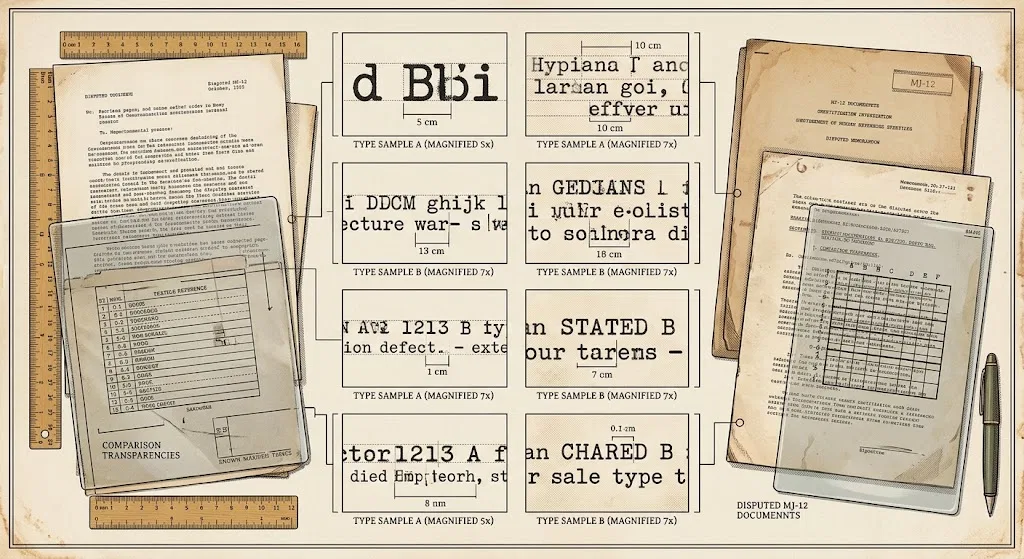
The clearest example is the 1954 Cutler-Twining memorandum. Sceptic Philip J. Klass argued that its larger Pica type was inconsistent with the smaller Elite type he had observed on authentic material from Robert Cutler’s and James Lay’s offices. MJ-12 advocate Stanton Friedman subsequently produced genuine period records using comparable Pica typography, and Klass paid the maximum amount offered in his challenge. That episode weakened a specific typography objection, but it did not authenticate the memorandum. The National Archives still identifies independent archival and administrative anomalies surrounding it.
Common typography objections
The strongest form of a typographical objection is not merely that a document “looks wrong”. It is that some identifiable feature could not have existed when the document was supposedly created. In the MJ-12 controversy, however, several different kinds of claim have sometimes been bundled together: character size, typeface design, typewriter model, spacing, the use of more than one machine, and general office formatting. They have very different evidential weight.
One long-running dispute concerns the alleged 24 September 1947 Truman-to-Forrestal memorandum reproduced with the Eisenhower Briefing Document. Questioned-document examiner Peter Tytell was reported as believing that its typing resembled output from a Corona machine introduced in the 1960s. If that identification were secure, it would be devastating: a 1947 memorandum plainly could not have been typed on a machine first sold in 1963. Sceptical researcher Philip Klass continued to cite Tytell’s conclusion, while acknowledging that another document examiner, James Black, disagreed and attributed the typography to an Underwood style available by about 1940.
That disagreement is important because it changes the argument from a simple chronological impossibility into a contested identification. Friedman stressed that Tytell had not produced a formal written forensic report on the matter and cited Black’s later examination as evidence that the type could be consistent with a pre-war Underwood machine. Friedman therefore argued that the often-repeated claim of a “1963 typeface” had been presented with greater certainty than the underlying evidence justified.
The same Truman memorandum has another typographical curiosity: its date appears not to have been produced entirely in the same typing operation. Critics argued that “September” and the numerical portion of the date showed characteristics of different machines, suggesting construction from separate elements. Klass interpreted this as possible evidence that a forger working decades later had encountered problems with an older typewriter and inserted part of the date using another machine. Friedman instead regarded the presence of more than one typewriter as something that could occur naturally in a working office rather than as proof of fabrication.
The distinction matters. A demonstrably post-1947 typeface would establish an anachronism. Two typewriters on one document would not. It demands an explanation, but both legitimate secretarial work and later document construction can produce mixed typing.
Period examples weakened the Pica objection
The most instructive episode concerns the Cutler-Twining memorandum dated 14 July 1954. Klass initially compared its type with a small collection of genuine correspondence associated with White House National Security Council officials Robert Cutler and James Lay. His examples used Elite type, typically about 12 characters per inch, whereas the disputed memorandum used the larger Pica spacing of roughly 10 characters per inch. He proposed that this discrepancy counted against authenticity.
Klass then made the claim testable. In January 1989 he offered Friedman $100 for each authentic Cutler- or Lay-related White House business letter or memorandum from the relevant period that matched the disputed document’s Pica type, up to $1,000. Surviving correspondence from the dispute records Friedman’s response that genuine files contained a considerably wider mixture of machines and formats than Klass’s original sample suggested.
Friedman produced enough qualifying material for Klass to pay the full $1,000. Klass himself later described the episode under the heading “Friedman Wins $1,000 On Cutler Memo Typeface”. Friedman reported finding more than a dozen matching examples at the Eisenhower Library and repeatedly used the episode to argue that the original objection resulted from extrapolating too much from a small sample of authentic documents.
This is one of the most useful lessons in the entire MJ-12 typography debate. An office did not necessarily possess one standard typewriter or consistently use one character pitch. Mid-century government paperwork was produced by secretaries, assistants and administrative units equipped with multiple machines; documents could consequently vary even when they originated in the same organisational setting. The discovery of genuine Pica examples therefore undermined the proposition that Pica type was itself incompatible with Cutler’s office.
It didnot, however, reverse the evidential burden and prove that the Cutler-Twining memo was genuine. Showing that an authentic 1954 White House documentcouldhave been typed that way establishes compatibility, not identity of origin. A later fabricator could also reproduce a historically available type style.
That distinction is especially important because the National Archives’ reservations about the Cutler-Twining memorandum do not depend on Pica versus Elite typography. The Archives notes that the document was found in a series normally filed by Top Secret register number but bears no such number; it was the only MJ-12 item in its folder; searches of relevant Defence, Joint Chiefs, Air Force and National Security Council files found no supporting records; and Cutler was abroad when the memorandum was dated. The Archives also recorded problems with its security markings, letterhead and watermark.
The Pica episode therefore narrows the case rather than settling it: one once-prominent objection became considerably weaker, while independent provenance and records-management problems remained.
The Truman memo shows why type identification is harder
The 1947 Truman-to-Forrestal memorandum illustrates a second problem: identifying a typewriter from a reproduced document can be far less definitive than identifying an impossible technology.
The core MJ-12 briefing material reached researchers as images on 35 mm film rather than as original sheets available for laboratory examination. That limits what an examiner can establish about impression depth, ribbon characteristics, paper, erasures and other physical features that can distinguish one machine or production process from another. Typography survives reproduction, but some diagnostic details do not.
This helps explain why the dating dispute produced opposing expert assessments. Tytell’s reported view placed the type on a much later Corona machine; Black’s examination, cited by MJ-12 supporters, instead associated it with an Underwood type style available around 1940. Klass himself later said that the expert disagreement warranted another expert examination rather than pretending the question had been resolved.
There is also a difference between identifying atypeface designand identifying thespecific machine that typed a document. Typeface designs could appear across machine families and persist for many years. Wear, alignment defects and repeated individual character abnormalities can sometimes tie text to a particular typewriter, but a broad visual resemblance to a known font does not necessarily provide that level of identification.
Consequently, the most defensible conclusion from this dispute is modest: the claim that the Truman memorandum is typographically impossible for 1947 has itself been contested, and the surviving public record does not provide a universally accepted forensic demonstration resolving the disagreement. That leaves typography as one evidential strand rather than a secure date stamp.
Formatting can be evidence without being proof
Typography also includes more than the shape of letters. Researchers have scrutinised spacing, capitalisation, date placement, headings and the general arrangement of MJ-12 pages because government offices developed recognisable documentary habits.
Such comparisons can be useful, but they are vulnerable to the same sampling problem exposed by the Cutler-Twining Pica dispute. An investigator who examines nine authentic memoranda and finds the same format in all nine has evidence of a practice; they have not necessarily proved an inviolable rule. A larger archive may reveal exceptions caused by different secretaries, temporary staff, replacement machines, drafts, carbon copies or documents prepared elsewhere.
The Cutler-Twining dispute supplies a concrete warning against reasoning from “I have not seen an authentic example” to “no authentic example existed”. Friedman’s archival finds showed that at least one alleged incompatibility with period White House typography arose because the comparison set had been too narrow.
The reverse error is equally possible. Finding one authentic government document with a particular style does not demonstrate that every disputed document using that style is legitimate. Historical compatibility is a necessary test for authenticity, not a sufficient one.
This is why typographical analysis works best through increasingly specific questions:
- Could this type technology have existed on the stated date?A clear “no” is potentially decisive.
- Was this type or spacing actually used in the relevant institution?Period exemplars can strengthen or weaken an objection.
- Was it used by the particular office involved?This is more informative, but office practices can still vary.
- Can distinctive defects identify an individual typewriter?That would be stronger evidence, particularly if supported by original documents rather than reproductions.
- Does the typography fit the document’s provenance and administrative history?Even a perfect typeface match cannot compensate for a document that otherwise appears in the wrong archival context.
That hierarchy explains why some arguments in the MJ-12 controversy have aged better than others.

Why typography rarely settles provenance
Typography is especially good at falsification when it reveals a hard anachronism. The classic hypothetical is straightforward: a document dated 1947 that can conclusively be shown to use technology first manufactured in 1963 cannot be an original 1947 document. But demonstrating mere compatibility works in only one direction. Establishing that an Underwood typeface existed by 1940 tells us that itcouldappear on a 1947 document; it does not tell us who typed the page, where or when.
That asymmetry is crucial to the MJ-12 argument. The Pica evidence substantially weakens the claim that the Cutler-Twining memorandum must be fraudulent because White House officials used only Elite type. The conflicting assessments of the Truman memorandum likewise make sweeping statements that its typeface alone conclusively proves a 1960s manufacture difficult to sustain from the available evidence.
Yet none of those corrections supplies what the MJ-12 documents most lack: secure provenance. The US Government Accountability Office reported in 1995 that the National Archives, Air Force and Information Security Oversight Office knew of MJ-12 chiefly through material supplied by private individuals, and that investigators found no evidence showing that the disputed papers originated within the executive branch. The FBI states that the Air Force investigation of the principal Majestic-12 briefing material determined it to be fake.
The National Archives reaches a similarly cautious position regarding its own role. Although the Cutler-Twining paper was physically found among Air Force records, the Archives expressly says that certification of a copy merely establishes that a document is in its custody; it doesnotauthenticate the document or the information contained in it. Its detailed reference report records the surrounding archival anomalies rather than treating the paper’s presence in a federal folder as proof of origin.
Typography therefore makes its strongest contribution by pruning bad arguments. Period records show that authentic government paperwork was typographically less uniform than some early MJ-12 criticism assumed. That is a genuine point in favour of caution when declaring a document fake solely because its character pitch or office format looks unusual.
But the same caution applies in the opposite direction. A historically plausible typeface cannot authenticate an anonymously photographed document, establish an archival chain of custody, explain anomalous security markings or create corroborating records where none have been found. In the MJ-12 case, typography can rule some claims in or out aspossible. It has not, by itself, established provenance—and provenance remains the more demanding test of authenticity.
Amazon book picks
Further Reading
Books and field guides related to Can Typography Date the MJ 12 Documents?. Use these as the next step if you want deeper reading beyond the article.
Detecting Forgery: Forensic Investigation of Documents
Detecting Forgery reveals the complete arsenal of forensic techniques used to detect forged handwriting and alterations in documents and...
Scientific Examination of Questioned Documents
This guide to all aspects of a questioned document for attorneys, investigators, document examiners, and others covers the scientific exa...
Forensic Document Examination: Principles and Practice
This book introduces the reader to the basic principles of handwriting and the factors that affect their development. The book discusses...
Scientific Examination of Documents: Methods and Techniques
Completely revised and updated to reflect the latest techniques and technological advances, this second edition provides and clear, conci...
eBay marketplace picks
Marketplace Samples
Live-tested eBay searches with available results related to this page.
Selected fromUFO poster oneBay.co.uk.


Endnotes
1.
Source: archives.gov
Title: National Archives Project BLUE BOOK
Link:https://www.archives.gov/research/military/air-force/ufos
Source snippet
National ArchivesProject BLUE BOOK - Unidentified Flying Objects | National Archives...
2.
Source: reaganlibrary.archives.gov
Title: Reagan Library Ronald Reagan Presidential Library
Link:https://reaganlibrary.archives.gov/public/2021-06/40-654-209237726-004-008-2021.pdf
3.
Source: vault.fbi.gov
Title: — Federal Bureau of Investigation
Link:https://vault.fbi.gov/unexplained-phenomenon/search
4.
Source: archives.gov
Title: White House Transition Interviews | National Archives
Link:https://www.archives.gov/presidential-records/support-to-the-white-house/transitions/interviews
5.
Source: archives.gov
Title: decision table fy2016
Link:https://www.archives.gov/declassification/iscap/decision-table-fy2016
6.
Source: archives.gov
Title: Atlanta Federal Penitentiary Index | National Archives
Link:https://www.archives.gov/atlanta/finding-aids/atlanta-penitentiary/inmates-c-d.html
7.
Source: archives.gov
Title: Records of the Army Air Force | National Archives
Link:https://www.archives.gov/fort-worth/finding-aids/rg018-army-air-force.html
8.
Source: archives.gov
Title: Medicine and Public Health | National Archives
Link:https://www.archives.gov/research/health
9.
Source: archives.gov
Title: National Archives Releases John Cutler Papers Online | National Archives
Link:https://www.archives.gov/press/press-releases/2011-170
10.
Source: archives.gov
Title: White House Counsel Transition Interviews | National Archives
Link:https://www.archives.gov/presidential-libraries/research/transition-interviews/counsel.html
11.
Source: archives.gov
Title: Clinton Adminstration Transition Interviews | National Archives
Link:https://www.archives.gov/presidential-libraries/research/transition-interviews/clinton-administration.html
12.
Source: archives.fbi.gov
Title: the fbi and ufos flying flapjacks saucers and saw blades
Link:https://archives.fbi.gov/archives/news/stories/2010/april/ufos_040610/the-fbi-and-ufos-flying-flapjacks-saucers-and-saw-blades
13.
Source: archives.gov
Title: Announces Homecoming of Long-Lost Lincoln Letter | National Archives
Link:https://www.archives.gov/press/press-releases/2009-238
14.
Source: archives.gov
Link:https://www.archives.gov/publications/prologue/1999/fall/roosevelt-family-history
15.
Source: vault.fbi.gov
Link:https://vault.fbi.gov/search?SearchableText=Majestic
16.
Source: vault.fbi.gov
Link:https://vault.fbi.gov/search?SearchableText=Unknown&b_start%3Aint=630
17.
Source: vault.fbi.gov
Title: alphabetical listing collection
Link:https://vault.fbi.gov/alphabetical-listing-collection/?b_start%3Aint=1100
18.
Source: vault.fbi.gov
Link:https://vault.fbi.gov/search?SearchableText=robert&=&b_start%3Aint=750
19.
Source: vault.fbi.gov
Link:https://vault.fbi.gov/search?SearchableText=robert&b_start%3Aint=210
20.
Source: vault.fbi.gov
Link:https://vault.fbi.gov/search?SearchableText=Name
21.
Source: vault.fbi.gov
Link:https://vault.fbi.gov/search?created%3Adate%3Alist=1970%2F02%2F01%3A00%3A00+US%2FEastern&created_usage=range%3Amin&portal_type%3Alist=ATFile&portal_type%3Alist=ATImage&portal_type%3Alist=Document&portal_type%3Alist=Event&portal_type%3Alist=FDPS&portal_type%3Alist=Favorite&portal_type%3Alist=File&portal_type%3Alist=Folder&portal_type%3Alist=Image&portal_type%3Alist=Large+Plone+Folder&portal_type%3Alist=Link&portal_type%3Alist=News+Item&portal_type%3Alist=Topic&pt_toggle=%23&submit=Search
22.
Source: vault.fbi.gov
Link:https://vault.fbi.gov/search?SearchableText=FBI&=&b_start%3Aint=270
23.
Source: vault.fbi.gov
Link:https://vault.fbi.gov/search?SearchableText=blue+book&=&b_start%3Aint=870
24.
Source: vault.fbi.gov
Title: search?SearchableText=robert&b start:int=1740
Link:https://vault.fbi.gov/search%3FSearchableText%3Drobert%26b_start%3Aint%3D1740
25.
Source: archives.gov
Link:https://www.archives.gov/research/guide-fed-records/groups/218.html
26.
Source: archives.gov
Link:https://www.archives.gov/publications/prologue/index/2009.html
27.
Source: youtube.com
Title: UFOs and MJ-12
Link:https://www.youtube.com/watch?v=zHqIXLOqRak
Source snippet
Majestic 12 | Secret Documents Expose UFO Cover-Up Vol. 1...
28.
Source: youtube.com
Title: Majestic 12 | Secret Documents Expose UFO Cover-Up Vol. 1
Link:https://www.youtube.com/watch?v=s9VoC8MoeUs
Source snippet
The MJ-12 Conspiracy Debunked...
29.
Source: odla.fr
Title: MAJESTI C 12
Link:https://www.odla.fr/2021/10/07/majestic-12/
30.
Source: glialienitranoi.it
Title: MAJESTI C 12
Link:https://www.glialienitranoi.it/majestic-12/
31.
Source: ufopedia.it
Title: Majestic 12
Link:https://ufopedia.it/Majestic_12.html
32.
Source: lurch2.blogspot.com
Title: majestic 12
Link:https://lurch2.blogspot.com/2013/09/majestic-12.html
33.
Source: chaindlk.com
Link:https://chaindlk.com/page/1157/?action=edit_event&d=0&m=0&page=calendar&y=0
34.
Source: disclosdex.com
Title: Majestic 12 | Disclosdex
Link:https://disclosdex.com/organizations/majestic-12
Additional References
35.
Source: youtube.com
Title: The Majestic 12 Documents | The Truman Memorandum | A UFO Researcher’s Discovery
Link:https://www.youtube.com/watch?v=5gVxTygJ79E
Source snippet
Stanton Friedman Majestic 12 documents debunks evidence Interview with UFO researcher Stanton Friedman...
36.
Source: youtube.com
Link:https://www.youtube.com/watch?v=ogJplVuElLs
Source snippet
The Majestic 12 Documents | The Truman Memorandum | A UFO Researcher's Discovery...
37.
Source: theblackvault.com
Title: The Black Vault Update on Operation Majestic 12 Documents
Link:https://www.theblackvault.com/casefiles/update-on-operation-majestic-12-documents/
Source snippet
The Black VaultUpdate on Operation Majestic 12 Documents - The Black Vault Case Files...
38.
Source: ufomagazines.com
Title: UFO Magazine Archive JUST CAUSE — Just Cause
Link:https://www.ufomagazines.com/just-cause-new-series-just-cause-1989-09-no-21-new-series/
Source snippet
UFO Magazine ArchiveJUST CAUSE — Just Cause - New Series | UFO Magazine Archive...
39.
Source: gao.gov
Link:https://www.gao.gov/assets/a243203.html
40.
Source: gao.gov
Link:https://www.gao.gov/assets/a250725.html
41.
Source: gao.gov
Link:https://www.gao.gov/assets/a299491.html
42.
Source: gao.gov
Link:https://www.gao.gov/assets/a305137.html
43.
Source: youtube.com
Title: The MJ-12 Conspiracy Debunked
Link:https://www.youtube.com/watch?v=9dF-iggJusY
Source snippet
A secret history: Inside shadow intelligence, the MJ-12 documents | Reality Check...
44.
Source: medium.com
Link:https://medium.com/stanton-friedmans-articles/book-review-kevin-d-randles-case-mj-12-the-true-story-behind-the-government-s-ufo-conspiracies-9e06f4e82250