Within Archive Provenance
How a Planted Document Can Look Archival
A paper placed into an authentic archival folder after the original filing period can borrow the credibility of its surroundings without sharing their history.
On this page
- Where later insertion could occur in a record's life
- Why discovery location can mislead
- What evidence could date the insertion
Page outline Jump by section
Introduction
A later insertion could mimic genuine provenance because an archive preserves custody and context, but those qualities do not automatically date every sheet in a folder to the period when the surrounding records were created. If a paper were added to an authentic 1950s file during later storage, declassification, processing or research handling, a subsequent researcher could genuinely discover it in the National Archives without thereby proving that government officials had filed it there in 1954.
That distinction is especially important for the alleged MJ-12 Cutler-Twining memorandum. The National Archives confirms that the memo is in Record Group 341, entry 267, but notes that it lacks the Top Secret register number used to file that series, has no related MJ-12 papers around it, and lacks corroboration in the other official records searched. NARA also explicitly says that certifying a copy establishes custody, not authenticity.[National Archives]archives.govNational Archives Project BLUE BOOKNational ArchivesProject BLUE BOOK - Unidentified Flying Objects | National ArchivesJune 25, 2024… The unresolved question, therefore, is not whether the archival paper exists. It is when and how that particular paper became part of the archival setting in which it was found.
Where later insertion could occur in a record’s life
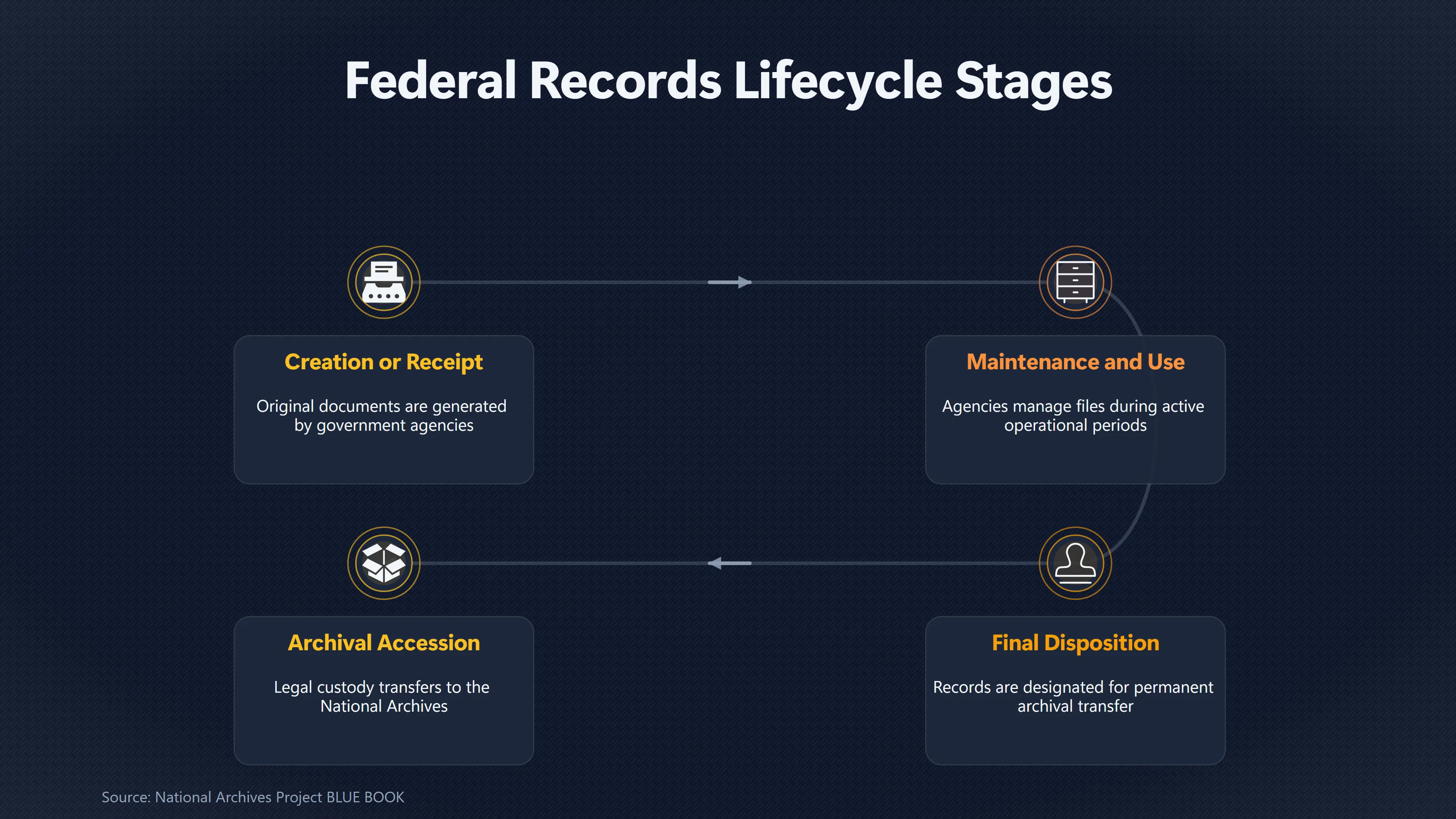
Federal records do not travel directly from the creator’s typewriter to an untouched archival shelf. NARA describes a records lifecycle encompassing creation or receipt, maintenance and use, and final disposition; permanent records can then be transferred into archival custody and continue through processing, preservation and research use. An accession represents the transfer of legal custody to NARA, while records may previously have spent time in a federal records centre under the originating agency’s legal control.[National Archives]archives.govNational ArchivesArchives and Records Management Resources | National ArchivesAugust 15, 2016…
That creates a crucial distinction when assessing the Cutler-Twining memo. A paper found among records generated in the 1950s could theoretically have entered their physical company at several different stages:
- During the original working-file period. This is the provenance required for the strongest authenticity claim: the memo was created or received in government business and filed normally with the Air Force records.
- During later agency storage or records management. Files could remain under agency control long after their active use before permanent transfer.
- During archival processing or declassification activity. Classified holdings necessarily underwent later examination and handling. NARA’s historical account says systematic declassification review had been operating since the 1970s, and its 1985 annual report records substantial continuing declassification work during the very period in which the Cutler-Twining memo was discovered.[National Archives]archives.govNational Archives Finding Aids: Holocaust-Era AssetsNational ArchivesFinding Aids: Holocaust-Era Assets Introduction | National ArchivesAugust 15, 2016…
- During subsequent research handling. Original archival boxes and folders are physically served to researchers. Modern NARA rules therefore impose tracking, inspection and strict original-order requirements specifically to prevent loss, substitution and misplacement.[National Archives]archives.govNational Archives Research Room Rules | National ArchivesNational ArchivesResearch Room Rules | National ArchivesApril 7, 2026…
These are possible points of insertion in principle, not evidence that insertion actually happened at any particular one. That qualification matters. The surviving evidence does not identify a proven planter, insertion date or insertion event.
The declassification period has nevertheless attracted particular attention in the MJ-12 debate. Stanton Friedman, the principal defender of the early MJ-12 documents, acknowledged the possibility that someone had deliberately put the Cutler-Twining memo into the box, while interpreting such a scenario differently from sceptics: for him, planting could have involved an insider placing genuine or deliberately released information where researchers might find it. His published account identifies the discovery as occurring in July 1985 in Box 189 of entry 267, Record Group 341.[The Black Vault]theblackvault.comThe Black Vault Update on Operation Majestic 12 DocumentsThe Black Vault Update on Operation Majestic 12 Documents
That argument demonstrates an important point about provenance even without accepting Friedman’s explanation. “Planted” and “forged” are not identical propositions. A genuine old document might theoretically be relocated into a file later; a fabricated document might be inserted later; or an innocently misplaced document might migrate between folders. Establishing later insertion would weaken the claim of continuous provenance, but additional evidence would still be required to determine what the paper itself was and who put it there.
Why discovery location can mislead
The persuasive power of an archival discovery comes from association. A loose paper surrounded by indisputably genuine Air Force records acquires a contextual credibility that the identical paper arriving anonymously through the post would not possess. The genuine box, genuine folders and genuine neighbouring records can therefore lend an inserted item what might be called borrowed provenance.
The Cutler-Twining case shows the mechanism particularly clearly. The document was not merely presented as something that supposedly came from a secret government file. Researchers actually encountered it in federal archival holdings. Yet NARA’s subsequent investigation found that the memo does not behave like an ordinary member of the series in which it appeared. Record Group 341, entry 267 was filed according to Top Secret register numbers, while the Cutler-Twining memo bears no such number. NARA further states that folder T4-1846 contains no other document concerning “NSC/MJ-12”.[National Archives]archives.govNational Archives Project BLUE BOOKNational ArchivesProject BLUE BOOK - Unidentified Flying Objects | National ArchivesJune 25, 2024…
That mismatch matters more than the simple fact that the memo shares a box with authentic material. A document’s strongest provenance normally comes from relationships produced by administrative activity: filing numbers, related incoming and outgoing correspondence, register entries, routing copies, references in other offices, withdrawal sheets, classification histories and connected records. NARA’s definition of a records series itself stresses that records are kept together because of relationships arising from their creation, receipt or use.[National Archives]archives.govNational Archives Records Basics | National ArchivesNational Archives Records Basics | National Archives Physical proximity is therefore only one form of context, and potentially the weakest one if the administrative relationships are absent.
For the Cutler-Twining memo, those relationships have proved unusually difficult to reconstruct. NARA searched records of the Secretary of Defense, Joint Chiefs of Staff, Headquarters US Air Force and related files without finding further information. Inquiries to the Air Force, Joint Chiefs and National Security Council likewise produced no corroboration. Searches of National Security Council indexes and July 1954 meeting minutes did not uncover MJ-12 or Majestic references.[National Archives]archives.govNational Archives Project BLUE BOOKNational ArchivesProject BLUE BOOK - Unidentified Flying Objects | National ArchivesJune 25, 2024…
The result is a striking asymmetry: the memo has a strong discovery location but a weak documentary network. That is exactly the pattern a later insertion could produce. The surrounding archive supplies authentic scenery, while the inserted document lacks the administrative traces that explain how it originally belonged there.
This does not prove insertion. Files can be incomplete, records can be lost, indexes can omit material and unusual documents can survive without their companions. But those possibilities cannot transform location alone into a continuous chain of custody. The archive can establish that the paper eventually became part of its holdings; without earlier documentation, it cannot necessarily establish when that happened.
The discovery circumstances sharpen the question
One disputed feature makes the later-insertion hypothesis unusually relevant to this particular case. Accounts of the 1985 discovery say Jaime Shandera and William Moore had previously received cryptic postcards containing references later interpreted as clues to the archival location, including “Suitland”, “Reese’s Pieces” and “Box 189”. The memo was subsequently reported found in Box 189 at the Suitland facility, where archivist Edward Reese worked. This account appears in both pro-MJ-12 and critical treatments, although conclusions about its significance differ sharply.[Crystalinks]crystalinks.comMajestic 12, Project Grudge, Project Bluebook, Trilateral CommissionMajestic 12, Project Grudge, Project Bluebook, Trilateral Commission
If that sequence is accurately reported, it creates a provenance problem independent of arguments about typefaces or terminology. An anonymous party apparently possessed information capable of directing researchers towards the eventual discovery location. That could be interpreted in several ways: knowledge of a genuine hidden document, participation in placing one there, advance knowledge of archival arrangements, or coincidence amplified after the event. The available evidence does not establish which explanation is correct.
What it does change is the evidential meaning of “found in the archives”. An entirely accidental discovery in a long-undisturbed, independently documented file would be one thing. A discovery apparently foreshadowed by unexplained clues pointing towards the repository and box is more difficult to treat as self-authenticating evidence of original filing. Critical MJ-12 researcher Kevin Randle has argued that there was no record of the memo’s presence in the box before its discovery, although that assertion comes from the later UFO literature rather than NARA’s present public reference report and should therefore be treated as a secondary claim rather than an established archival finding.[The UFO Chronicles]theufochronicles.comThe UFO Chronicles The Myth of MJ-12: Appendix A –Pt 2The UFO Chronicles The Myth of MJ-12: Appendix A –Pt 2
Just as importantly, the hypothesis does not require Moore or Shandera themselves to have inserted the paper. That accusation has circulated, but the mere possibility of later insertion leaves the identity of any responsible person completely open. Contemporary and later discussions have included scenarios involving researchers, archival or declassification handling, insiders, deliberate disinformation and simple misfiling. None has been demonstrated conclusively by the surviving public evidence. The narrow provenance question is therefore stronger than any accusation against a particular individual: can the memo’s presence in the box be traced back beyond its 1985 discovery?
What evidence could date the insertion
The most decisive evidence would not be another argument about whether the memo “looks official”. It would be a dated record showing that this specific sheet was already present at an earlier stage of the archive’s history.
An inventory or finding aid that individually identified the Cutler-Twining memo before 1985 would be particularly valuable. NARA explains that accession numbers connect archival holdings with acquisition documentation and that finding aids are important to archival control and retrieval.[National Archives]archives.govNational Archives Accession Number | National ArchivesNational Archives Accession Number | National Archives If contemporaneous transfer documentation, box lists or processing records unmistakably described the memo, they could push its documented presence backwards in time and sharply reduce the window in which later insertion was possible.
A dated image would be stronger still. Microfilm, photocopies or photographs made before the disputed discovery could establish that the sheet was already in the file at the time the image was produced. Conversely, a sufficiently detailed earlier image or item-level inventory showing the relevant sequence without the memo could support a later-entry hypothesis. The evidential requirement is simple but demanding: the earlier record must be detailed enough to distinguish “not documented” from “demonstrably absent”.
Declassification documentation could also be important. The National Archives reports that the National Security Council’s declassification office had no record of declassification action on the Cutler-Twining memorandum or other alleged MJ-12 documents.[National Archives]archives.govNational Archives Project BLUE BOOKNational ArchivesProject BLUE BOOK - Unidentified Flying Objects | National ArchivesJune 25, 2024… That absence is significant because a genuine classified memo might be expected to generate some administrative trace as records were reviewed, although exactly what should survive depends on the applicable procedures and the document’s handling history. It is therefore an anomaly, not a timestamp proving insertion.
Physical examination can narrow possibilities but is less decisive than an administrative trail. Paper manufacture, watermarks, ink or toner composition, typewriter characteristics, folds, staple holes, ageing and impressions can sometimes show that an alleged historical document is too recent or physically inconsistent with comparable files. But period-correct paper does not establish period filing. An old blank sheet can be typed on later, and a genuine old document can be moved later. Physical age and archival provenance answer different questions.
Finally, researcher and staff tracking records could potentially establish who accessed particular holdings during a relevant period. Today’s NARA procedures illustrate the kind of controls designed to preserve original order: researchers sign records out, retain tracking slips, work with one box and folder at a time, and must report misplaced material rather than rearranging it. Papers and personal materials entering or leaving research areas are controlled and inspected.[National Archives]archives.govNational Archives Research Room Rules | National ArchivesNational ArchivesResearch Room Rules | National ArchivesApril 7, 2026… Those present-day rules should not simply be projected backwards unchanged onto 1985, but they demonstrate why reconstructing the historical procedures actually operating at Suitland in 1985 would matter before claiming that a particular insertion route was either easy or impossible.

What the later-insertion hypothesis actually establishes
A later insertion is a mechanism capable of explaining an otherwise puzzling combination: a document can be physically real, genuinely held by the National Archives and genuinely discovered among authentic government files while still lacking continuous provenance from its stated date.
For the Cutler-Twining memorandum, that mechanism remains plausible because the strongest official evidence establishes present archival custody while simultaneously identifying breaks in the expected filing context. The absent Top Secret register number, isolation from other MJ-12 material, unsuccessful searches for corroborating records and lack of an identified NSC declassification trail all weaken the inference that the paper simply travelled through normal government filing channels from 1954 to its 1985 discovery.[National Archives]archives.govNational Archives Project BLUE BOOKNational ArchivesProject BLUE BOOK - Unidentified Flying Objects | National ArchivesJune 25, 2024…
But the evidence also sets a firm limit on what can responsibly be claimed. NARA does not say that it has identified a planter or proved a 1980s insertion. Its position is narrower: the document presents substantial problems, and archival certification does not authenticate it.[National Archives]archives.govNational Archives Project BLUE BOOKNational ArchivesProject BLUE BOOK - Unidentified Flying Objects | National ArchivesJune 25, 2024…
That leaves the provenance issue at the correct level of uncertainty. Finding the Cutler-Twining memo in Record Group 341 establishes an important fact about where its documented history is known to lead. It does not, without an earlier chain of records, establish where that history began. A pre-1985 inventory, image, processing record or comparable timestamp tying the sheet securely to the collection would materially strengthen its provenance. Evidence showing that the relevant box had been checked in sufficient detail before the memo appeared would strengthen the opposite case. Until such evidence closes the gap, the archival surroundings cannot by themselves supply the missing history of the sheet inside them.
Amazon book picks
Further Reading
Books and field guides related to How a Planted Document Can Look Archival. Use these as the next step if you want deeper reading beyond the article.
Archives: Principles and Practices
This new and extensively revised second edition offers an international perspective on archives management, providing authoritative guida...
Forensic Document Examination: Principles and Practice
This book introduces the reader to the basic principles of handwriting and the factors that affect their development. The book discusses...
eBay marketplace picks
Marketplace Samples
Live-tested eBay searches with available results related to this page.
Selected fromUFO poster oneBay.co.uk.



Endnotes
1.
Source: archives.gov
Title: National Archives Project BLUE BOOK
Link:https://www.archives.gov/research/military/air-force/ufos
Source snippet
National ArchivesProject BLUE BOOK - Unidentified Flying Objects | National ArchivesJune 25, 2024...
Published: June 25, 2024
2.
Source: archives.gov
Link:https://www.archives.gov/research/alic/reference/archives-resources/terminology.html
Source snippet
National ArchivesArchives and Records Management Resources | National ArchivesAugust 15, 2016...
Published: August 15, 2016
3.
Source: archives.gov
Title: National Archives Accessioning Guidance and Policy | National Archives
Link:https://www.archives.gov/records-mgmt/accessioning
4.
Source: archives.gov
Title: National Archives Records Center Transfer Number | National Archives
Link:https://www.archives.gov/research/catalog/lcdrg/elements/recordscenter.html
5.
Source: archives.gov
Title: National Archives Finding Aids: Holocaust-Era Assets
Link:https://www.archives.gov/research/holocaust/finding-aid/introduction.html
Source snippet
National ArchivesFinding Aids: Holocaust-Era Assets Introduction | National ArchivesAugust 15, 2016...
Published: August 15, 2016
6.
Source: archives.gov
Title: National Archives THE NATIONAL ARCHIVES
Link:https://www.archives.gov/files/about/history/sources/reports/1985-annual-report.pdf
7.
Source: archives.gov
Title: National Archives Research Room Rules | National Archives
Link:https://www.archives.gov/research/research-room-rules
Source snippet
National ArchivesResearch Room Rules | National ArchivesApril 7, 2026...
Published: April 7, 2026
8.
Source: archives.gov
Title: National Archives Research Room Guidance | National Archives
Link:https://www.archives.gov/research/research-room-guidance
9.
Source: archives.gov
Title: National Archives Records Basics | National Archives
Link:https://www.archives.gov/records-mgmt/scheduling/basics
10.
Source: crystalinks.com
Title: Majestic 12, Project Grudge, Project Bluebook, Trilateral Commission
Link:https://www.crystalinks.com/mj12.html
11.
Source: archives.gov
Title: National Archives Accession Number | National Archives
Link:https://www.archives.gov/research/catalog/lcdrg/elements/accession-number
12.
Source: archives.gov
Title: National Archives Finding Aid Requirements | National Archives
Link:https://www.archives.gov/records-mgmt/accessioning/finding-aid.html
13.
Source: archives.gov
Title: National Archives Information for Researchers | National Archives
Link:https://www.archives.gov/college-park/researcher-info
14.
Source: archives.gov
Title: Access to National Archives Facilities
Link:https://www.archives.gov/locations/building-access-security-requirements
15.
Source: archives.gov
Link:https://www.archives.gov/dc/researcher-info
16.
Source: archives.gov
Title: Lifecycle Data Requirements Guide | National Archives
Link:https://www.archives.gov/research/catalog/lcdrg
17.
Source: archives.gov
Link:https://www.archives.gov/research/topics/uaps/moving-images-and-sound
18.
Source: archives.gov
Link:https://www.archives.gov/research/topics/uaps/photographs
19.
Source: archives.gov
Title: Lifecycle Data Requirements Guide Table of Contents | National Archives
Link:https://www.archives.gov/research/catalog/lcdrg/toc
20.
Source: archives.gov
Title: Reviewing Transfer Requests in ERA 2.0 for the Annual Move | National Archives
Link:https://www.archives.gov/records-mgmt/accessioning/annual-move.html
21.
Source: archives.gov
Title: Record Groups 304
Link:https://www.archives.gov/fort-worth/holdings/rg-300-600.html
22.
Source: archives.gov
Title: Researching Accessioned Records | National Archives
Link:https://www.archives.gov/records-mgmt/accessioning/research
23.
Source: archives.gov
Title: 2022 quarter 2
Link:https://www.archives.gov/research/accessions/2022-quarter-2
24.
Source: archives.gov
Title: Researcher Identification Card Requirements | National Archives
Link:https://www.archives.gov/research/start/researcher-card
25.
Source: archives.gov
Link:https://www.archives.gov/san-francisco/researcher-info
26.
Source: archives.gov
Title: 2019 quarter 3
Link:https://www.archives.gov/research/accessions/2019-quarter-3
27.
Source: archives.gov
Title: 2020 quarter 1
Link:https://www.archives.gov/research/accessions/2020-quarter-1
28.
Source: archives.gov
Title: 2017 quarter 4
Link:https://www.archives.gov/research/accessions/2017-quarter-4
29.
Source: archives.gov
Title: 2018 quarter 4
Link:https://www.archives.gov/research/accessions/2018-quarter-4
30.
Source: archives.gov
Title: Research Room Rules | National Archives
Link:https://www.archives.gov/research/notices/2018-research-room-rules
31.
Source: archives.gov
Link:https://www.archives.gov/denver/holdings/rg
32.
Source: archives.gov
Title: Record Group Concept | National Archives
Link:https://www.archives.gov/research/guide-fed-records/index-numeric/concept.html
33.
Source: archives.gov
Link:https://www.archives.gov/research/accessions/research/accessions/index
34.
Source: archives.gov
Title: Finding Aids: General Information Leaflet 71 | National Archives
Link:https://www.archives.gov/publications/general-info-leaflets/71-06-dc-area-records.html
35.
Source: archives.gov
Link:https://www.archives.gov/publications/general-info-leaflets/57-research-room-guidelines.html
36.
Source: archives.gov
Title: Scanning Documents in the Research Rooms | National Archives
Link:https://www.archives.gov/research/order/scanning.html
37.
Source: archives.gov
Title: General Information about [Restricted]({{ ‘restricted/’ | relative_url }}) Records | National Archives
Link:https://www.archives.gov/declassification/ndc/restricted-records.html
38.
Source: transforming-classification.blogs.archives.gov
Title: simplifying the declassification review process for historical records
Link:https://transforming-classification.blogs.archives.gov/2011/03/29/simplifying-the-declassification-review-process-for-historical-records/
39.
Source: obamawhitehouse.archives.gov
Title: executive order classified national security information
Link:https://obamawhitehouse.archives.gov/realitycheck/the-press-office/executive-order-classified-national-security-information
40.
Source: archives.gov
Title: ISO O Audit & Audit Reports | National Archives
Link:https://www.archives.gov/isoo/reports/2006-audit-report.html
41.
Source: archives.gov
Title: Federal Enterprise Architecture Records Management Profile | National Archives
Link:https://www.archives.gov/records-mgmt/policy/rm-profile.html
42.
Source: archives.gov
Link:https://www.archives.gov/files/about/policies/nara1301.docx.pdf%3F_ga%3D2.125791242.1442077890.1699914723-1396814520.1657300307
43.
Source: archives.gov
Title: Record Group 341
Link:https://www.archives.gov/findingaid/stat/discovery/341
44.
Source: youtube.com
Title: The Majestic-12 Documents [With Ryan S. Wood]
Link:https://www.youtube.com/watch?v=vzB87RJkQVU
Source snippet
Stanton Friedman - William Moore...
45.
Source: youtube.com
Title: Stanton Friedman
Link:https://www.youtube.com/watch?v=OzkNAAYT1pw
Source snippet
Beginner's Guide to Disinformation in Ufology...
46.
Source: theblackvault.com
Title: The Black Vault Update on Operation Majestic 12 Documents
Link:https://www.theblackvault.com/casefiles/update-on-operation-majestic-12-documents/
47.
Source: theufochronicles.com
Title: The UFO Chronicles The Myth of MJ-12: Appendix A –Pt 2
Link:https://www.theufochronicles.com/2014/06/the-myth-of-mj-12-appendix-pt-2.html
48.
Source: wikidisc.org
Title: Majestic 12 documents | Wiki Disc
Link:https://www.wikidisc.org/wiki/Majestic_12_documents
49.
Source: odla.fr
Title: MAJESTI C 12
Link:https://www.odla.fr/2021/10/07/majestic-12/
50.
Source: theufochronicles.com
Title: M J-12: No Proof that TF, CT, or EBD Documents are Fraudulent, Argues Friedman
Link:https://www.theufochronicles.com/2014/10/mj-12-no-proof-that-tf-ct-or-ebd.html
51.
Source: theufochronicles.com
Title: the myth of mj 12 appendix pt 3
Link:https://www.theufochronicles.com/2014/06/the-myth-of-mj-12-appendix-pt-3.html
52.
Source: theufochronicles.com
Title: “Appendix A: The Myth of MJ-12” An Annotated Commentary By Barry Greenwood
Link:https://www.theufochronicles.com/2014/06/appendix-the-myth-of-mj-12-annotated.html
53.
Source: theufochronicles.com
Title: the myth of mj 12 appendix pt 1
Link:https://www.theufochronicles.com/2014/06/the-myth-of-mj-12-appendix-pt-1.html
54.
Source: lurch2.blogspot.com
Title: majestic 12
Link:https://lurch2.blogspot.com/2013/09/majestic-12.html
55.
Source: scribd.com
Title: Majestic 12
Link:https://www.scribd.com/document/1606041/Majestic-12
56.
Source: internationalflyingsaucerbureau.com
Title: Majestic 12
Link:https://www.internationalflyingsaucerbureau.com/majestic-12/
57.
Source: col2.com
Title: operation majestic 12
Link:https://col2.com/operation-majestic-12
59.
Source: nationalarchives.gov.uk
Title: Intelligence and security services
Link:https://www.nationalarchives.gov.uk/help-with-your-research/research-guides/intelligence-and-security-services/
60.
Source: nationalarchives.gov.uk
Title: Step 3: Sensitivity reviews of selected records
Link:https://www.nationalarchives.gov.uk/information-management/manage-information/selection-and-transfer/sensitivity-reviews-on-selected-records/
61.
Source: nationalarchives.gov.uk
Title: Sensitivity review
Link:https://www.nationalarchives.gov.uk/information-management/manage-information/public-inquiry-guidance/sensitivity-review/
62.
Source: nationalarchives.gov.uk
Title: Records collection policy
Link:https://www.nationalarchives.gov.uk/about-us/how-we-work/plans-policies-performance-and-projects/our-policies/records-collection-policy/
63.
Source: luforu.org
Title: Cutler-Twining memo
Link:https://luforu.org/cutler-twining-memo/
Additional References
64.
Source: youtube.com
Link:https://www.youtube.com/watch?v=ogJplVuElLs
Source snippet
Cutler-Twining memo planted National Archives Karl Pflock discusses The Cutler - Twining Memo...
65.
Source: youtube.com
Title: Beginner’s Guide to Disinformation in Ufology
Link:https://www.youtube.com/watch?v=YH7cE47-6j4
Source snippet
A secret history: Inside shadow intelligence, the MJ-12 documents | Reality Check...
66.
Source: medium.com
Link:https://medium.com/stanton-friedmans-articles/book-review-kevin-d-randles-case-mj-12-the-true-story-behind-the-government-s-ufo-conspiracies-9e06f4e82250
67.
Source: skepsis.nl
Link:https://skepsis.nl/majestic-12/
68.
Source: scribd.com
Link:https://www.scribd.com/document/875558418/Project-BLUE-BOOK-Unidentified-Flying-Objects
69.
Source: bibliotecapleyades.net
Link:https://bibliotecapleyades.net/sociopolitica/esp_sociopol_mj12_10.htm
71.
Source: music.amazon.co.uk
Link:https://music.amazon.co.uk/podcasts/6204a3cd-1c86-451f-bf3c-0db47f3cfdbc/episodes/bc13aa1f-d48e-46dd-9b65-32d898974479/uap-as-nhi-probability-vs-certainty-ep-020-a-full-reading-of-the-mj-12-eisenhower-briefing-document?tag=searcht-20
72.
Source: dokumen.pub
Link:https://dokumen.pub/awful-archives-conspiracy-theory-rhetoric-and-acts-of-evidence-0814214355-9780814214350.html
73.
Source: youtube.com
Title: Karl Pflock discusses The Cutler
Link:https://www.youtube.com/watch?v=I6smHEhd9MI
Source snippet
The Majestic-12 Documents [With Ryan S. Wood]...