Within Cutler Abroad
What Evidence Would Prove the Lay Theory?
No located NSC, Joint Chiefs, Air Force, or Defense Department record identifies Lay as the drafter or preserves a corroborating copy.
On this page
- Which government files were searched
- The missing drafter, transmitter, and corroborating copy
- Why possibility is weaker than documented authorship
Page outline Jump by section
Introduction
The strongest problem with the theory that National Security Council (NSC) Executive Secretary James S. Lay Jr. drafted the alleged 14 July 1954 Cutler-to-Twining MJ-12 memorandum is not that Lay lacked the opportunity or authority to handle business while Robert Cutler was abroad. He plainly had both. The problem is documentary: no located NSC, Joint Chiefs of Staff, Air Force or Defense Department record identifies Lay as the drafter, transmitter or approving official for this memorandum, and no corroborating government copy has emerged from the record systems where related correspondence might reasonably have left traces.[National Archives]archives.govOpen source on archives.gov.
That distinction matters because the Lay theory was developed to explain a genuine anomaly: Cutler was overseas when the memorandum bearing his name was dated. Supporters can therefore establish a plausible mechanism — Lay could have kept Cutler’s work moving — but the surviving archives do not establish that he actually created this document. Indeed, an authentic NSC memorandum issued by Lay on the very same date provides an unusually useful control sample: Lay signed that communication in his own name.[The Black Vault]theblackvault.comOpen source on theblackvault.com.
Which government files were searched?
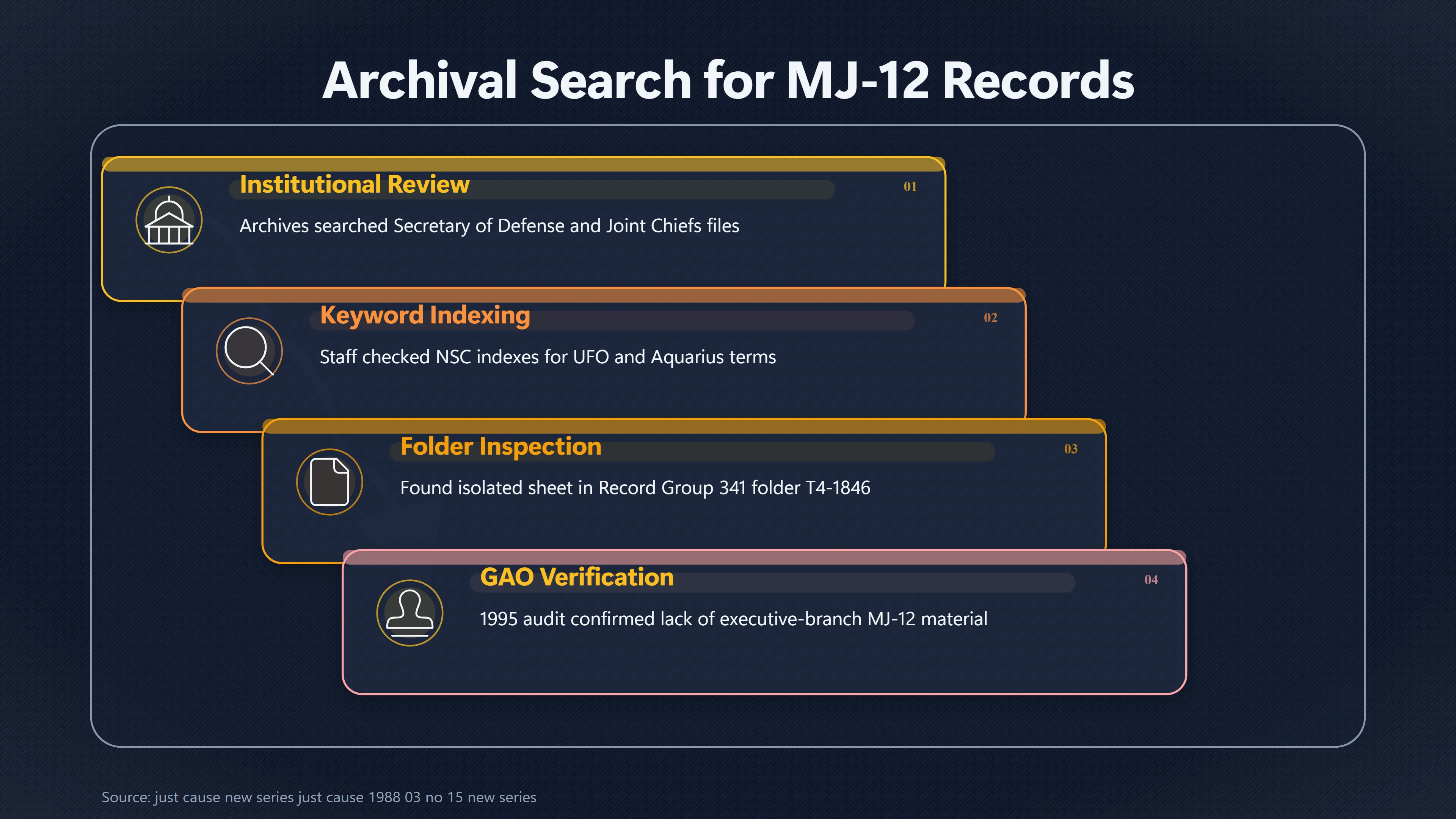
The archival gap is broader than the absence of a second copy in Cutler’s personal papers. The National Archives’ MJ-12 reference report records searches across several of the institutions that would be relevant to a purported NSC communication addressed to Air Force Chief of Staff General Nathan Twining. Archivists searched records of the Secretary of Defense, the Joint Chiefs of Staff, Headquarters U.S. Air Force and related files without finding further information on the supposed project. Direct enquiries to the Air Force, Joint Chiefs and NSC likewise produced nothing further.[National Archives]archives.govOpen source on archives.gov.
The NSC holdings were also checked from a different direction. National Archives staff searched indexes to NSC policy-paper and meeting-minute files using terms including “MJ-12”, “majestic”, “unidentified flying objects”, “UFO”, “flying saucers”, “extraterrestrial biological entities” and “Aquarius”. Those searches produced no supporting MJ-12 trail apart from the disputed Cutler-to-Twining memorandum itself. The Archives also reported that the relevant NSC indexes contained no listing for MJ-12 or Majestic and that the July 1954 NSC meeting minutes contained no mention of either term.[National Archives]archives.govOpen source on archives.gov.
This matters because the disputed sheet is not merely an isolated surviving member of an otherwise documented sequence. It is isolated within the archival search results. The memorandum was found in Record Group 341, records of Headquarters U.S. Air Force, in folder T4-1846. The National Archives noted that the series was arranged by Top Secret register number, yet the MJ-12 memorandum carries no such number, and that no other document in the folder concerns “NSC/MJ-12”.[National Archives]archives.govOpen source on archives.gov.
The wider search record did not subsequently produce an independent institutional anchor. In 1995, the U.S. Government Accountability Office reported that federal archivists had found no material fitting the description of Majestic 12 or references establishing it in executive-branch records, while the agencies it consulted said their knowledge of MJ-12 material came from documents supplied by non-governmental sources. The GAO’s investigation was broader than this particular Cutler memorandum, so it cannot by itself decide who typed the 14 July sheet. It does, however, reinforce the narrower point: no independently preserved government record has emerged that closes the Lay authorship gap.[Government Accountability Office]gao.govOpen source on gao.gov.
The missing drafter, transmitter and corroborating copy
A useful way to assess the Lay theory is to separate three propositions that are sometimes blended together.
First, Lay was in a position to act for the NSC while Cutler was away. This is well supported. Cutler had left instructions for Lay and J. Patrick Coyne concerning the handling of NSC administrative matters during his absence. Stanton Friedman, the most prominent defender of the MJ-12 documents, also pointed to correspondence from Lay indicating that he was handling matters while Cutler was overseas.[The Black Vault]theblackvault.comOpen source on theblackvault.com.
Second, Lay therefore could have drafted or transmitted a routine message connected with Cutler’s responsibilities. That is a reasonable possibility. Lay was not a peripheral aide: the State Department’s published Foreign Relations of the United States volumes identify him as Executive Secretary of the National Security Council, and surviving records show him transmitting classified NSC material to senior Cabinet and atomic-energy officials. For example, an earlier Top Secret memorandum concerning atomic-weapons policy was explicitly headed as a memorandum by Executive Secretary Lay and ended with his name.[Office of the Historian]state.govOpen source on state.gov.
Third, however, Lay actually wrote the Cutler-to-Twining MJ-12 memorandum. This is where the evidence disappears. The archival record located so far contains no drafting notation naming Lay, no Lay signature, no covering memorandum from him, no transmission record linking him to the sheet, and no independently filed recipient copy that identifies its administrative origin. The National Archives’ own conclusion from Cutler’s delegation memorandum was that, had the Twining communication been genuine, Lay or Coyne would be expected to have signed it.[National Archives]archives.govOpen source on archives.gov.
That is an authorship gap, not simply an absence of a handwritten signature. An unsigned carbon can certainly be authentic. But once an alternative author is proposed to rescue a document from a chronological contradiction, evidence identifying that substitute author becomes especially important. Here the Lay attribution is inferential: Cutler was absent; Lay was handling work; therefore Lay might have produced the memorandum. Nothing in the located archival trail completes the final step.
There is another missing link at the receiving end. The alleged memorandum was addressed to Twining, yet the National Archives reported that searches of Headquarters Air Force, Joint Chiefs and Defense records produced no further information. Thus there is no independently located Twining-office or military copy serving as a second witness to the communication.[National Archives]archives.govOpen source on archives.gov.
That does not prove that no such copy ever existed. Classified records can be destroyed, separated, retained in unexpected series or remain unavailable. But the evidential distinction is important: “a duplicate might have been lost” is an explanation for missing evidence, not positive evidence that the memorandum was transmitted.
The same-day Lay memorandum is the crucial comparison
The most revealing comparison comes from 14 July 1954 itself. A declassified NSC memorandum dated that day concerns the Aircraft Nuclear Propulsion Program. It is addressed to the Secretary of Defense and the Chairman of the Atomic Energy Commission and records a presidential decision about handling the programme. Unlike the disputed Cutler-to-Twining sheet, the document identifies James S. Lay Jr. as Executive Secretary and bears his name.[UFO Magazine Archive]ufomagazines.comjust cause new series just cause 1988 03 no 15 new seriesjust cause new series just cause 1988 03 no 15 new series
This comparison has unusual evidential value because it controls for several variables at once. It is not a document from another administration or a distant period. It comes from the NSC, involves sensitive national-security business, was produced on exactly the date at issue, and shows how Lay communicated officially while Cutler was abroad.
It therefore weakens a simple version of the claim that Lay’s normal way of acting for an absent Cutler was to issue unsigned correspondence under Cutler’s identity. At minimum, the same-day document demonstrates that Lay could and did issue official NSC correspondence under his own name on 14 July. Contemporary critics of MJ-12 consequently treated it as direct evidence against the proposed authorship explanation.[Skeptical Inquirer]skepticalinquirer.orgOpen source on skepticalinquirer.org.
The comparison should not be pushed beyond what it proves. Different kinds of White House and NSC correspondence could follow different procedures, and a brief scheduling communication need not have been processed identically to a substantive presidential-policy memorandum. One authentic Lay-signed document therefore cannot establish an absolute rule that Lay never drafted material for Cutler without identifying himself.
But that qualification cuts both ways. To turn the exception into an explanation for the MJ-12 sheet, supporters would ideally need contemporary examples showing Lay producing comparable communications in Cutler’s name during an absence. The materials cited in defence of the Lay theory establish his role and his opportunity; they do not supply such a matching example.[The Black Vault]theblackvault.comOpen source on theblackvault.com.
Why the pro-Lay evidence stops short of authorship
Friedman’s case deserves to be stated accurately because it contains real archival discoveries rather than merely speculation. He argued that Cutler had instructed Lay to keep matters moving while he was overseas; that Lay subsequently communicated with Cutler about handling business; and that Lay was in contact with President Eisenhower on 14 July. From this, Friedman regarded Lay as his best candidate for the actual author of the disputed memorandum. He also stressed that the Cutler-to-Twining sheet lacks both a signature and an “/s/” notation, which in his view was consistent with Cutler being unavailable to sign it.[The Black Vault]theblackvault.comOpen source on theblackvault.com.
Those findings answer an important question: could somebody at the NSC have dealt with Cutler’s business while he was away? Yes. They substantially weaken any argument that Cutler’s physical absence alone makes creation of correspondence in his office impossible.
They answer a different question much less effectively: what contemporary record connects Lay specifically to this memorandum? None of the cited material says that Lay drafted a message to Twining about an “NSC/MJ-12 Special Studies Project”. Lay’s access to Eisenhower does not establish the subject of their communications, and his responsibility for Cutler’s administrative workload does not identify every unsigned document carrying Cutler’s name as Lay’s work. The inference remains possible, but uncorroborated.[The Black Vault]theblackvault.comOpen source on theblackvault.com.
The distinction is particularly important because authentic Lay documents leave identifiable trails elsewhere. Published government records show Lay circulating classified NSC material under his title and name; one 1952 Top Secret memorandum on atomic weapons, for example, survives in State Department files with another copy identified in the Truman Library. That is the sort of cross-file preservation that can turn an administrative attribution into documented provenance.[Office of the Historian]state.govOpen source on state.gov.
The Cutler-to-Twining memorandum lacks an equivalent chain. Its physical presence in National Archives custody establishes where the sheet was found, not who created it. The Archives explicitly cautions that certification of a reproduction means only that it is a true copy of a document in its custody; certification does not authenticate the document or the information written on it.[National Archives]archives.govOpen source on archives.gov.

What evidence would prove the Lay theory?
The Lay hypothesis is testable in principle. A particularly strong discovery would be a contemporaneous record independent of the disputed sheet that explicitly connects Lay with the 14 July message — for example, a Lay office copy, drafting notation, outgoing correspondence log, Top Secret control record, Twining-office incoming copy, routing slip or diary entry identifying the communication and its subject.
Other discoveries would not be decisive individually but could substantially strengthen the case. Several authentic examples from 1954 showing Lay issuing comparable unsigned memoranda under Cutler’s name while Cutler was absent would establish the claimed administrative practice. A surviving military record acknowledging receipt of the 14 July communication would independently establish transmission even if the drafter remained uncertain. An NSC file containing associated scheduling papers could likewise move the document from an isolated sheet towards a reconstructable bureaucratic transaction.
The current record falls short on all three fronts. The National Archives found no accompanying MJ-12 documents in the folder, no further information in relevant Defense, Joint Chiefs and Air Force files, and no supporting NSC index or meeting-minute entries. Its enquiries to the agencies concerned were also unsuccessful.[National Archives]archives.govOpen source on archives.gov.
The absence is especially significant because this is not a case in which nobody looked beyond the original folder. Searches crossed institutional boundaries and were later supplemented by broader federal examination of the alleged MJ-12 material. The GAO reported in 1995 that it found no evidence that the Majestic 12 material represented genuine executive-branch documents, while the FBI’s published MJ-12 material records the Air Force conclusion that the alleged MJ-12 briefing material examined in its investigation was fake. Those findings concern the wider MJ-12 corpus rather than proving the origin of the Cutler sheet specifically, but they provide no independent support for assigning the disputed memorandum to Lay.[Government Accountability Office]gao.govOpen source on gao.gov.
Possibility is weaker than documented authorship
The archive gap leaves the Lay explanation in a precise position. It is possible but undocumented.
That is more nuanced than saying that Cutler’s trip automatically proves the memorandum false. The archival record confirms that Cutler delegated responsibilities and that Lay was an official capable of conducting highly sensitive NSC business. A defensible historical assessment therefore should not claim that no one could have generated correspondence for Cutler on 14 July 1954.[National Archives]archives.govOpen source on archives.gov.
But possibility cannot do the work of provenance. To accept Lay as the author requires an additional inference for which no located contemporary document provides direct support. Moreover, the same-day Aircraft Nuclear Propulsion memorandum demonstrates that when Lay conducted important NSC correspondence on 14 July, at least one surviving example identifies him plainly as Executive Secretary.[UFO Magazine Archive]ufomagazines.comjust cause new series just cause 1988 03 no 15 new seriesjust cause new series just cause 1988 03 no 15 new series
That is why the missing archival copies matter more than a simple argument from silence. The Lay hypothesis predicts a bureaucratic mechanism: an NSC official acts for an absent superior, produces or transmits a communication to the Air Force chief, and thereby resolves the Cutler travel contradiction. Yet searches have not recovered the records that would document any stage of that mechanism — no identified Lay draft, no transmission trace and no corroborating recipient copy.
The surviving evidence therefore supports the modest proposition that Lay could have acted for Cutler. It does not support the stronger proposition that Lay created the alleged MJ-12 memorandum. Until an independent contemporary record bridges that gap, attributing the document to Lay remains a proposed explanation for an anomaly, rather than a documented piece of its provenance.
Amazon book picks
Further Reading
Books and field guides related to What Evidence Would Prove the Lay Theory?. Use these as the next step if you want deeper reading beyond the article.
Top Secret/Majic: Operation Majestic-12 and the United States...
Top Secret/Majic is the result of nuclear physicist and renowned UFO investigator Stanton T. Friedman's twenty-one year search for the tr...
UFOs and the National Security State: Chronology of a Cover-U...
Included in this volume are the records of more than fifty military bases relating to innumerable violations of sensitive airspace by unk...
The Report on Unidentified Flying Objects
The Report on Unidentified Flying Objects, written by Captain Edward Ruppelt in 1956, was the first serious, unbiased account written abo...
The UFO Experience: A Scientific Inquiry
The author belives that a number of UFO siting are still to be explained.
eBay marketplace picks
Marketplace Samples
Live-tested eBay searches with available results related to this page.
Selected fromUFO poster oneBay.co.uk.


Endnotes
1.
Source: archives.gov
Link:https://www.archives.gov/research/military/air-force/ufos
2.
Source: ufomagazines.com
Title: just cause new series just cause 1988 03 no 15 new series
Link:https://www.ufomagazines.com/just-cause-new-series-just-cause-1988-03-no-15-new-series/
3.
Source: theblackvault.com
Link:https://www.theblackvault.com/casefiles/update-on-operation-majestic-12-documents/
4.
Source: youtube.com
Title: The Robertson Panel Chairman and the MJ-12 Connection
Link:https://www.youtube.com/watch?v=zdwNc4ZP55E
Source snippet
National Archives MJ-12 [Cutler Twining memo]({{ 'cutler-memo/' | relative_url }}) 【宇宙人極秘文書】MJ-12は本物か|FBIが書いた「BOGUS」...
Additional References
5.
Source: youtube.com
Link:https://www.youtube.com/watch?v=dA69pv9AQx0
Source snippet
The Majestic-12 Documents [With Ryan S. Wood]...
6.
Source: youtube.com
Title: Karl Pflock discusses The Cutler
Link:https://www.youtube.com/watch?v=I6smHEhd9MI
Source snippet
The 1954 Top-Secret Intel Memo Exposing the Government's Most Guarded UAP Working Group...
7.
Source: youtube.com
Title: Karl Pflock
Link:https://www.youtube.com/watch?v=8g5tYfcQ9RQ
Source snippet
The Robertson Panel Chairman and the MJ-12 Connection...
8.
Source: youtube.com
Title: The Majestic-12 Documents [With Ryan S. Wood]
Link:https://www.youtube.com/watch?v=vzB87RJkQVU
Source snippet
Karl Pflock - The creation of the MJ-12 documents...