Within Archive Provenance
Could Classification Review Have Changed the File?
Classification review gives authorized personnel later access to old files, creating a handling stage that must be considered when reconstructing when a
On this page
- What later review access means for provenance
- Why continuous custody cannot be assumed
- How researchers could test the review stage hypothesis
Page outline Jump by section
Introduction
The 1985 classification review of the US Air Force records in which the Cutler-Twining memorandum was found creates a crucial break in any simple chain-of-custody argument. The memo is unquestionably now held in Record Group 341 at the US National Archives, but the Archives has stated that there is no way to determine when it was filed. It also confirmed that the entire 30,000-page series was reviewed for declassification by the Air Force in 1985 — the same year researchers found the alleged 1954 MJ-12 memo.[Project Aquarius]projectaquarius.mufon.comARCHIVES NATLProject AquariusMSI PATCH.SHEETJune 24, 2026…
That does not prove that a reviewer inserted, removed or altered anything. It does mean, however, that the document’s location in an archival box cannot by itself establish uninterrupted custody from 1954 to 1985. Between its purported creation and its discovery lies a poorly documented handling stage in which authorised personnel had legitimate access to the files. For provenance purposes, that distinction is fundamental.
What later review access means for provenance
Record Group 341 contains records of Headquarters, United States Air Force. The Cutler-Twining memo was found in Entry 267, records of the Dissemination Branch of the Office of the Director of Intelligence. In a December 1987 letter, the National Archives explained that Entry 267 contained roughly 30,000 pages in 150 boxes and had no index, making systematic research dependent on examining the boxes themselves. More importantly, the Archives stated that the entire series had been reviewed by the Air Force for declassification in 1985.[Project Aquarius]projectaquarius.mufon.comARCHIVES NATLProject AquariusMSI PATCH.SHEETJune 24, 2026…
The declassification authority associated with the series, NND 857013, is therefore informative but easily misunderstood. According to the Archives, “NND” identified its Declassification Division and “85” identified the fiscal year in which the series was reviewed and declassified. The date appearing on a later reproduced copy — 1/12/87 — recorded the transfer of the original declassification authority to that copy; it was not evidence that the underlying memorandum had first been declassified on that date.[Project Aquarius]projectaquarius.mufon.comARCHIVES NATLProject AquariusMSI PATCH.SHEETJune 24, 2026…
This matters because a declassification stamp proves something quite different from historical provenance. It documents an archival processing action. It does not establish that the sheet being stamped had occupied that folder continuously since 1954. The National Archives makes the broader distinction explicit: when it certifies a reproduction, it attests that the reproduction is a true copy of a document in its custody, not that the document itself or the information in it is authentic.[National Archives]archives.govNational Archives Project BLUE BOOKNational ArchivesProject BLUE BOOK - Unidentified Flying Objects | National Archives…
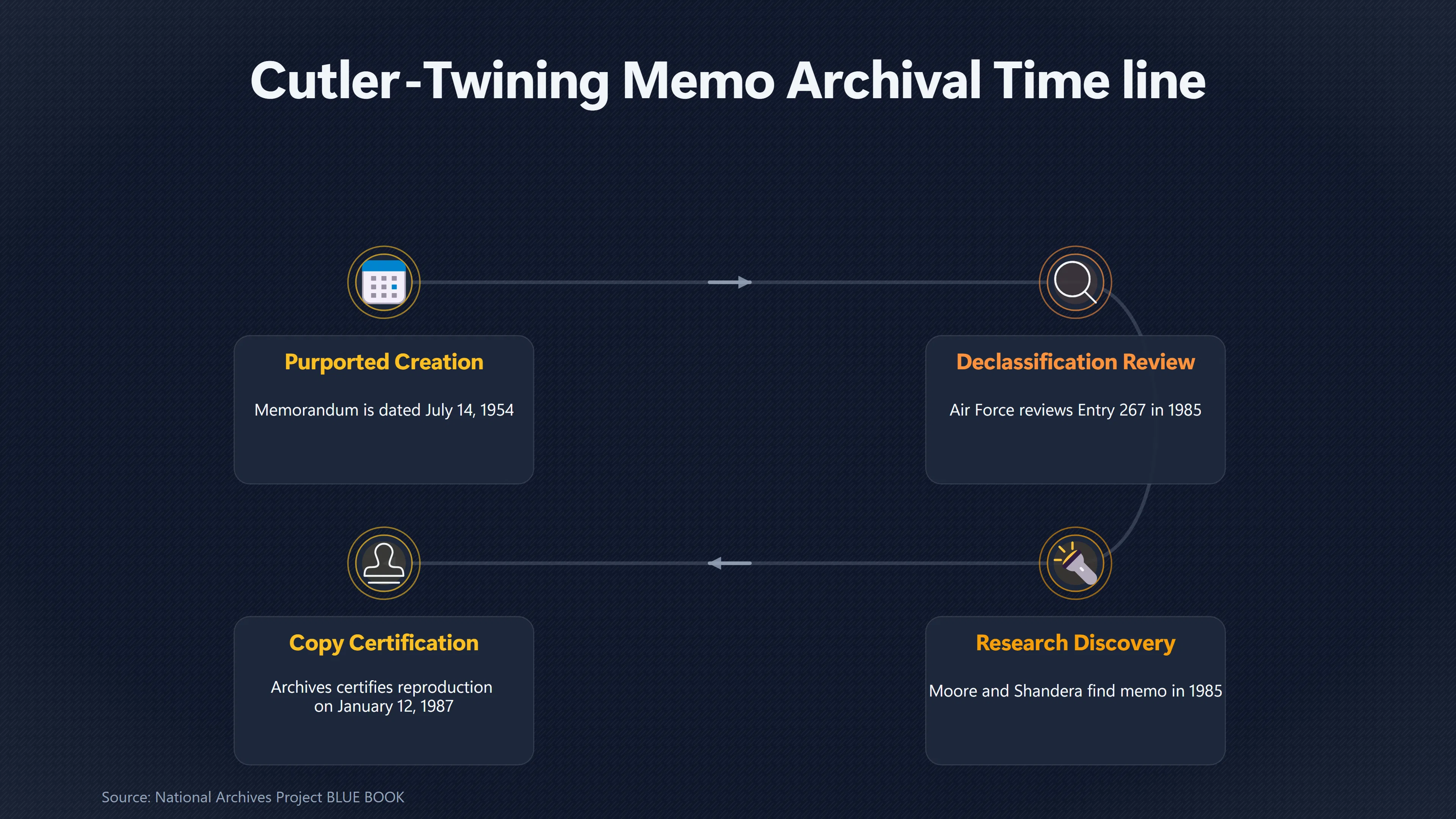
The chronology therefore contains at least three separate propositions:
- Purported creation: the memorandum is dated 14 July 1954.
- Classification review: Entry 267 underwent Air Force declassification review in 1985.
- Research discovery: William Moore and Jaime Shandera reported finding the memo among those recently reviewed records in 1985.
Only the last two events have a reasonably identifiable connection to the modern archival history of the sheet. The difficult interval is everything before them.
Why continuous custody cannot be assumed
An ideal provenance trail would connect the purported 1954 creation of the memorandum to its official transmission, registration, filing, retirement to the National Archives, classification review and eventual release. The surviving evidence does not supply that continuous sequence.
The National Archives’ most important statement on this narrow question is unusually direct: although Headquarters US Air Force retired the relevant records to the Archives, “There is no way to determine when this memorandum was filed.”[Project Aquarius]projectaquarius.mufon.comARCHIVES NATLProject AquariusMSI PATCH.SHEETJune 24, 2026… That leaves open a much wider range of possible filing dates than the date typed at the top of the memo.
The surrounding filing system makes the gap more consequential. Entry 267 was filed according to Top Secret register numbers, but the Cutler-Twining memorandum bears no such number. It was found in folder T4-1846, yet the Archives reported that no other document in that folder concerned “NSC/MJ-12”. Searches of records belonging to the Secretary of Defense, Joint Chiefs of Staff, Headquarters Air Force and National Security Council also failed to uncover the supporting administrative trail that might independently locate the memo within 1954 government business.[National Archives]archives.govNational Archives Project BLUE BOOKNational ArchivesProject BLUE BOOK - Unidentified Flying Objects | National Archives…
Those anomalies do not demonstrate that the document arrived during the 1985 review. Misfiling, incomplete records and unusual handling are possible in large archival collections. But they prevent the archival location from doing the work that a genuine registration trail normally could. There is no surviving piece of filing evidence presently establishing, for example, “this memorandum entered file T4-1846 on a particular date in 1954”.
Classification review adds another complication because it was an intervention in the records, not simply a period in which sealed boxes sat untouched. Reviewers had to examine classified material and decide what could be opened and what had to remain restricted. Evidence associated with Box 189 shows withdrawal actions dated June 1985 for other records around the relevant numerical sequence, including material withheld under National Security Agency or Department of Energy authority.[Project Aquarius]projectaquarius.mufon.comCUTLER TWINNING MEMOProject AquariusMSI PATCH SHEETMay 7, 2026…
That makes 1985 a provenance checkpoint rather than a neutral blank. Researchers trying to reconstruct custody need to ask what happened during that checkpoint, who handled the material and what documentation the review generated.
The review stage creates competing possibilities
The evidence supports several logically different histories, and the present archival record does not cleanly choose between them.
The memo was already there. The simplest authenticity-compatible scenario is that the Cutler-Twining sheet had long been among the Air Force records, perhaps imperfectly registered or misfiled, and survived the 1985 review before Moore and Shandera encountered it. A large, unindexed series containing tens of thousands of pages certainly creates opportunities for anomalous filing.[Project Aquarius]projectaquarius.mufon.comARCHIVES NATLProject AquariusMSI PATCH.SHEETJune 24, 2026…
It entered the files sometime after 1954 but before review. An archival document can be physically old without having occupied its eventual folder since the date written on it. Because the Archives cannot determine when the memorandum was filed, the presently documented chain does not eliminate this intermediate possibility.[Project Aquarius]projectaquarius.mufon.comARCHIVES NATLProject AquariusMSI PATCH.SHEETJune 24, 2026…
It entered during or around the review period. This is the possibility that makes classification review particularly important to the MJ-12 provenance debate. Later writers and participants in that debate have explicitly raised the idea that somebody with access to the files could have planted the sheet. Stanton Friedman, who defended the memorandum’s authenticity, acknowledged the significance of the classification-review episode while rejecting the implication that the review explains the memo’s presence. Accounts attributed to him describe multiple Air Force review teams working on the records before the researchers’ search.[LUFORU]luforu.orgCutler-Twining memoCutler-Twining memoJuly 14, 1954…
The key point is narrower than accusing any particular reviewer or researcher. Access creates opportunity, not proof of insertion. Nothing in the archival evidence located here establishes that an Air Force reviewer planted the document. Conversely, because the Archives cannot date its filing, the fact that authorised personnel handled the series shortly before discovery means an unbroken 1954-to-1985 custody chain cannot simply be presumed.
That is why “found in the National Archives” and “continuously preserved there as an authentic 1954 record” are materially different claims.

The declassification stamp cannot close the gap
Photographs and reproductions of the Cutler-Twining memorandum prominently display National Archives markings and the authority NND 857013. Visually, those markings can give the impression that the government authenticated the memo as an official 1954 document.
The Archives’ own explanation is more limited. NND 857013 identified the authority under which the series had undergone declassification review. Archivists subsequently transferred that authority to a reproduced copy. The other archival stamp identified the reproduction as coming from Record Group 341.[Project Aquarius]projectaquarius.mufon.comARCHIVES NATLProject AquariusMSI PATCH.SHEETJune 24, 2026…
Neither marking supplies a missing 1954 accession or registration history. Indeed, the National Archives’ MJ-12 reference report points in the opposite direction by recording that the document lacks the Top Secret register number used to file the series.[National Archives]archives.govNational Archives Project BLUE BOOKNational ArchivesProject BLUE BOOK - Unidentified Flying Objects | National Archives…
A useful way to read the stamps, therefore, is:
They establish archival processing and present custody, not original authorship or continuous historical custody.
This distinction also explains why the 1985 review is simultaneously helpful and troublesome. It gives historians a dated administrative event associated with the collection, but it does not tell them where the questioned sheet was before that event.
Could classification review itself have changed the file?
In principle, yes: a classification review necessarily creates authorised handling of classified records, and records may be withdrawn, retained, referred to another agency or cleared for release. In this particular case, contemporary withdrawal information indicates that material around the relevant Top Secret numerical sequence was indeed being removed or referred during June 1985.[Project Aquarius]projectaquarius.mufon.comCUTLER TWINNING MEMOProject AquariusMSI PATCH SHEETMay 7, 2026…
But the available evidence does not justify the stronger statement that reviewers changed the file by inserting the Cutler-Twining memo. That remains a hypothesis.
The distinction is important because two arguments sometimes get collapsed into one:
Review personnel could access and rearrange records; therefore a reviewer planted the MJ-12 memorandum.
The first proposition makes the second possible, but does not prove it. Demonstrating insertion would require evidence tied to the particular sheet: review logs, inventories, witness accounts, dated photographs or copies, handling records, or some other documentation showing its absence before one point and presence afterwards.
At present, the more defensible conclusion is that classification review widens the uncertainty interval. The memo’s secure modern history reaches the National Archives and its 1985 discovery, but the documentary evidence cited by the Archives does not bridge that history continuously backwards to 14 July 1954.

How researchers could test the review-stage hypothesis
The strongest investigation would focus less on debating the memo’s wording and more on reconstructing the administrative footprint of the 1985 review. The National Archives’ identification of NND 857013 provides a concrete starting point because it ties the records to a particular declassification action rather than merely to the broad Record Group 341 designation.[Project Aquarius]projectaquarius.mufon.comARCHIVES NATLProject AquariusMSI PATCH.SHEETJune 24, 2026…
Several kinds of surviving material would be especially valuable:
- Review documentation for NND 857013: work sheets, project files, reviewer assignments, box lists or correspondence could establish who reviewed Entry 267, when individual boxes were handled and how decisions were recorded.
- Pre-review inventories or copies: any trustworthy image, photocopy, microfilm or detailed inventory of folder T4-1846 made before the 1985 review would provide a powerful test. Presence of the memo would push its demonstrable custody backwards; documented absence would sharply strengthen an insertion hypothesis.
- Withdrawal records: the June 1985 withdrawal actions around the relevant numerical files could help reconstruct the physical state of the box during review and distinguish released material from documents referred to other agencies.[Project Aquarius]projectaquarius.mufon.comCUTLER TWINNING MEMOProject AquariusMSI PATCH SHEETMay 7, 2026…
- Register evidence: because Entry 267 was organised around Top Secret register numbers, locating the original registers or equivalent control records could show whether the memorandum ever had an independent administrative identity that was subsequently lost.
- Reviewer testimony or contemporaneous notes: recollections decades later would be weaker than paperwork, but contemporaneous notes identifying the contents of T4-1846 before public interest in MJ-12 would still be useful.
- Earlier archival references: researcher request slips, staff correspondence or references to the folder predating the MJ-12 controversy could potentially establish that somebody encountered the sheet before Moore and Shandera did.
The test is therefore not whether somebody could have planted a document during classification review. That possibility is too easy to assert and too difficult to falsify on its own. The useful question is whether the surviving administrative records can progressively narrow the last date at which the memo is known to have been absent, or the earliest date at which it can independently be shown to have been present.
The chain of custody stops short of 1954
The classification-review episode does not settle the Cutler-Twining controversy in either direction. It does something more specific: it prevents the memo’s archival discovery from being treated as a seamless provenance trail.
The National Archives can establish that the document is in Record Group 341, that Entry 267 was reviewed for declassification in 1985 and that NND 857013 relates to that review. It can also establish the folder in which the sheet was found. But the Archives has explicitly said it cannot determine when the memorandum was filed, while its own investigation identified the missing Top Secret register number and absence of corroborating MJ-12 material in the folder and related government files.[Project Aquarius]projectaquarius.mufon.comARCHIVES NATLProject AquariusMSI PATCH.SHEETJune 24, 2026…
That leaves a consequential gap between the date printed on the document — 14 July 1954 — and its documented emergence in 1985. Classification review sits at the far end of that gap as a known period of official handling. It neither proves that the memo was planted nor supplies the missing history that would demonstrate continuous custody.
For the wider question of archival discovery versus genuine provenance, that is the central lesson of the Cutler-Twining memo: an archive can establish where a document was found without establishing when it got there.
Amazon book picks
Further Reading
Books and field guides related to Could Classification Review Have Changed the File?. Use these as the next step if you want deeper reading beyond the article.
Archives: Principles and Practices
This new and extensively revised second edition offers an international perspective on archives management, providing authoritative guida...
The Secret World: A History of Intelligence
'The most comprehensive narrative of intelligence compiled ... unrivalled' Max Hastings, Sunday Times 'Captivating, insightful and master...
eBay marketplace picks
Marketplace Samples
Live-tested eBay searches with available results related to this page.
Selected fromAir Force patch oneBay.co.uk.



Endnotes
1.
Source: archives.gov
Title: National Archives Project BLUE BOOK
Link:https://www.archives.gov/research/military/air-force/ufos
Source snippet
National ArchivesProject BLUE BOOK - Unidentified Flying Objects | National Archives...
2.
Source: reaganlibrary.archives.gov
Title: Reagan Library Ronald Reagan [Presidential Library]({{ ‘library-searches/’ | relative_url }})
Link:https://reaganlibrary.archives.gov/public/2021-06/40-654-209237726-004-008-2021.pdf
3.
Source: luforu.org
Title: Cutler-Twining memo
Link:https://luforu.org/cutler-twining-memo/
Source snippet
Cutler-Twining memoJuly 14, 1954...
Published: July 14, 1954
4.
Source: archives.gov
Title: Compilation of Periodical Literature: Genealogy Cluster | National Archives
Link:https://www.archives.gov/research/alic/periodicals/nara-citations/genealogy.html
5.
Source: archive.ph
Title: Cult of National Security Trolls: Art Bell and Coast to Coast AM Analyzed
Link:https://archive.ph/eQwT6
6.
Source: archive.org
Title: Full text of “Maji
Link:https://archive.org/stream/majiall337/Maji%20all_djvu.txt
7.
Source: projectaquarius.mufon.com
Title: ARCHIVES NATL
Link:https://projectaquarius.mufon.com/wp-content/uploads/pcg-bill-moore-files-collection/ARCHIVES-NATL.pdf
Source snippet
Project AquariusMSI PATCH.SHEETJune 24, 2026...
Published: June 24, 2026
8.
Source: projectaquarius.mufon.com
Title: CUTLER TWINNING MEMO
Link:https://projectaquarius.mufon.com/wp-content/uploads/pcg-bill-moore-files-collection/CUTLER-TWINNING-MEMO.pdf
Source snippet
Project AquariusMSI PATCH SHEETMay 7, 2026...
Published: May 7, 2026
9.
Source: wikidisc.org
Title: Nathan F
Link:https://www.wikidisc.org/wiki/Nathan_F._Twining
Source snippet
Twining | WikiDiscJuly 2, 2026 — CLAIMS AND CONTROVERSIES[EDIT | EDIT SOURCE] ALLEGED MAJESTIC 12 INVOLVEMENT[EDIT | EDIT SOURCE] General...
Published: July 2, 2026
10.
Source: scribd.com
Link:https://www.scribd.com/document/414396702/Index
Additional References
11.
Source: gyatdalf.substack.com
Title: mj 12 new majestic revelations
Link:https://gyatdalf.substack.com/p/mj-12-new-majestic-revelations
Source snippet
The document was located in Record Group 341, entry 267. The series is filed by a Top Secret register number. 2. The document is filed in...
12.
Source: uscode.house.gov
Link:https://uscode.house.gov/view.xhtml?edition=prelim&f=treesort&fq=&hl=false&num=0&path=&req=%28title%3A50+section%3A3161+edition%3Aprelim%29+OR+%28granuleid%3AUSC-prelim-title50-section3161%29
Source snippet
No. 11652, Mar. 8, 1972, 37 F.R. 5209, as amended by Ex. Ord. No. 11714, Apr. 24, 1973, 38 F.R. 10245; Ex. Ord. No. 11862, June 11, 1975...
Published: June 11, 1975
13.
Source: youtube.com
Title: Dr Kevin D Randle
Link:https://www.youtube.com/watch?v=gPohcz-7kD0
Source snippet
"Cutler-Twining" memorandum Karl Pflock discusses The Cutler - Twining Memo...
14.
Source: youtube.com
Title: Rob Swiatek
Link:https://www.youtube.com/watch?v=zH9Je-mVJdk
Source snippet
Dr Kevin D Randle - The Growing MJ-12 Controversy...
15.
Source: youtube.com
Title: Karl Pflock
Link:https://www.youtube.com/watch?v=8g5tYfcQ9RQ
Source snippet
Rob Swiatek - FUFOR and "Final Report on Operation Majestic 12"...
16.
Source: studylib.es
Link:https://studylib.es/doc/9220332/a-field-guide-to-grad-school—uncovering-the-hidden-curr
17.
Source: bluebook.one
Link:https://www.bluebook.one/case/PURSUE-RELEASE-01/serial/56a8f6c8-cd23-4932-a2e8-6701b74e11b5
18.
Source: scribd.com
Link:https://www.scribd.com/document/292419381/First-25-Cases-in-Administrative-Law-Without-Ruperto-vs-Torre
19.
Source: medium.com
Link:https://medium.com/stanton-friedmans-articles/book-review-kevin-d-randles-case-mj-12-the-true-story-behind-the-government-s-ufo-conspiracies-9e06f4e82250
20.
Source: scribd.com
Link:https://www.scribd.com/document/745634234/Church-Committee-report-Book-II