Within Anomaly Tests
Can a Security Marking Date an MJ 12 Forgery?
A security marking can become powerful evidence when its documented introduction postdates the document it appears on.
On this page
- When an anachronism becomes a falsifier
- What the National Archives found about the marking
- Could the marking have been added later?
Page outline Jump by section
Introduction
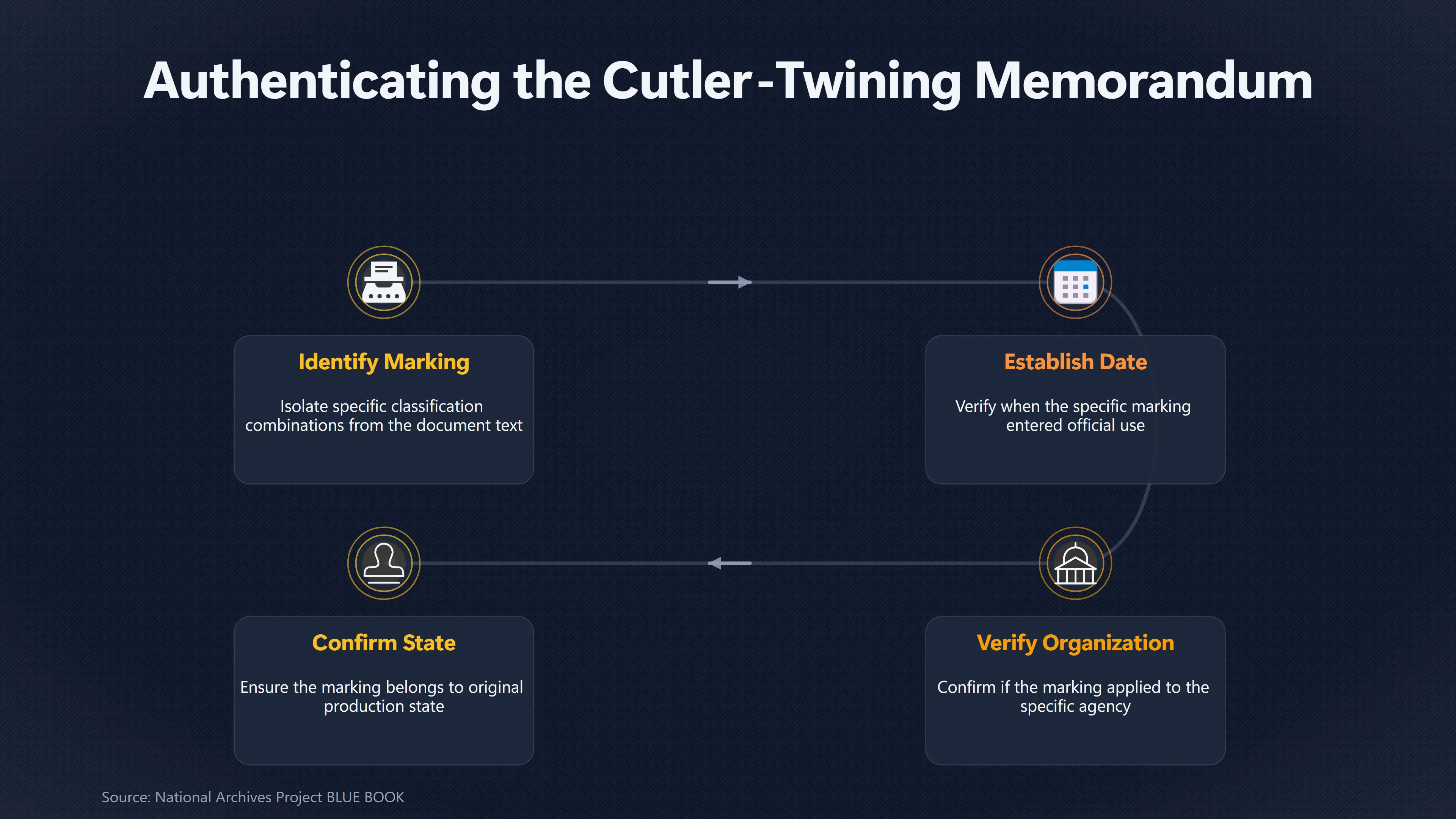
A security marking can be a powerful falsification test for an alleged MJ-12 document, but only when the historical constraint is genuinely firm. The key example is the Cutler–Twining memorandum, dated 14 July 1954. The National Archives reported that its “Top Secret Restricted Information” marking did not come into use at the National Security Council (NSC) until the Nixon administration, and that the Eisenhower Presidential Library likewise found that the marking was not used during Eisenhower’s presidency. On its face, that is close to the ideal anachronism: a 1954 document apparently carrying a marking from a later administrative era.[National Archives]archives.govNational Archives Project BLUE BOOKNational ArchivesProject BLUE BOOK - Unidentified Flying Objects | National ArchivesJune 25, 2024…
The complication is that subsequent MJ-12 debate produced evidence that superficially similar combinations of “Top Secret”, “Restricted” and “Security Information” existed elsewhere in government during the 1950s. That does not vindicate the memorandum, but it changes the test. The decisive question is not whether those words existed somewhere in federal security practice. It is whether this particular marking could legitimately have appeared on an NSC memorandum of the claimed date — and whether what survives on the document is an original marking rather than something added during later handling.
When an anachronism becomes a falsifier
Document authentication distinguishes an improbable feature from an impossible one. If genuine records show that an office normally used one format but occasionally used another, finding the unusual format weakens an authenticity case at most. If a regulation, securely dated administrative change or sufficiently complete record establishes that a particular marking did not yet exist, its appearance can instead establish a terminus post quem: the earliest date at which that marked version of the document could have existed.
That distinction is particularly important with classified records because security markings are governed practices rather than decorative conventions. They identify classification levels and can also carry handling, compartment or dissemination information. Their forms change as classification systems and administrative rules change. Modern National Archives guidance likewise treats markings as formal information about a record’s classification and declassification status, rather than incidental typography.[National Archives]archives.govNational Archives Marking | National ArchivesNational ArchivesMarking | National ArchivesJanuary 3, 2025…
A persuasive marking-based falsification therefore needs three propositions to hold together:
- The marking is identified correctly. Similar-looking combinations must not be collapsed into one supposed classification.
- Its introduction date is securely established for the relevant organisation. Evidence that an NSC marking began in 1969 is much stronger for an alleged NSC document than evidence about unrelated Air Force or State Department practice.
- The marking belongs to the document’s claimed creation state. A later archival, declassification or handling annotation cannot sensibly be used to date the underlying text.
The Cutler–Twining case is unusually interesting because the first two propositions became disputed, while the third is complicated by visible evidence of later records handling.
What the National Archives actually found
The National Archives’ MJ-12 reference report concerns the physical memorandum attributed to presidential special assistant Robert Cutler and addressed to Air Force Chief of Staff General Nathan Twining. It is dated 14 July 1954 and refers to an “NSC/MJ-12 Special Studies Project”. Rather than authenticating the sheet because it was found in government files, Archives staff documented a series of problems with it.[National Archives]archives.govNational Archives Project BLUE BOOKNational ArchivesProject BLUE BOOK - Unidentified Flying Objects | National ArchivesJune 25, 2024…
For the security marking specifically, the Archives recorded two institutional findings. Its enquiry to the NSC’s Freedom of Information Office produced the answer that “Top Secret Restricted Information” did not come into use at the NSC until the Nixon administration, which began in January 1969. Separately, the Eisenhower Presidential Library confirmed that the particular marking was not used during the Eisenhower administration.[National Archives]archives.govNational Archives Project BLUE BOOKNational ArchivesProject BLUE BOOK - Unidentified Flying Objects | National ArchivesJune 25, 2024…
That is much stronger than saying archivists had merely failed to notice another example. It places the objection at the organisation from which the memorandum ostensibly derives and adds a second institution holding extensive Eisenhower-era presidential records. The Archives also found no other MJ-12 material in the folder, no corroborating material after searches of relevant defence and Air Force records, and no Top Secret register number on a document filed in a series organised by such numbers. Those are separate anomalies, but they matter here because the security-marking problem did not arise in isolation.[National Archives]archives.govNational Archives Project BLUE BOOKNational ArchivesProject BLUE BOOK - Unidentified Flying Objects | National ArchivesJune 25, 2024…
There is also an important wording problem. The disputed header is commonly rendered as “Top Secret Restricted Information”, but defenders describe the actual layout more precisely as “TOP SECRET RESTRICTED” above “SECURITY INFORMATION”. That matters because authentic early-1950s records certainly did use Security Information with classifications such as Top Secret. The State Department’s official Foreign Relations of the United States series identifies genuine 1953 NSC and CIA records marked “Top Secret; Security Information”, including memoranda of NSC discussions.[Office of the Historian]history.state.govOffice of the Historian Historical DocumentsOffice of the HistorianHistorical Documents - Office of the Historian…
“Security Information”, therefore, is not itself an anachronism. Nor was “Restricted” absent from early-1950s government security terminology: a 1953 State Department telegram explicitly distinguished “top secret and secret security information” from “confidential and restricted security information”, and another official historical record preserves a 1953 telegram described as “Restricted; Security Information”.[Office of the Historian]history.state.govOffice of the Historian Historical DocumentsOffice of the HistorianHistorical Documents - Office of the HistorianApril 9, 1953…
The sharper question is the combination represented on the Cutler–Twining sheet, especially in NSC practice. Genuine records showing “Top Secret; Security Information” or “Restricted; Security Information” do not by themselves establish that “Top Secret Restricted” was an authorised contemporaneous NSC marking.

The counter-evidence weakens the simple date test
MJ-12 advocate Stanton Friedman directly challenged the Archives’ conclusion. He acknowledged that he had initially found examples such as “Confidential Restricted” and “Secret Restricted” but not “Top Secret Restricted”. He later cited notes from the Government Accountability Office’s 1994 Roswell records search saying investigators had encountered “Top Secret Restricted” on several Air Force documents covering 1948–1956.[The Black Vault]theblackvault.comThe Black Vault Update on Operation Majestic 12 DocumentsThe Black VaultUpdate on Operation Majestic 12 Documents - The Black Vault Case Files…
This deserves careful treatment because it changes the logical status of the argument without settling authenticity. The publicly available GAO report confirms that investigators searched government records concerning Roswell, but the quoted observation about “Top Secret Restricted” comes from accounts of GAO working material reproduced by Friedman rather than from the short published report itself.[Government Accountability Office]gao.govnsiadGovernment Accountability OfficeGovernment Records: Results of a Search for Records Concerning the 1947 Crash Near Roswell, New Mexico |… The underlying documents Friedman said GAO personnel had seen were reportedly still classified, so the precise markings, agencies, contexts and reasons for the wording cannot readily be compared with the Cutler–Twining sheet.
Even accepting that observation, it refutes only an overly broad claim: “Top Secret Restricted” could not occur anywhere in the US government during 1948–56. That is not identical to the National Archives’ narrower and more relevant claim that the particular marking did not come into use at the National Security Council until the Nixon administration. An Air Force atomic-energy or weapons file could follow marking conventions that were inappropriate for a White House or NSC memorandum.
There is a further historical complication. Nuclear information had its own statutory category, Restricted Data, which could coexist with ordinary classification levels such as Top Secret. Consequently, finding the words “Top Secret” and “Restricted” together on an atomic-energy record would not automatically demonstrate the same administrative construction as the disputed MJ-12 marking. The context and exact wording of each exemplar have to be examined before treating them as equivalent.
The result is an instructive reversal. The marking initially looked capable of functioning as a straightforward calendar test: Nixon-era marking on a purported Eisenhower-era document, therefore forgery. The later evidence makes the government-wide version of that argument unsafe. What remains potentially powerful is the NSC-specific proposition, for which the National Archives and Eisenhower Library findings still provide direct institutional evidence.[National Archives]archives.govNational Archives Project BLUE BOOKNational ArchivesProject BLUE BOOK - Unidentified Flying Objects | National ArchivesJune 25, 2024…
Could the marking have been added later?
A genuine old document can acquire younger markings without becoming a forgery. Archival records routinely accumulate declassification stamps and other evidence of later processing. National Archives guidance explicitly describes declassification markings applied during review, while its research-room guidance explains that formerly classified records may receive declassification-authority stamps or equivalent markings when copies are made.[National Archives]archives.govOpen source on archives.gov.
That possibility means an apparent anachronism must be tied physically to the document’s original production. A clearly separate declassification stamp dated decades later tells the history of the record, not the date of the underlying memorandum. Conversely, if an anachronistic classification banner was typed as part of the original text in the same production process, a “later archival stamp” explanation becomes much harder to sustain.
The Cutler–Twining sheet is relevant on precisely this point. The National Archives’ conservation examination described it as a ribbon copy on dictation onionskin, not merely a modern photocopy on which the relationship between markings and paper is unknowable.[National Archives]archives.govNational Archives Project BLUE BOOKNational ArchivesProject BLUE BOOK - Unidentified Flying Objects | National ArchivesJune 25, 2024… Friedman, defending the memorandum, likewise describes the controversial security language as a typed marking and distinguishes it from a diagonal red-pencil line crossing the classification marking, which he argues was associated with later declassification handling.[The Black Vault]theblackvault.comThe Black Vault Update on Operation Majestic 12 DocumentsThe Black VaultUpdate on Operation Majestic 12 Documents - The Black Vault Case Files…
That distinction cuts both ways. The red pencil line could plausibly be later administrative handling without dating the memorandum’s creation. The typed classification header is different: explaining an anachronistic typed header as a routine later declassification annotation would require evidence that somebody subsequently altered or retyped the document in that fashion. The National Archives does not present such an explanation.
At the same time, the presence of period-looking paper or authentic-style declassification treatment cannot establish that the text itself was created in 1954. A later fabricator could in principle use older paper or imitate archival practices. Those features therefore address particular forgery hypotheses rather than reversing the burden created by an independently demonstrated anachronism.
How strong is the security-marking test?
The Cutler–Twining marking is best understood as a potentially strong but not self-sufficient falsification test. The National Archives’ institutional finding is unusually damaging because it is specific to the NSC and is corroborated by the Eisenhower Presidential Library: both place the disputed marking outside documented Eisenhower-era NSC practice.[National Archives]archives.govNational Archives Project BLUE BOOKNational ArchivesProject BLUE BOOK - Unidentified Flying Objects | National ArchivesJune 25, 2024…
But describing the matter simply as “this classification did not exist in 1954” goes further than the available evidence safely permits. Genuine early-1950s records demonstrate that “Security Information” was normal terminology and that “Restricted” remained present in security markings. Friedman’s later citation of GAO investigators encountering “Top Secret Restricted” in 1948–56 Air Force holdings further undermines any claim that the words were chronologically impossible throughout the federal government.[Office of the Historian]history.state.govOffice of the Historian Historical DocumentsOffice of the HistorianHistorical Documents - Office of the Historian…
The historically defensible test is narrower: could an NSC memorandum produced in July 1954 have carried the exact Cutler–Twining marking in the form found on the questioned sheet? On the published official record, the National Archives and Eisenhower Library say that this particular marking was not used there in that period. No comparably direct evidence establishing its use on an authentic Eisenhower-era NSC document has emerged in the sources examined here.
That makes the marking more probative than a mere oddity, but its real lesson is methodological. An anachronism becomes conclusive only when the comparison class is controlled. “Nobody normally wrote it this way” is weak. “This office did not yet use this marking” is much stronger. “This marking was introduced on a documented later date, is demonstrably part of the questioned document’s original production, and has no contemporaneous exception” is the form of evidence that can turn a suspicious feature into a genuine falsifier.
Amazon book picks
Further Reading
Books and field guides related to Can a Security Marking Date an MJ 12 Forgery?. Use these as the next step if you want deeper reading beyond the article.
Top Secret/Majic: Operation Majestic-12 and the United States...
Top Secret/Majic is the result of nuclear physicist and renowned UFO investigator Stanton T. Friedman's twenty-one year search for the tr...
UFOs and the National Security State: Chronology of a Cover-U...
Included in this volume are the records of more than fifty military bases relating to innumerable violations of sensitive airspace by unk...
Forensic Document Examination: Principles and Practice
This book introduces the reader to the basic principles of handwriting and the factors that affect their development. The book discusses...
Scientific Examination of Questioned Documents
This guide to all aspects of a questioned document for attorneys, investigators, document examiners, and others covers the scientific exa...
eBay marketplace picks
Marketplace Samples
Live-tested eBay searches with available results related to this page.
Selected fromUFO poster oneBay.co.uk.




Endnotes
1.
Source: archives.gov
Title: National Archives Project BLUE BOOK
Link:https://www.archives.gov/research/military/air-force/ufos
Source snippet
National ArchivesProject BLUE BOOK - Unidentified Flying Objects | National ArchivesJune 25, 2024...
Published: June 25, 2024
2.
Source: archives.gov
Title: National Archives Marking | National Archives
Link:https://www.archives.gov/isoo/faqs/marking
Source snippet
National ArchivesMarking | National ArchivesJanuary 3, 2025...
Published: January 3, 2025
3.
Source: archives.gov
Title: isoo implementing directive
Link:https://www.archives.gov/isoo/policy-documents/isoo-implementing-directive.html
Source snippet
National Archives32 CFR Parts 2001 and 2003 Classified National Security Information; Final Rule | National Archives...
4.
Source: history.state.gov
Title: Office of the Historian Historical Documents
Link:https://history.state.gov/historicaldocuments/frus1951-54Iran/ch3
Source snippet
Office of the HistorianHistorical Documents - Office of the Historian...
5.
Source: history.state.gov
Title: Office of the Historian Historical Documents
Link:https://history.state.gov//historicaldocuments/frus1951-54Iran/ch3
Source snippet
Office of the HistorianHistorical Documents - Office of the Historian...
6.
Source: history.state.gov
Title: Office of the Historian Historical Documents
Link:https://history.state.gov/historicaldocuments/frus1952-54v01p2/d209
Source snippet
Office of the HistorianHistorical Documents - Office of the HistorianApril 9, 1953...
Published: April 9, 1953
7.
Source: history.state.gov
Title: Office of the Historian Historical Documents
Link:https://history.state.gov/historicaldocuments/frus1951-54IranEd2/d261
Source snippet
Office of the HistorianHistorical Documents - Office of the Historian...
8.
Source: gao.gov
Title: nsiad 95 187
Link:https://www.gao.gov/products/nsiad
Source snippet
Government Accountability OfficeGovernment Records: Results of a Search for Records Concerning the 1947 Crash Near Roswell, New Mexico |...
9.
Source: gao.gov
Title: nsiad 95 187
Link:https://www.gao.gov/assets/nsiad-95-187.pdf
10.
Source: archives.gov
Link:https://www.archives.gov/publications/general-info-leaflets/57-research-room-guidelines.html
11.
Source: archives.gov
Title: National Archives Finding Aids: Holocaust-Era Assets
Link:https://www.archives.gov/research/holocaust/finding-aid/introduction.html
12.
Source: archives.gov
Title: Records Controls Schedules (RCS) Frequently Asked Questions | National Archives
Link:https://www.archives.gov/records-mgmt/faqs/rcs.html
13.
Source: archives.gov
Title: Standard Forms | National Archives
Link:https://www.archives.gov/isoo/security-forms
14.
Source: archives.gov
Title: Basic Laws and Authorities | National Archives
Link:https://www.archives.gov/about/laws/appendix/12958.html
15.
Source: archives.gov
Title: Paper-Based Records | National Archives
Link:https://www.archives.gov/preservation/holdings-maintenance/paper
16.
Source: archives.gov
Title: Classified National Security Information (CNSI) Guidance | National Archives
Link:https://www.archives.gov/guidance/classified-info-guidance
17.
Source: history.state.gov
Title: september 2013
Link:https://history.state.gov//about/hac/september-2013
Published: september 2013
18.
Source: history.state.gov
Title: september 2013
Link:https://history.state.gov/about/hac/september-2013
Published: september 2013
19.
Source: history.state.gov
Title: guide to sources on vietnam 1969 1975
Link:https://history.state.gov/historicaldocuments/guide-to-sources-on-vietnam
20.
Source: archives.gov
Title: Basic Laws and Authorities | National Archives
Link:https://www.archives.gov/about/laws/appendix/13526.html
21.
Source: obamawhitehouse.archives.gov
Link:https://obamawhitehouse.archives.gov/21stcenturygov/actions/classification/
22.
Source: georgewbush-whitehouse.archives.gov
Link:https://georgewbush-whitehouse.archives.gov/wmd/text/report.html
23.
Source: archives.gov
Title: NAR A Bulletin 96-02 | National Archives
Link:https://www.archives.gov/records-mgmt/bulletins/1996/96-02.html
24.
Source: history.state.gov
Link:https://history.state.gov//historicaldocuments/frus1969-76v17/d164
25.
Source: history.state.gov
Link:https://history.state.gov/historicaldocuments/frus1950-55Intel/ch1?start=151
26.
Source: history.state.gov
Link:https://history.state.gov/historicaldocuments/frus1951-54Iran/ch3?start=121
27.
Source: history.state.gov
Link:https://history.state.gov/historicaldocuments/frus1952-54Guat/comp1?start=31
28.
Source: history.state.gov
Link:https://history.state.gov/historicaldocuments/frus1951-54Iran/ch2?start=61
29.
Source: history.state.gov
Link:https://history.state.gov/historicaldocuments/frus1950-55Intel/ch1?start=121
30.
Source: history.state.gov
Link:https://history.state.gov/historicaldocuments/frus1951-54IranEd2/ch2?start=61
31.
Source: history.state.gov
Link:https://history.state.gov/historicaldocuments/frus1961-63v01/d326
32.
Source: history.state.gov
Link:https://history.state.gov//historicaldocuments/frus1961-63v01/d326fn1
33.
Source: history.state.gov
Link:https://history.state.gov//historicaldocuments/frus1955-57v04/d145fn4
34.
Source: history.state.gov
Link:https://history.state.gov//historicaldocuments/frus1955-57v04/d145
35.
Source: history.state.gov
Link:https://history.state.gov//historicaldocuments/frus1955-57v04/d145fn5
36.
Source: history.state.gov
Link:https://history.state.gov//historicaldocuments/frus1955-57v04/d145fn3
37.
Source: history.state.gov
Link:https://history.state.gov//historicaldocuments/frus1955-57v04/d145fn2
38.
Source: history.state.gov
Link:https://history.state.gov//historicaldocuments/frus1955-57v14/d364fn3
39.
Source: history.state.gov
Link:https://history.state.gov//historicaldocuments/frus1955-57v14/d364fn1
40.
Source: history.state.gov
Link:https://history.state.gov//historicaldocuments/frus1955-57v14/d364
41.
Source: cia.gov
Link:https://www.cia.gov/readingroom/document/cia-rdp80-01065a000600040115-1
42.
Source: cia.gov
Link:https://www.cia.gov/readingroom/document/cia-rdp80-01065a000600040116-0
43.
Source: cia.gov
Title: CORRESPONDENC E FROM MR. (Sanitized) | CIA FOIA (foia.cia.gov)
Link:https://www.cia.gov/readingroom/document/cia-rdp80-01065a000600020030-7
44.
Source: theblackvault.com
Title: The Black Vault Update on Operation Majestic 12 Documents
Link:https://www.theblackvault.com/casefiles/update-on-operation-majestic-12-documents/
Source snippet
The Black VaultUpdate on Operation Majestic 12 Documents - The Black Vault Case Files...
45.
Source: medium.com
Link:https://medium.com/stanton-friedmans-articles/update-on-operation-majestic-12-documents-ed2df58fd8a1
46.
Source: lurch2.blogspot.com
Title: majestic 12
Link:https://lurch2.blogspot.com/2013/09/majestic-12.html
47.
Source: col2.com
Title: operation majestic 12
Link:https://www.col2.com/operation-majestic-12
48.
Source: ns2.col2.com
Title: operation majestic 12
Link:https://ns2.col2.com/operation-majestic-12
Additional References
49.
Source: youtube.com
Title: Flying Saucers Are Real
Link:https://www.youtube.com/watch?v=ZWyV6Go15-c
Source snippet
The investigative discussion in Inside shadow intelligence, the MJ-12 documents directly examines the [Cutler-Twining memo]({{ 'cutler-memo/' | relative_url }}) and the specifi...
50.
Source: youtube.com
Link:https://www.youtube.com/watch?v=ogJplVuElLs
Source snippet
Evaluation of Two 'Leaked' UFO Documents | Robert Wood...
51.
Source: youtube.com
Title: The Declassification Engine: What History Reveals about America’s Top Secrets
Link:https://www.youtube.com/watch?v=3uqrBZqULYM
Source snippet
2023 Mandatory Declassification Review Forum...
52.
Source: trumanlibrary.gov
Link:https://www.trumanlibrary.gov/library/public-papers/233/statement-president-upon-signing-executive-order-prescribing-regulations
53.
Source: youtube.com
Link:https://www.youtube.com/watch?v=zfIPef7TPA8
Source snippet
Flying Saucers Are Real - Volume 2 | Top Secret Majic | Stanton T. Friedman...
54.
Source: govinfo.gov
Link:https://www.govinfo.gov/app/details/GOVPUB-D15-PURL-gpo222773
55.
Source: govinfo.gov
Title: Shots Annie to Ray: The First Five Tests of the Upshot-Knothole Series, 17 March
Link:https://www.govinfo.gov/app/details/GOVPUB-D15-PURL-gpo222772
56.
Source: youtube.com
Title: Understanding Classification Markings
Link:https://www.youtube.com/watch?v=Afne8jjSCms
Source snippet
The Declassification Engine: What History Reveals about America's Top Secrets...
57.
Source: reddit.com
Link:https://www.reddit.com/r/UFOs/comments/1f8a4zc/extraordinary_top_secret_meeting_mentioned_cia/
58.
Source: studylibpl.com
Link:https://studylibpl.com/doc/1493801/area-51-the-revealing-truth-of-ufos–secret-aircraft–cov