Within Secrecy Problem
What Records Should a Truly Secret Program Leave?
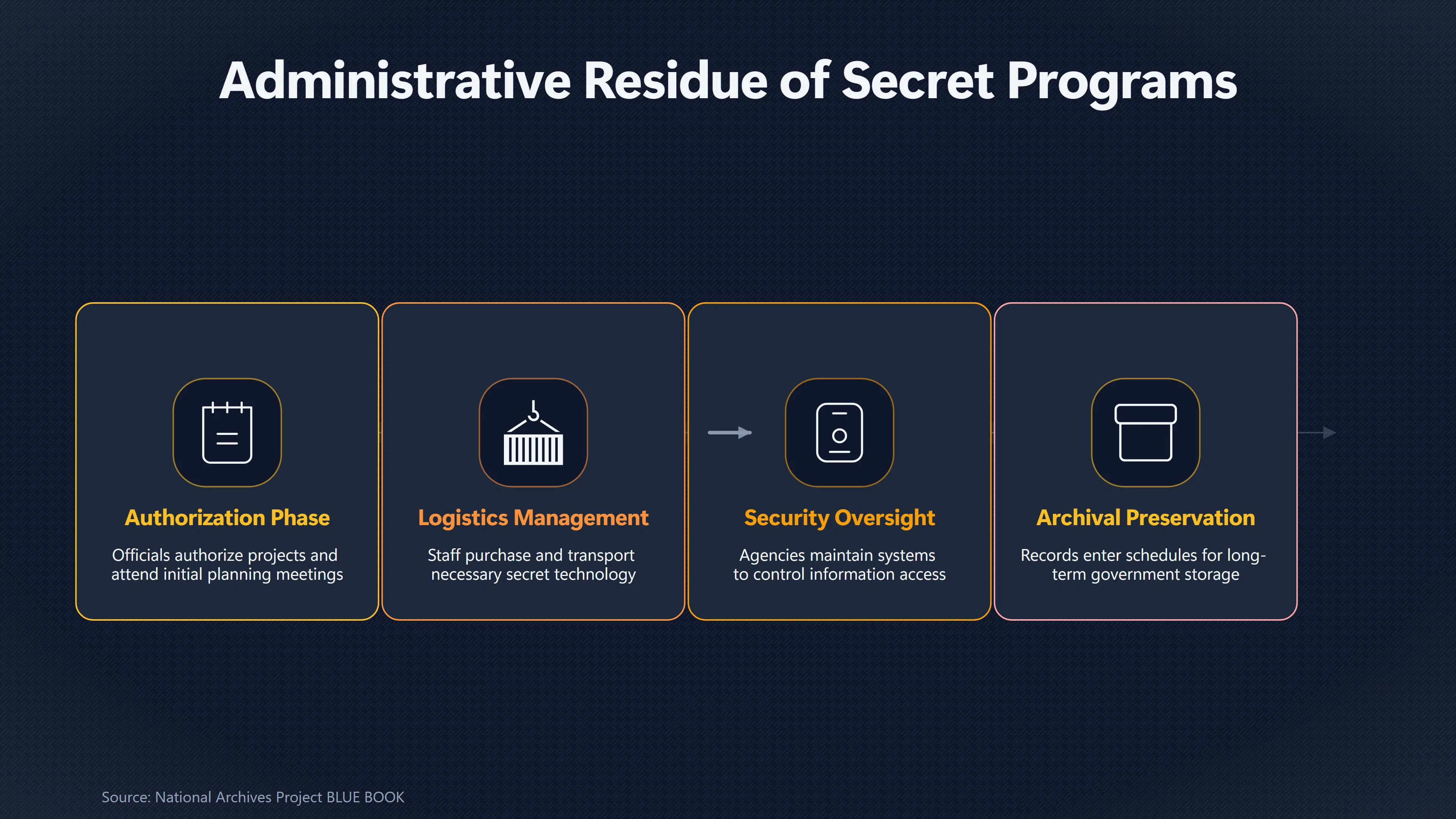
Even highly classified programs normally generate schedules, correspondence, security records and other controlled administrative residue.
On this page
- Why classification does not erase recordkeeping duties
- The secondary traces a compartmented program should create
- How missing administrative residue weakens the MJ 12 claim
Page outline Jump by section
Introduction
Even a genuinely secret government programme does not operate outside government administration. Classification can conceal the substance of a project, restrict who may read its files and delay public access for decades, but the programme still needs people to authorise it, attend meetings, receive clearances, exchange instructions, spend money, handle documents and preserve decisions for authorised successors. Those activities normally create what might be called administrative residue: records whose existence may reveal little about the secret itself but much about the machinery surrounding it.
That distinction matters for the alleged MJ-12 documents. The relevant question is not whether every file describing an exceptionally classified programme should have become public. It is whether a programme supposedly involving senior White House, military and intelligence figures should have left some coherent secondary footprint across the record systems through which those people worked. Searches by the National Archives and other US government bodies have found remarkably little of that supporting residue for MJ-12.[Government Accountability Office]gao.govGovernment Accountability Office[Comments on Majestic 12 Material] | U.S. GAOJuly 28, 1995…
Why classification does not erase recordkeeping duties
Classification and recordkeeping perform different jobs. Classification governs access to sensitive information; records management governs what government activities are documented, retained and eventually disposed of or preserved. Under US federal records law, agency heads must make and preserve records providing “adequate and proper documentation” of their organisations, functions, policies, decisions, procedures and essential transactions. NARA, the National Archives and Records Administration, explains that records are evidence of agency actions and must be managed accordingly.[National Archives]archives.govNational ArchivesRecords Management by Federal Agencies (44 U.S.C. Chapter 31) | National ArchivesApril 29, 2020…
That requirement is particularly relevant to significant decisions made in meetings. NARA’s records-management guidance says formal bodies such as committees, boards and task forces should generate documentation identifying participants, agendas, materials distributed, significant discussions, decisions, follow-up actions and assignments of responsibility. Important decisions made orally are also supposed to be documented so that authorised officials and their successors can understand what was decided.[National Archives]archives.govNational Archives A Management Guide | National ArchivesNational ArchivesA Management Guide | National ArchivesApril 25, 2019…
Secrecy therefore changes where records are kept and who can see them, rather than making administration unnecessary. Even records destined for destruction are normally governed by records schedules. Federal records cannot lawfully be destroyed merely because an official decides that they are inconvenient: NARA states that all federal records must be covered by an approved schedule, while unscheduled records must be treated as permanent until properly scheduled.[National Archives]archives.govNational Archives Scheduling Records | National ArchivesNational ArchivesScheduling Records | National ArchivesSeptember 9, 2025…
The same principle appears explicitly in rules for unusually sensitive compartments. Executive Order 12356, issued in 1982, allowed special access programmes for particularly sensitive classified information but required agency heads to maintain a system accounting for those programmes. The current framework under Executive Order 13526 likewise requires accounting for special access programmes, limits access to relatively small groups, subjects programmes to oversight and calls for annual review of whether each programme remains necessary.[National Archives]archives.govNational Archives Executive Orders | National ArchivesNational ArchivesExecutive Orders | National ArchivesApril 2, 1982…
Those later rules cannot simply be projected backwards as the exact procedures that would have governed a hypothetical MJ-12 organisation beginning in 1947. They demonstrate a broader institutional point, however: extreme compartmentation itself requires administration. Someone must decide that a compartment exists, decide who belongs inside it, control distribution and maintain enough information to keep the security system functioning.
What secondary traces should a compartmented programme create?
The most useful records for verification need not be documents explaining the programme’s deepest secret. A secret project can generate records at several layers, some highly revealing and others comparatively mundane.
A senior-level programme might leave scheduling traces when officials meet, even if the subject of the meeting remains concealed. Eisenhower’s surviving presidential appointment books, for example, cover nearly 23,000 pages and record dates, times, locations and visitors. Significantly, the books sometimes label meetings simply as “Off the Record”. Secrecy about what happened inside a meeting therefore did not necessarily mean that the meeting vanished from the administrative calendar.[Eisenhower Presidential Library]eisenhowerlibrary.govEisenhower Presidential LibraryPresidential Appointment Books | Eisenhower Presidential LibraryJanuary 12, 2026…
It might also create correspondence and routing records: requests for briefings, cover memoranda, acknowledgements, distribution information, file-register entries or instructions passed between offices. A document containing an extraordinary secret may be tightly held while an associated record merely establishes that one official sent material to another.
There would commonly be security residue as well. A compartment cannot remain compartmented unless access is controlled. Later special-access rules make this logic explicit by requiring systems of accounting and oversight. Even where the underlying operational papers remain classified, the security apparatus has to distinguish authorised people and controlled information from everyone and everything else.[National Archives]archives.govNational Archives Executive Orders | National ArchivesNational ArchivesExecutive Orders | National ArchivesApril 2, 1982…
A substantial operation can also create financial, contractual and logistical records. Secret technology still has to be designed, purchased, transported, staffed and maintained. Those processes may be disguised or compartmented, but they tend to multiply the number of administrative systems touched by a programme.
Real secret programmes illustrate the point. The Manhattan Project was among the most closely guarded US wartime undertakings, yet its surviving archival footprint includes formerly classified correspondence, contract case files, field-office records and records concerning production techniques. NARA holdings include Manhattan Engineer District central files, reports, financial material, plant schedules, work orders and meeting minutes; the Department of Energy notes that core administrative records from the project were eventually transferred to NARA.[National Archives]archives.govNational Archives Records of the office of the Chief of Engineers [OCENational Archives Records of the office of the Chief of Engineers [OCE
The highly secret CORONA reconnaissance satellite programme provides another clear example. The National Reconnaissance Office’s declassified collection does not consist solely of intelligence imagery or technical revelations. Its early records include memoranda on financing, charts of programme costs, support directives and documents assigning responsibilities. In other words, the surviving evidence records the bureaucracy required to make the secret project work.[National Reconnaissance Office]nro.govOpen source on nro.gov.
CIA’s U-2 programme similarly produced a documentary history encompassing technological, political and bureaucratic questions. The programme was secret enough that its missions created major national-security consequences when exposed, yet its subsequent historical record can be reconstructed through organisational decisions, inter-agency relationships and programme documentation rather than through a single dramatic document.[CIA]cia.govthe cia and the u 2 programthe cia and the u 2 program
These examples do not establish a fixed quantity of paperwork that every classified operation must leave behind. They show why distributed traces are normal. A project may conceal its purpose from most employees while still producing records in contracting, scheduling, security, logistics and senior management.

MJ-12 has a residue problem, not merely a missing-file problem
This is where the alleged MJ-12 material encounters a more serious evidential difficulty than the familiar argument that “the government has not released the files”. The National Archives reports extensive searches among Air Force and Joint Chiefs of Staff records, as well as searches at the Truman and Eisenhower presidential libraries. Researchers also searched National Security Council indexes using terms including “MJ-12”, “majestic”, “unidentified flying objects”, “UFO”, “flying saucers”, “extraterrestrial biological entities” and “Aquarius”. Those searches produced no supporting body of MJ-12 records.[National Archives]archives.govNational Archives Project BLUE BOOKNational ArchivesProject BLUE BOOK - Unidentified Flying Objects | National Archives…
The exception is important precisely because it illustrates how administrative context can test a document. A one-page memorandum dated 14 July 1954, apparently from presidential adviser Robert Cutler to General Nathan Twining, refers to an “NSC/MJ-12 Special Studies Project” briefing on 16 July. The document is physically held by the National Archives, but NARA stresses that archival custody does not itself authenticate either a document or the information written on it.[National Archives]archives.govNational Archives Project BLUE BOOKNational ArchivesProject BLUE BOOK - Unidentified Flying Objects | National Archives…
The surrounding record system raises several problems. NARA says the memorandum was found in a series filed by Top Secret register number but lacks such a number. No other documents in its folder concern NSC/MJ-12. Searches of related Secretary of Defense, Joint Chiefs, Air Force and NSC records failed to produce further information, while the July 1954 NSC meeting minutes contained no reference to MJ-12 or Majestic.[National Archives]archives.govNational Archives Project BLUE BOOKNational ArchivesProject BLUE BOOK - Unidentified Flying Objects | National Archives…
The scheduling residue is similarly awkward. According to the Eisenhower Library’s archival research reported by NARA, the President’s appointment books contain no entry for the alleged 16 July 1954 special briefing. That absence is more informative than it might initially seem because Eisenhower’s appointment system recorded some confidential encounters merely as “Off the Record”. The library therefore had an administrative mechanism for acknowledging that a meeting occurred without publicly explaining its substance.[National Archives]archives.govNational Archives Project BLUE BOOKNational ArchivesProject BLUE BOOK - Unidentified Flying Objects | National Archives…
There is also a problem with the supposed sender. NARA found records showing that Cutler was visiting military installations in Europe and North Africa from 3 to 15 July 1954. Before leaving, he had given two subordinates instructions for handling NSC administrative matters during his absence. NARA consequently noted the expectation that one of those officials would have signed an authentic memorandum issued through his office while he was away.[National Archives]archives.govNational Archives Project BLUE BOOKNational ArchivesProject BLUE BOOK - Unidentified Flying Objects | National Archives…
None of those anomalies, considered alone, constitutes a mathematical proof of fabrication. Administrative systems contain errors. Files can be misfiled, duplicated, lost or legally destroyed; classified collections can remain closed; and historians rarely possess a perfect record of government activity. The stronger point is cumulative: an alleged document becomes more credible when the surrounding bureaucracy behaves as expected and less credible when it repeatedly does not.
What a convincing administrative footprint would look like
For MJ-12, persuasive corroboration would not require the discovery of another spectacular briefing paper describing extraterrestrial bodies or recovered spacecraft. In fact, mundane records could carry greater evidential weight because they would be harder to explain as copies derived from the same disputed narrative.
The strongest corroborating pattern would involve independent records from different administrative systems converging on the same organisation. A presidential calendar might establish a meeting; an Air Force register might document receipt of a controlled memorandum; a security file might show access being granted; a budget or contract record might reveal a concealed expenditure; and correspondence in a participant’s personal papers might independently refer to the same committee or compartment. Individually, such records could disclose very little. Together, they could establish that the organisation actually functioned.
This is how archival verification becomes stronger than judging whether a typeface, signature or security marking “looks official”. Genuine programmes become embedded in institutional processes. The Manhattan Project’s records spread through field offices, contracts, correspondence and administrative files. CORONA generated financing papers, cost charts and responsibility directives. Even VENONA, a small and exceptionally sensitive cryptanalytic programme begun in 1943, ultimately left a substantial documentary collection; the NSA’s released holdings include chronologies, dated documents and material explicitly concerned with administrative and personnel matters.[archives.gov]archives.govNational Archives Records of the office of the Chief of Engineers [OCENational Archives Records of the office of the Chief of Engineers [OCE
That comparison must be used carefully. It would be unreasonable to demand that a hypothetical MJ-12 programme produce exactly the same kinds or volume of surviving records as Manhattan, CORONA or VENONA. Different agencies, eras, missions and security arrangements create different archives. The comparison establishes the mechanism, not a rigid archival template: real secret work still requires real administrative work.
Why the missing residue weakens the MJ-12 claim
The absence of corroborating administrative traces does not prove that no deeply classified programme could ever have existed. Historical records are incomplete, and classification can substantially reduce what researchers are allowed to see. The proper conclusion is narrower.
The alleged MJ-12 organisation is presented as a high-level undertaking involving senior officials and matters of extraordinary national importance. Such a body would have had to operate repeatedly through offices already generating schedules, correspondence, security controls and institutional records. Yet extensive archival searches have not produced the kind of distributed supporting footprint that established secret programmes commonly leave. GAO reported in 1995 that the Information Security Oversight Office, Air Force and National Archives knew of MJ-12 material principally because private individuals had submitted it to them, and that archivists had found neither records fitting the alleged organisation nor references establishing it. GAO concluded that there was no evidence the circulated MJ-12 material constituted genuine executive-branch documents.[Government Accountability Office]gao.govGovernment Accountability Office[Comments on Majestic 12 Material] | U.S. GAOJuly 28, 1995…
This turns the secrecy argument into a testable evidential question. If secrecy is invoked to explain the absence of the primary files, it must eventually also explain the missing calendars, registers, correspondence, meeting records, security administration and other secondary traces. Each individual absence may have an innocent explanation. Requiring all of them to disappear, remain hidden or evade multiple archival searches demands a progressively stronger secrecy hypothesis.
That is why administrative residue matters so much when assessing the alleged MJ-12 documents. The issue is not that secret programmes cannot hide important information; demonstrably, they can. It is that classification suppresses access more readily than it suppresses the organisational consequences of doing government work. Until independent records reveal those consequences around MJ-12, exceptional secrecy remains a possible explanation for missing evidence, but not positive evidence that MJ-12 existed.
Amazon book picks
Further Reading
Books and field guides related to What Records Should a Truly Secret Program Leave?. Use these as the next step if you want deeper reading beyond the article.

The CIA and the Cult of Intelligence
First published 1974. Subjects: United States, United States. Central Intelligence Agency, CIA, Inlichtingendiensten, Spionage.
Top Secret/Majic: Operation Majestic-12 and the United States...
Top Secret/Majic is the result of nuclear physicist and renowned UFO investigator Stanton T. Friedman's twenty-one year search for the tr...
Legacy of Ashes: The History of the CIA
Traces the history of the CIA from the end of World War II to Iraq, in a study that condemns the organization for its record, its inabili...
eBay marketplace picks
Marketplace Samples
Live-tested eBay searches with available results related to this page.
Selected fromUFO poster oneBay.co.uk.




Endnotes
1.
Source: gao.gov
Link:https://www.gao.gov/products/154832
Source snippet
Government Accountability Office[Comments on Majestic 12 Material] | U.S. GAOJuly 28, 1995...
Published: July 28, 1995
2.
Source: archives.gov
Title: National Archives Project BLUE BOOK
Link:https://www.archives.gov/research/military/air-force/ufos
Source snippet
National ArchivesProject BLUE BOOK - Unidentified Flying Objects | National Archives...
3.
Source: archives.gov
Link:https://www.archives.gov/about/laws/fed-agencies.html
Source snippet
National ArchivesRecords Management by Federal Agencies (44 U.S.C. Chapter 31) | National ArchivesApril 29, 2020...
Published: April 29, 2020
4.
Source: archives.gov
Link:https://www.archives.gov/records-mgmt/faqs/general.html
5.
Source: archives.gov
Title: National Archives A Management Guide | National Archives
Link:https://www.archives.gov/records-mgmt/policy/agency-recordkeeping-requirements.html
Source snippet
National ArchivesA Management Guide | National ArchivesApril 25, 2019...
Published: April 25, 2019
6.
Source: archives.gov
Title: National Archives Scheduling Records | National Archives
Link:https://www.archives.gov/records-mgmt/scheduling/sch-records
Source snippet
National ArchivesScheduling Records | National ArchivesSeptember 9, 2025...
Published: September 9, 2025
7.
Source: archives.gov
Title: National Archives Disposal of Records (44 U.S.C. Chapter 33) | National Archives
Link:https://www.archives.gov/about/laws/disposal-of-records.html
8.
Source: archives.gov
Title: National Archives Executive Orders | National Archives
Link:https://www.archives.gov/federal-register/codification/executive-order/12356.html
Source snippet
National ArchivesExecutive Orders | National ArchivesApril 2, 1982...
Published: April 2, 1982
9.
Source: archives.gov
Title: National Archives Basic Laws and Authorities | National Archives
Link:https://www.archives.gov/about/laws/appendix/13526.html
10.
Source: archives.gov
Title: National Archives Records of the office of the Chief of Engineers [OCE]
Link:https://www.archives.gov/research/guide-fed-records/groups/077.html
11.
Source: archives.gov
Title: National Archives Record Groups 310
Link:https://www.archives.gov/atlanta/holdings/rg-300-600.html
12.
Source: energy.gov
Link:https://www.energy.gov/lm/manhattan-project-historical-resources
13.
Source: cia.gov
Title: the cia and the u 2 program 1954 1974
Link:https://www.cia.gov/resources/csi/books-monographs/the-cia-and-the-u-2-program-1954-1974/
14.
Source: nsa.gov
Title: National Security Agency Venona Documents
Link:https://www.nsa.gov/Helpful-Links/NSA-FOIA/Declassification-Transparency-Initiatives/Historical-Releases/Venona/smdpage14707/24/smdsort14707/title/
15.
Source: archives.gov
Title: Specific Access Restriction | National Archives
Link:https://www.archives.gov/research/catalog/lcdrg/elements/specific-access-restriction
16.
Source: archives.gov
Link:https://www.archives.gov/personnel-records-center/civilian-non-archival
17.
Source: archives.gov
Title: Records Scheduling and Appraisal | National Archives
Link:https://www.archives.gov/records-mgmt/sch-appraisal
18.
Source: energy.gov
Title: FOI A/Privacy Act | Department of Energy
Link:https://www.energy.gov/emcbc/foiaprivacy-act
19.
Source: archives.gov
Link:https://www.archives.gov/personnel-records-center/civilian-personnel/employee-medical-folders
20.
Source: archives.gov
Title: Records Basics | National Archives
Link:https://www.archives.gov/records-mgmt/scheduling/basics
21.
Source: archives.gov
Title: Freedom of Information Act Requests | National Archives
Link:https://www.archives.gov/foia-requests
22.
Source: energy.gov
Link:https://www.energy.gov/nnsa/articles/army-and-origins-nuclear-security-enterprise
23.
Source: archives.gov
Title: NAR A Privacy Act Systems: NARA 45 | National Archives
Link:https://www.archives.gov/privacy/inventory/nara-45
24.
Source: archives.gov
Title: Exemptions from Automatic Declassification | National Archives
Link:https://www.archives.gov/declassification/iscap/auto-declass-exemptions.html
25.
Source: archives.gov
Title: National Archives and Records Administration (NARA) | National Archives
Link:https://www.archives.gov/about/laws/nara
26.
Source: archives.gov
Title: Energy Records at the National Archives at Atlanta | National Archives
Link:https://www.archives.gov/atlanta/finding-aids/energy
27.
Source: records-express.blogs.archives.gov
Title: new bulletin on metadata for classified electronic records
Link:https://records-express.blogs.archives.gov/2025/02/03/new-bulletin-on-metadata-for-classified-electronic-records/
28.
Source: archives.gov
Link:https://www.archives.gov/records-mgmt/bulletins/2025/2025-01
29.
Source: archives.gov
Title: Special Access and FOIA | National Archives
Link:https://www.archives.gov/research/foia
30.
Source: archives.gov
Title: Records Control Schedules (RCS) | National Archives
Link:https://www.archives.gov/records-mgmt/rcs
31.
Source: archives.gov
Title: Records of the Atomic Energy Commission [AEC]
Link:https://www.archives.gov/research/guide-fed-records/groups/326.html
32.
Source: archives.gov
Title: Records of the Central Intelligence Agency [CIA]
Link:https://www.archives.gov/research/guide-fed-records/groups/263.html
33.
Source: archives.gov
Title: Records of the War Department General and Special Staffs
Link:https://www.archives.gov/research/guide-fed-records/groups/165.html
34.
Source: archives.gov
Title: “OK, We’ll Go” | National Archives
Link:https://www.archives.gov/publications/prologue/2014/spring/d-day-ok-well-go
35.
Source: archives.gov
Title: Basic Laws and Authorities | National Archives
Link:https://www.archives.gov/about/laws/appendix/12958.html
36.
Source: archives.gov
Title: PR A Special Access Requests from Congress | National Archives
Link:https://www.archives.gov/press/press-releases/2023/nr23
37.
Source: energy.gov
Title: Oppenheimer: Then & Now | Department of Energy
Link:https://www.energy.gov/articles/oppenheimer-then-now
38.
Source: gao.gov
Link:https://www.gao.gov/products/b-334032.2
39.
Source: gao.gov
Link:https://www.gao.gov/products/b-334032
40.
Source: archives.gov
Title: NAR A Privacy Act Systems: NARA 24 | National Archives
Link:https://www.archives.gov/privacy/inventory/nara-24
41.
Source: archives.gov
Title: Milestones | National Archives
Link:https://www.archives.gov/open/milestones.html
42.
Source: archives.gov
Title: Special Prosecutors and Independent Counsels Records | National Archives
Link:https://www.archives.gov/research/investigations/special-prosecutors-indept-counsels
43.
Source: archives.gov
Link:https://www.archives.gov/about/laws/records-management.html
44.
Source: archives.gov
Title: NAR A Records Schedule | National Archives
Link:https://www.archives.gov/about/records-schedule
45.
Source: archives.gov
Title: General Records Schedules (GRS) | National Archives
Link:https://www.archives.gov/open/grs-dataset
46.
Source: archives.gov
Title: Transcript | National Archives
Link:https://www.archives.gov/ogis/foia-advisory-committee/2020-2022-term/meetings/foiaac-mtg-transcript
47.
Source: archives.gov
Link:https://www.archives.gov/records-mgmt/faqs/records-mgmt/faqs/scheduling-appraisal
48.
Source: archives.gov
Title: National Archives and Declassification | National Archives
Link:https://www.archives.gov/declassification
49.
Source: archives.gov
Title: Declassified Records | National Archives
Link:https://www.archives.gov/research/declassification.html
50.
Source: archives.gov
Title: Using the General Records Schedules | National Archives
Link:https://www.archives.gov/records-mgmt/scheduling/grs
51.
Source: archives.gov
Title: Preparing Disposition Instructions | National Archives
Link:https://www.archives.gov/records-mgmt/scheduling/instructions
52.
Source: gao.gov
Link:https://www.gao.gov/products/gao
53.
Source: archives.gov
Title: Frequently Asked Questions about Federal Records Management | National Archives
Link:https://www.archives.gov/records-mgmt/faqs/federal.html
54.
Source: archives.gov
Title: 2017 02 html
Link:https://www.archives.gov/records-mgmt/bulletins/2017/2017-02-html
55.
Source: archives.gov
Title: Classification 319: Administrative Records | National Archives
Link:https://www.archives.gov/research/investigations/fbi/classifications/319-administrative-records.html
56.
Source: archives.gov
Title: Finding Aids: Holocaust-Era Assets
Link:https://www.archives.gov/research/holocaust/finding-aid/introduction.html
57.
Source: archives.gov
Title: General Information about [Restricted]({{ ‘restricted/’ | relative_url }}) Records | National Archives
Link:https://www.archives.gov/declassification/ndc/restricted-records.html
58.
Source: gao.gov
Link:https://www.gao.gov/products/gao
59.
Source: declassification.blogs.archives.gov
Title: ndc releases 445 new entries processed between june 1 and july 26 2013
Link:https://declassification.blogs.archives.gov/2013/08/26/ndc-releases-445-new-entries-processed-between-june-1-and-july-26-2013/
60.
Source: declassification.blogs.archives.gov
Title: nobel prize winning scientists associated with the manhattan project
Link:https://declassification.blogs.archives.gov/2013/02/01/nobel-prize-winning-scientists-associated-with-the-manhattan-project/
61.
Source: energy.gov
Link:https://www.energy.gov/lm/manhattan-project-background-information-and-preservation-work
62.
Source: gao.gov
Link:https://www.gao.gov/assets/a314440.html
63.
Source: narations.blogs.archives.gov
Title: what do all those numbers associated with nara records mean
Link:https://narations.blogs.archives.gov/2010/04/30/what-do-all-those-numbers-associated-with-nara-records-mean/
64.
Source: obamawhitehouse.archives.gov
Title: executive order classified national security information
Link:https://obamawhitehouse.archives.gov/realitycheck/the-press-office/executive-order-classified-national-security-information
65.
Source: obamawhitehouse.archives.gov
Link:https://obamawhitehouse.archives.gov/21stcenturygov/actions/classification/
66.
Source: obamawhitehouse.archives.gov
Link:https://obamawhitehouse.archives.gov/node/28387/
67.
Source: gao.gov
Link:https://www.gao.gov/assets/a276567.html
68.
Source: cia.gov
Title: The U-2 Program: The DCI’s Perspective
Link:https://www.cia.gov/resources/csi/studies-in-intelligence/archives/vol-42-no-5/the-u-2-program-the-dcis-perspective/
69.
Source: pclt.defense.gov
Title: qnro 21
Link:https://pclt.defense.gov/DIRECTORATES/Privacy-and-Civil-Liberties-Directorate/Privacy/SORNsIndex/Article/4007789/qnro-21/
70.
Source: gao.gov
Link:https://www.gao.gov/assets/a250315.html
71.
Source: archives.gov
Title: ig1605 2
Link:https://www.archives.gov/foia/directives/ig1605-2.html
72.
Source: archives.gov
Title: Federal Enterprise Architecture Records Management Profile | National Archives
Link:https://www.archives.gov/records-mgmt/policy/rm-profile.html
73.
Source: georgewbush-whitehouse.archives.gov
Link:https://georgewbush-whitehouse.archives.gov/news/releases/2005/06/20050628-4.html
74.
Source: gao.gov
Title: 04 295r
Link:https://www.gao.gov/products/gao-04-295r
75.
Source: archives.gov
Title: Strategic Planning and Reporting | National Archives
Link:https://www.archives.gov/about/plans-reports/strategic-plan/2003
76.
Source: georgewbush-whitehouse.archives.gov
Link:https://georgewbush-whitehouse.archives.gov/news/releases/2003/03/text/20030325-11.html
77.
Source: archives.gov
Title: performance plan
Link:https://www.archives.gov/about/plans-reports/performance-plan/2003
78.
Source: pclt.defense.gov
Title: qnro 19
Link:https://pclt.defense.gov/DIRECTORATES/Privacy-and-Civil-Liberties-Directorate/Privacy/SORNsIndex/Article/4007774/qnro-19/
79.
Source: gao.gov
Title: gao 01 780
Link:https://www.gao.gov/products/gao
80.
Source: archives.gov
Title: Third Report | National Archives
Link:https://www.archives.gov/legislative/cla/advisory-committee/third-report.html
81.
Source: cia.gov
Title: NATIONA L SECURITY INFORMATION | CIA FOIA (foia.cia.gov)
Link:https://www.cia.gov/readingroom/document/cia-rdp87b01034r000200050009-9
82.
Source: archives.gov
Title: NAR A Bulletin 98-02 | National Archives
Link:https://www.archives.gov/records-mgmt/bulletins/1998/98-02.html
83.
Source: cia.gov
Link:https://www.cia.gov/resources/csi/books-monographs/venona/
84.
Source: gao.gov
Title: nsiad 95 187
Link:https://www.gao.gov/products/nsiad
85.
Source: gao.gov
Link:https://www.gao.gov/products/b-259569.3-0
86.
Source: gao.gov
Link:https://www.gao.gov/products/t-nsiad
87.
Source: archives.gov
Title: eo 12829
Link:https://www.archives.gov/files/isoo/policy-documents/eo-12829.html
88.
Source: cia.gov
Title: DIRECTO R OF CENTRAL INTELLIGENCE DIRECTIVE NO. 1/14 | CIA FOIA (foia.cia.gov)
Link:https://www.cia.gov/readingroom/document/cia-rdp85b01152r000100110076-4
89.
Source: cia.gov
Title: ZER O-BASED CLEARANCE REVIEW | CIA FOIA (foia.cia.gov)
Link:https://www.cia.gov/readingroom/document/cia-rdp96m01138r000400020008-6
90.
Source: cia.gov
Title: COMMUNIT Y-WIDE ADHERENCE TO DCID 1/14 | CIA FOIA (foia.cia.gov)
Link:https://www.cia.gov/readingroom/document/cia-rdp96m01138r000600030066-9
91.
Source: cia.gov
Link:https://www.cia.gov/readingroom/document/cia-rdp82m00591r000100100035-3
92.
Source: cia.gov
Link:https://www.cia.gov/readingroom/document/cia-rdp10t01930r000600030019-1
93.
Source: cia.gov
Link:https://www.cia.gov/readingroom/document/cia-rdp10t01930r000600030024-5
94.
Source: archives.gov
Link:https://www.archives.gov/records-mgmt/policy/managing-web-records-background.html
95.
Source: obamawhitehouse.archives.gov
Link:https://obamawhitehouse.archives.gov/node/18434/
96.
Source: obamawhitehouse.archives.gov
Link:https://obamawhitehouse.archives.gov/open/around/eop/omb/plan/
97.
Source: archives.gov
Link:https://www.archives.gov/research/guide-fed-records/groups/227.html
98.
Source: archives.gov
Link:https://www.archives.gov/research/guide-fed-records/groups/374.html/1000
99.
Source: archives.gov
Link:https://www.archives.gov/research/guide-fed-records/groups/326.html/1000
100.
Source: archives.gov
Title: ike presidency
Link:https://www.archives.gov/publications/prologue/2015/fall/ike-presidency
101.
Source: archives.gov
Link:https://www.archives.gov/research/guide-fed-records/groups/130.html/1000
102.
Source: archives.gov
Link:https://www.archives.gov/research/guide-fed-records/groups/130.html
103.
Source: obamalibrary.archives.gov
Title: electronic records guide
Link:https://obamalibrary.archives.gov/research/electronic-records-guide
104.
Source: archives.gov
Link:https://www.archives.gov/research/guide-fed-records/groups/077.html/1000
105.
Source: archives.gov
Link:https://www.archives.gov/research/guide-fed-records/groups/319.html
106.
Source: archives.gov
Link:https://www.archives.gov/records-mgmt/rcs/schedules/index.html
107.
Source: archives.gov
Link:https://www.archives.gov/records-mgmt/grs/machine-implementable-faq
108.
Source: archives.gov
Link:https://www.archives.gov/publications/prologue/index/2009.html
109.
Source: epds.gao.gov
Link:https://epds.gao.gov/
110.
Source: nsa.gov
Link:https://www.nsa.gov/Helpful-Links/NSA-FOIA/Declassification-Transparency-Initiatives/FOIA-Reports-and-Releases/FOIA-Reports-and-Releases-List/smdpage17166/2/
111.
Source: nsa.gov
Link:https://www.nsa.gov/Helpful-Links/NSA-FOIA/Declassification-Transparency-Initiatives/FOIA-Reports-and-Releases/FOIA-Reports-and-Releases-List/
112.
Source: nsa.gov
Link:https://www.nsa.gov/serve-from-netstorage/news-features/declassified-documents/venona/index.html
113.
Source: nsa.gov
Link:https://www.nsa.gov/Helpful-Links/NSA-FOIA/Declassification-Transparency-Initiatives/Historical-Releases/Venona/smdpage14707/27/
114.
Source: nsa.gov
Link:https://www.nsa.gov/Helpful-Links/NSA-FOIA/Declassification-Transparency-Initiatives/Historical-Releases/Venona/smdpage14707/9/smdsort14707/title/
115.
Source: nsa.gov
Link:https://www.nsa.gov/Helpful-Links/NSA-FOIA/Declassification-Transparency-Initiatives/FOIA-Reports-and-Releases/FOIA-Reports-and-Releases-List/igtag/6652457/
116.
Source: nsa.gov
Link:https://www.nsa.gov/Helpful-Links/NSA-FOIA/Declassification-Transparency-Initiatives/Historical-Releases/Venona/?smdpage14707=81
117.
Source: energy.gov
Link:https://www.energy.gov/cio/doe-records-disposition-schedules-0
118.
Source: energy.gov
Link:https://www.energy.gov/lm/historical-resources
119.
Source: energy.gov
Link:https://www.energy.gov/lm/researching-doe-records
120.
Source: stage.energy.gov
Title: researching doe records
Link:https://stage.energy.gov/lm/researching-doe-records
121.
Source: ehss.energy.gov
Link:https://ehss.energy.gov/ohre/new/findingaids/epidemiologic/orise/orise/32.html
122.
Source: usc-cdn.house.gov
Link:https://usc-cdn.house.gov/view.xhtml?edition=prelim&path=%2Fprelim%40title50%2Fchapter45%2Fsubchapter3
123.
Source: uscode.house.gov
Link:https://uscode.house.gov/view.xhtml?edition=prelim&req=granuleid%3AUSC-prelim-title50-section3348
124.
Source: historyhub.history.gov
Title: manhattan project files
Link:https://historyhub.history.gov/military-records/military-and-civilian-personnel-records/f/personnel-records-forum/39786/manhattan-project-files
125.
Source: cia.gov
Title: cia rdp75b00159r000200070002 1
Link:https://www.cia.gov/readingroom/document/cia-rdp75b00159r000200070002-1
126.
Source: cia.gov
Title: ASSESSMEN T OF THE PRESENT AND FUTURE(SANITIZED) | CIA FOIA (foia.cia.gov)
Link:https://www.cia.gov/readingroom/document/cia-rdp75b00159r000400100068-3
127.
Source: cia.gov
Title: U-2 AIRCRAFT CARRIER OPERATION | CIA FOIA (foia.cia.gov)
Link:https://www.cia.gov/readingroom/document/cia-rdp80t01137a000400080001-8
128.
Source: cia.gov
Title: CI A’S ROLE IN THE NATIONAL RECONNAISSANCE PROGRAMS | CIA FOIA (foia.cia.gov)
Link:https://www.cia.gov/readingroom/document/cia-rdp63-00313a000500140016-5
129.
Source: cia.gov
Title: NR O SECURITY POLICY | CIA FOIA (foia.cia.gov)
Link:https://www.cia.gov/readingroom/document/cia-rdp75b00326r000200230018-0
130.
Source: cia.gov
Title: VIEW S CONCERNING TRANSFER OF U-2 AIRCRAFT TO CIA | CIA FOIA (foia.cia.gov)
Link:https://www.cia.gov/readingroom/document/cia-rdp75b00159r000400010024-1
131.
Source: cia.gov
Title: cia rdp90t00782r000100120006 5
Link:https://www.cia.gov/readingroom/document/cia-rdp90t00782r000100120006-5
132.
Source: youtube.com
Title: Top Secret / MAJIC: Investigation into the MJ-12 UFO Documents
Link:https://www.youtube.com/watch?v=-Je48I-xNjY
Source snippet
National Archives declassification government records secret programs The War Department's UAP Declassification Enigma...
133.
Source: eisenhowerlibrary.gov
Link:https://www.eisenhowerlibrary.gov/research/presidential-appointment-books
Source snippet
Eisenhower Presidential LibraryPresidential Appointment Books | Eisenhower Presidential LibraryJanuary 12, 2026...
Published: January 12, 2026
134.
Source: nro.gov
Link:https://www.nro.gov/foia-home/foia-declassified-nro-programs-and-projects/Declassified-Collection-of-CORONA-ARGON-and-LANYARD-Records/
135.
Source: eisenhowerlibrary.gov
Title: Oral Histories | Eisenhower [Presidential Library]({{ ‘library-searches/’ | relative_url }})
Link:https://www.eisenhowerlibrary.gov/research/oral-histories
136.
Source: eisenhowerlibrary.gov
Title: Speeches | Eisenhower Presidential Library
Link:https://www.eisenhowerlibrary.gov/eisenhowers/speeches
137.
Source: eisenhowerlibrary.gov
Title: Robert Culter and the Lavender Scare | Eisenhower Presidential Library
Link:https://www.eisenhowerlibrary.gov/press-releases/robert-culter-and-lavender-scare
138.
Source: en.wikisource.org
Title: Executive Order 13526
Link:https://en.wikisource.org/wiki/Executive_Order_13526
139.
Source: archives.gettysburg.edu
Link:https://archives.gettysburg.edu/repositories/4/resources/112
140.
Source: nro.gov
Link:https://www.nro.gov/foia-home/foia-declassified-nro-programs-and-projects/
141.
Source: nro.gov
Link:https://www.nro.gov/foia-home/Declassified-NRO-Programs-and-Projects/
142.
Source: nro.gov
Link:https://www.nro.gov/Site-Index/
143.
Source: nro.gov
Link:https://www.nro.gov/foia-home/FOIA/
144.
Source: nro.gov
Title: foia declassified from the nro archives
Link:https://www.nro.gov/foia-home/foia-declassified-from-the-nro-archives/
145.
Source: nro.gov
Link:https://www.nro.gov/foia-home/foia-declassified-historically-significant-documents/hexagon-index-declassified-documents/
146.
Source: eisenhowerlibrary.gov
Title: seaton fred
Link:https://www.eisenhowerlibrary.gov/research/finding-aids/seaton-fred
147.
Source: eisenhowerlibrary.gov
Link:https://www.eisenhowerlibrary.gov/research/finding-aids?page=2
148.
Source: eisenhowerlibrary.gov
Title: eisenhower dwight d 3
Link:https://www.eisenhowerlibrary.gov/research/finding-aids/eisenhower-dwight-d-3
149.
Source: eisenhowerlibrary.gov
Link:https://www.eisenhowerlibrary.gov/research/finding-aids/white-house-office-office-special-assistant-national-security-affairs-robert
150.
Source: eisenhowerlibrary.gov
Title: Declassified Documents
Link:https://www.eisenhowerlibrary.gov/research/online-documents/declassified-documents-fiscal-year-2017
151.
Source: eisenhowerlibrary.gov
Title: Declassified Documents
Link:https://www.eisenhowerlibrary.gov/research/online-documents/declassified-documents-fiscal-year-2012
152.
Source: eisenhowerlibrary.gov
Title: cutler robert
Link:https://www.eisenhowerlibrary.gov/research/finding-aids/cutler-robert
153.
Source: eisenhowerlibrary.gov
Title: finding aids
Link:https://www.eisenhowerlibrary.gov/research/finding-aids?page=1
154.
Source: eisenhowerlibrary.gov
Title: Finding Aids | Eisenhower Presidential Library FINDING AIDS Displaying 501
Link:https://www.eisenhowerlibrary.gov/research/finding-aids?page=10
155.
Source: eisenhowerlibrary.gov
Link:https://www.eisenhowerlibrary.gov/search/%E9%BB%91%E7%9A%AE%E4%B9%A6bt?page=1
156.
Source: eisenhowerlibrary.gov
Title: Finding Aids | Eisenhower Presidential Library FINDING AIDS Displaying 551
Link:https://www.eisenhowerlibrary.gov/research/finding-aids?page=11
157.
Source: findingaids.loc.gov
Link:https://findingaids.loc.gov/repositories/19/resources/3213
158.
Source: nationalarchives.gov.uk
Title: Redaction Toolkit
Link:https://www.nationalarchives.gov.uk/terms-and-conditions/takedown-and-reclosure-policies/reclosure-policy/redaction-toolkit/
159.
Source: osti.gov
Link:https://www.osti.gov/opennet/manhattan-project-history/People/NonTechnicalPersonnel/information.html
160.
Source: osti.gov
Link:https://www.osti.gov/opennet/manhattan-project-history/Events/1945-present/venona.htm
Additional References
161.
Source: congress.gov
Link:https://www.congress.gov/crs-product/IF12080
162.
Source: osti.gov
Link:https://www.osti.gov/opennet/manhattan-project-history/Resources/openness.htm
163.
Source: osti.gov
Link:https://www.osti.gov/opennet/manhattan-project-history/People/Administrators/robert-oppenheimer.html
164.
Source: osti.gov
Link:https://www.osti.gov/opennet/manhattan-project-history/People/Administrators/leslie-groves.html
165.
Source: osti.gov
Link:https://www.osti.gov/opennet/manhattan-project-history/People/Administrators/administrators.html
166.
Source: osti.gov
Link:https://www.osti.gov/opennet/manhattan-project-history/People/MilitaryOrgs/cic.html
167.
Source: osti.gov
Link:https://www.osti.gov/opennet/manhattan-project-history/People/MilitaryOrgs/wac.html
168.
Source: osti.gov
Link:https://www.osti.gov/opennet/manhattan-project-history/People/NonTechnicalPersonnel/non-technical-personnel.html
169.
Source: osti.gov
Link:https://www.osti.gov/opennet/manhattan-project-history/Places/LosAlamos/la-security.html
170.
Source: osti.gov
Link:https://www.osti.gov/opennet/manhattan-project-history/Resources/sources.htm