Within Proof Needed
How Much Physical Consistency Would an MJ 12 Original Need?
Paper, ink, typewriting and production methods would matter most if all of them independently converged on the claimed date, creator and handling process.
On this page
- What paper, ink and typed text testing can actually establish
- Why period compatibility cannot prove official authorship
- How multiple forensic results could strengthen proven provenance
Page outline Jump by section
Introduction
Physical testing could materially strengthen the case for an alleged original MJ-12 document, but merely showing that its paper, ink and typing are compatible with the 1940s or 1950s would not authenticate it. The stronger forensic question is whether several independent features converge on the same claimed date, office, production method and documentary history — and whether those findings also fit a demonstrable government provenance.
That distinction is crucial because forensic document examination can establish technological possibilities, identify inconsistencies and sometimes connect a document to particular materials or equipment. It cannot ordinarily turn period-correct stationery into proof of official authorship. The National Archives’ own MJ-12 research illustrates the problem: the disputed Cutler-Twining memorandum physically exists in federal holdings, yet its filing context, markings and surrounding records raise unresolved difficulties rather than independently confirming the alleged MJ-12 programme.[National Archives]archives.govNational Archives Project BLUE BOOKNational ArchivesProject BLUE BOOK - Unidentified Flying Objects | National ArchivesJune 25, 2024…
What paper, ink and typed-text testing can actually establish
A genuine original would permit substantially more testing than a photocopy or scan. Questioned-document examination encompasses paper and ink analysis, typewriting, mechanical impressions, alterations and other physical features. The Scientific Working Group for Forensic Document Examination (SWGDOC) has published methods covering non-destructive paper examination, writing-ink comparison and identification, typed text and physical relationships between pieces of paper. The US National Institute of Justice likewise describes chemical and physical examination of inks and papers as tools for investigating a document’s authorship, authenticity or creation date.[SWGDoc]swgdoc.orgPublished StandardsPublished StandardsMay 28, 2021…
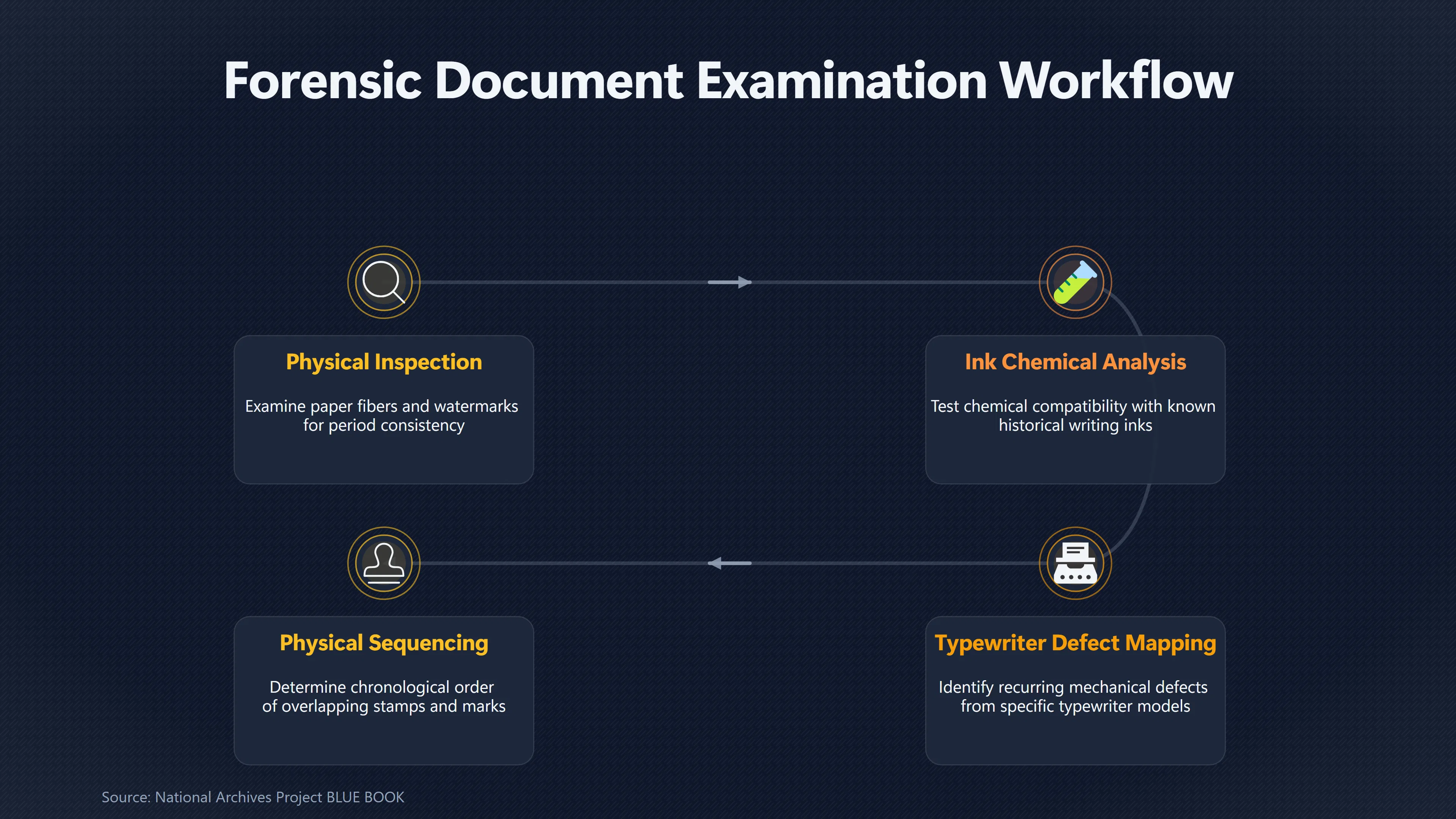
For an alleged MJ-12 original, these methods would be most useful when asked narrowly defined questions. Does the paper contain fibres, coatings, optical characteristics or a watermark inconsistent with its claimed date? Is an ink chemically compatible with the period? Was the text produced by an impact typewriter rather than a later printing technology? Do defects in particular characters correspond to a known machine? Do different pages appear to belong to the same physical production run?
Typewriting can sometimes be especially informative. Traditional forensic examination compares such characteristics as type design, character size and spacing, alignment and recurring defects. An FBI technical account notes that individual defects in characters and alignment can assist efforts to associate typing with a particular machine, while proper comparison requires suitable exemplars from the suspected typewriter. ASTM’s historical guide for examining typewritten items similarly distinguished comparisons of questioned and known material and emphasised whether sufficient material exists for a meaningful examination.[Office of Justice Programs]ojp.govOpen source on ojp.gov.
That distinction between a typewriter model and a particular typewriter matters enormously for MJ-12. Establishing that a memorandum was typed using a design available in 1954 is only a compatibility finding. Establishing distinctive recurring defects matching contemporaneous documents from the actual office that supposedly produced it would be considerably stronger. The latter begins to connect the physical object with a specific documentary environment rather than merely with an era.
Ink evidence requires similar restraint. ASTM’s forensic ink-comparison guidance was designed to help determine whether two ink samples have a common or different origin, but explicitly placed identification of the manufacturer’s formula, manufacture date and ink dating outside that particular comparison standard. Scientific reviews describe absolute ink dating as a particularly difficult problem because chemical ageing depends on the ink itself and on environmental variables such as light, humidity, temperature and storage.[ASTM Store]store.astm.orgASTM StoreE1422 Standard Guide for Test Methods for Forensic Writing Ink ComparisonAugust 16, 2017…
Modern analytical techniques can nevertheless discriminate among inks and papers with considerable power. NIJ-sponsored research using laser-induced breakdown spectroscopy reported high discrimination rates among tested writing and printing inks, while mass-spectrometry research has shown that chemically distinguishable profiles can be obtained from inks on paper. Such techniques could help determine whether supposedly contemporaneous entries actually used materially different inks or whether substituted pages differ from the rest of a document. But discrimination is not the same as historical attribution: finding that two inks differ, or resemble one another, does not by itself identify who applied them or why.[National Institute of Justice]nij.ojp.govOpen source on ojp.gov.
Why period compatibility cannot prove official authorship
The central forensic risk is confusing absence of anachronism with positive authentication. A document made with materials available in 1952 could have been produced in 1952, but it could also have been produced later using old paper, an old typewriter and historically appropriate office supplies. Physical compatibility therefore narrows the possible explanations; it does not establish which explanation is correct.
This is especially relevant because supporters of MJ-12 authenticity have themselves emphasised favourable findings involving paper, ink, watermarks, typography and typewriters. The Majestic Documents project, an advocacy source rather than a neutral forensic authority, argues that such testing indicates that a number of specimens are unlikely to be straightforward modern computer-generated forgeries. Significantly, however, the same project acknowledges that documents in the wider corpus come from sources of differing provenance and treats provenance separately from forensic characteristics in its own authentication framework.[Majestic Documents]majesticdocuments.comMajestic Documents Authentication Articles | Majestic DocumentsMajestic Documents Authentication Articles | Majestic Documents
That separation is methodologically sound even if one disagrees about individual MJ-12 specimens. A chemically appropriate ink can establish compatibility with a production scenario. A matching watermark can constrain the possible paper source. Correct typography can remove one suspected anachronism. None of those results identifies the government official who ordered the document, the secretary or clerk who prepared it, the office that filed it or the route by which it entered archival custody.
The US government’s findings therefore remain an important control against overinterpreting physical compatibility. In 1995, the Government Accountability Office reported that the Information Security Oversight Office, Air Force and National Archives knew the publicly circulated MJ-12 material through submissions from non-governmental persons and that there was no evidence those materials were actual executive-branch documents. That conclusion is fundamentally about origin and documentary status, not whether someone could acquire period-compatible paper or typography.[Government Accountability Office]gao.govGovernment Accountability Office[Comments on Majestic 12 Material] | U.S. GAOGovernment Accountability Office[Comments on Majestic 12 Material] | U.S. GAO
The National Archives’ treatment of the Cutler-Twining memorandum provides an even sharper example. The memorandum was found in Record Group 341, but the Archives notes that it lacks the Top Secret register number expected for the series, has no accompanying MJ-12 documents in its folder, and has no supporting trail in searches of relevant Air Force, Joint Chiefs, defence and National Security Council records. It also records that Robert Cutler was overseas when the memorandum bearing his name was supposedly issued.[National Archives]archives.govNational Archives Project BLUE BOOKNational ArchivesProject BLUE BOOK - Unidentified Flying Objects | National ArchivesJune 25, 2024…
This does not mean that a single filing irregularity automatically proves forgery. Archival collections can contain misplaced, misfiled or anomalous records. It means that physical age cannot erase contextual anomalies. If laboratory examination showed that the Cutler-Twining sheet and typing were entirely consistent with 1954, the archival questions would remain: who produced it, why is it where it is, why does it lack the expected register number, and why has no corresponding documentary trail been located?
A persuasive result would require independent convergence
The most valuable forensic result would therefore not be one spectacular laboratory test. It would be a set of independent findings that all point towards the same historical production event.
Imagine, for example, an alleged 1950s MJ-12 memorandum recovered from an authenticated government file. Its evidential value would increase substantially if examination established that its paper matched stock independently documented as being used by that office; its typewriting contained recurring defects matching contemporaneous records produced on an identifiable office machine; its ink or ribbon characteristics were compatible with those records; its stamps, annotations and filing marks were physically applied in an order consistent with normal processing; and associated records showed that the named sender, recipient and meeting actually belonged to the same administrative chain.
The significance would come from convergence, not simply from accumulating compatible features. Ten findings that merely say “this technology existed in 1954” are less probative than several independent findings that connect the object specifically to the office, equipment, workflow and records series claimed for it.
Physical sequencing could add another useful layer where the document contains overlapping typing, handwriting, stamps or other markings. Research in questioned-document examination shows that, under suitable conditions, microscopy, spectroscopy and fluorescence techniques can sometimes determine which of two intersecting marks was applied first. The effectiveness varies with the materials and method: studies have reported strong results for particular combinations but also conditions in which sequencing remains difficult.[PubMed]pubmed.ncbi.nlm.nih.govOpen source on nih.gov.
For MJ-12, such a result would matter most if it tested an historically meaningful proposition. Suppose an original bore a security stamp crossing typed text and a dated handwritten routing annotation. Establishing the physical order of those operations could test whether the document was processed in the sequence expected of a genuine office record. A contradictory sequence — for example, an allegedly original administrative mark demonstrably applied before material it was supposed to certify — could be powerful evidence against authenticity. A correct sequence would be supportive, although still not uniquely diagnostic of official origin.
The same principle applies to comparison specimens. Forensic conclusions become more informative when questioned material can be compared with genuine contemporaneous records rather than with general descriptions of period practice. A claimed White House or National Security Council document should ideally be tested against originals from the relevant office, dates and workflow: comparable paper stocks, typewriting, routing marks, classification markings, filing conventions and other production details. National Archives guidance on provenance explains why records gain evidential meaning from their relationship to the agency and administrative processes that created them, rather than from their textual contents in isolation.[National Archives]archives.govOpen source on archives.gov.
Provenance determines how much the laboratory results mean
The same favourable laboratory finding can carry radically different evidential weight depending on where the document came from. If an anonymous source supplies an old-looking sheet, confirmation that its paper dates from the appropriate period mainly establishes that the material is plausible. If an untouched document is discovered inside a demonstrably continuous official file, surrounded by independently authenticated records generated by the same office, an equivalent paper result becomes one element of a much stronger cumulative case.
This is why chain of custody is not an administrative technicality. The US National Archives defines custodial history as the history of archival material from creation to accession and specifically says that changes of ownership or breaks in government custody can affect interpretation and the assurance of authenticity and integrity.[National Archives]archives.govNational Archives Custodial History Note | National ArchivesNational Archives Custodial History Note | National Archives
The archival principle of provenance goes further. Government records acquire much of their evidential significance from the functions and administrative organisation that produced and accumulated them. Removing an item from that context can obscure precisely the relationships needed to understand what the document represents.[National Archives]archives.govOpen source on archives.gov.
For alleged MJ-12 originals, forensic testing should therefore operate as a cross-check on provenance rather than a substitute for it. The strongest possible discovery would have two mutually reinforcing dimensions: an independently demonstrable government history explaining why the document exists where it does, and physical evidence independently consistent with that history.
What would materially change the MJ-12 assessment?
A genuinely important forensic breakthrough would need to move beyond the weak proposition that an alleged document “could be old”. The practical threshold should be whether examination creates a specific, difficult-to-explain connection between the physical object and its claimed official production history.
Several results together could meet that threshold: an original recovered through documented official custody; paper and other materials consistent with genuine comparison records from the claimed office; typed characteristics associating it with equipment demonstrably used there; physically coherent stamps, annotations and processing sequences; and corroborating records showing the same event, personnel or administrative action independently of the disputed document. Each finding should ideally come from evidence that does not depend on assuming MJ-12 was real in the first place.
Conversely, a period-correct watermark, historically available typeface or chemically plausible ink would remain limited evidence if the specimen arrived anonymously and lacked an official documentary trail. Such results would be worth reporting because they could eliminate particular forgery hypotheses. They would not justify the stronger conclusion that the US government created the document.
That is the key evidential distinction for alleged MJ-12 material. Physical consistency is strongest at answering “Could this object have been made in the claimed period and manner?” Authentication requires the harder question: “Does independent evidence show that this particular object was actually made, processed and preserved by the government office it claims to represent?” The available official record has not supplied that convergence: GAO found no evidence that the circulated MJ-12 material originated as executive-branch documents, while National Archives searches found no supporting MJ-12 documentary trail beyond the problematic Cutler-Twining memorandum.[Government Accountability Office]gao.govGovernment Accountability Office[Comments on Majestic 12 Material] | U.S. GAOGovernment Accountability Office[Comments on Majestic 12 Material] | U.S. GAO
Forensic examination could help change that assessment if a suitable original emerged. But its most convincing contribution would not be proving that somebody possessed old paper, old ink and an old typewriter. It would be demonstrating that multiple independent physical characteristics align with a separately established chain of provenance — the combination that turns period plausibility into meaningful positive evidence of origin.
Amazon book picks
Further Reading
Books and field guides related to How Much Physical Consistency Would an MJ 12 Original Need?. Use these as the next step if you want deeper reading beyond the article.
Forensic Document Examination: Principles and Practice
This book introduces the reader to the basic principles of handwriting and the factors that affect their development. The book discusses...
Scientific Examination of Questioned Documents
This guide to all aspects of a questioned document for attorneys, investigators, document examiners, and others covers the scientific exa...
Forensic Science: An Introduction to Scientific and Investiga...
Covering a range of fundamental topics essential to modern forensic investigation, the fourth edition of the landmark text Forensic Scien...
eBay marketplace picks
Marketplace Samples
Live-tested eBay searches with available results related to this page.
Selected fromUFO poster oneBay.co.uk.




Endnotes
1.
Source: archives.gov
Title: National Archives Project BLUE BOOK
Link:https://www.archives.gov/research/military/air-force/ufos
Source snippet
National ArchivesProject BLUE BOOK - Unidentified Flying Objects | National ArchivesJune 25, 2024...
Published: June 25, 2024
2.
Source: gao.gov
Title: Government Accountability Office[Comments on Majestic 12 Material] | U.S. GAO
Link:https://www.gao.gov/products/154832
3.
Source: swgdoc.org
Title: Published Standards
Link:https://www.swgdoc.org/index.php/standards/published-standards
Source snippet
Published StandardsMay 28, 2021...
Published: May 28, 2021
4.
Source: store.astm.org
Link:https://store.astm.org/e2494-07.html
Source snippet
ASTM StoreE2494 Standard Guide for Examination of Typewritten Items...
5.
Source: store.astm.org
Link:https://store.astm.org/e1422-01.html
Source snippet
ASTM StoreE1422 Standard Guide for Test Methods for Forensic Writing Ink ComparisonAugust 16, 2017...
Published: August 16, 2017
6.
Source: archives.gov
Link:https://www.archives.gov/research/alic/reference/archives-resources/principles-of-arrangement.html
7.
Source: archives.gov
Title: National Archives Custodial History Note | National Archives
Link:https://www.archives.gov/research/catalog/lcdrg/elements/custodial-history-note
8.
Source: archives.gov
Title: Records Basics | National Archives
Link:https://www.archives.gov/records-mgmt/scheduling/basics
9.
Source: swgdoc.org
Link:https://www.swgdoc.org/
10.
Source: swgdoc.org
Link:https://www.swgdoc.org/index.php/2-uncategorised
11.
Source: swgdoc.org
Title: Estándares Publicados en Español
Link:https://www.swgdoc.org/index.php/standards/en-espanol
13.
Source: archives.gov
Link:https://www.archives.gov/records-mgmt/scheduling/id
14.
Source: swgdoc.org
Title: About Us
Link:https://www.swgdoc.org/index.php/about-us
15.
Source: store.astm.org
Link:https://store.astm.org/e1422-98.html
16.
Source: store.astm.org
Link:https://store.astm.org/e2290-07.html
17.
Source: store.astm.org
Link:https://store.astm.org/e2494-08.html
18.
Source: archives.gov
Link:https://www.archives.gov/records-mgmt/publications/managing-audiovisual-records.html
19.
Source: archives.gov
Title: Intrinsic Value in Archival Material | National Archives
Link:https://www.archives.gov/research/alic/reference/archives-resources/archival-material-intrinsic-value.html
20.
Source: store.astm.org
Link:https://store.astm.org/e2325-05.html
21.
Source: store.astm.org
Link:https://store.astm.org/e2287-08.html
22.
Source: archives.gov
Title: Strategic Directions: Custody | National Archives
Link:https://www.archives.gov/records-mgmt/initiatives/custody.html
23.
Source: gao.gov
Link:https://www.gao.gov/products/hr
24.
Source: gao.gov
Link:https://www.gao.gov/products/hr
25.
Source: astm.org
Link:https://www.astm.org/membership-participation/technical-committees/committee-e30/subcommittee-e30/jurisdiction-e3090
26.
Source: vault.fbi.gov
Link:https://vault.fbi.gov/search?SearchableText=Majestic
27.
Source: vault.fbi.gov
Link:https://vault.fbi.gov/unexplained-phenomenon/search
28.
Source: vault.fbi.gov
Title: alphabetical listing collection
Link:https://vault.fbi.gov/alphabetical-listing-collection/?b_start%3Aint=1100
29.
Source: fbi.gov
Link:https://www.fbi.gov/video-repository/inside-the-fbi-ufos-102921.mp4/view
30.
Source: vault.fbi.gov
Link:https://vault.fbi.gov/Majestic%2012/Majestic%2012%20Part%2001%20%28Final%29/view
31.
Source: vault.fbi.gov
Title: Majestic 12
Link:https://vault.fbi.gov/Majestic%2012/
32.
Source: vault.fbi.gov
Link:https://vault.fbi.gov/search?created%3Adate%3Alist=1970%2F02%2F01%3A00%3A00+US%2FEastern&created_usage=range%3Amin&portal_type%3Alist=ATFile&portal_type%3Alist=ATImage&portal_type%3Alist=Document&portal_type%3Alist=Event&portal_type%3Alist=FDPS&portal_type%3Alist=Favorite&portal_type%3Alist=File&portal_type%3Alist=Folder&portal_type%3Alist=Image&portal_type%3Alist=Large+Plone+Folder&portal_type%3Alist=Link&portal_type%3Alist=News+Item&portal_type%3Alist=Topic&pt_toggle=%23&submit=Search
33.
Source: nij.ojp.gov
Link:https://nij.ojp.gov/topics/articles/overview-questioned-documents
34.
Source: ojp.gov
Link:https://www.ojp.gov/ncjrs/virtual-library/abstracts/examination-typewritten-document
35.
Source: nij.ojp.gov
Link:https://nij.ojp.gov/topics/articles/fast-and-versatile-forensic-analysis-ink-and-paper-easily-operated-laser
36.
Source: nij.ojp.gov
Link:https://nij.ojp.gov/library/publications/analysis-writing-inks-paper-using-direct-analysis-real-time-mass-spectrometry
37.
Source: majesticdocuments.com
Title: Majestic Documents Authentication Articles | Majestic Documents
Link:https://majesticdocuments.com/documents/document-authentication/authentication-articles/
38.
Source: majesticdocuments.com
Title: Majestic Documents Authenticity Ratings | Majestic Documents
Link:https://majesticdocuments.com/documents/majestic-documents/authenticity-ratings/
39.
Source: pubmed.ncbi.nlm.nih.gov
Link:https://pubmed.ncbi.nlm.nih.gov/28585688/
40.
Source: pubmed.ncbi.nlm.nih.gov
Link:https://pubmed.ncbi.nlm.nih.gov/27122424/
41.
Source: pubmed.ncbi.nlm.nih.gov
Link:https://pubmed.ncbi.nlm.nih.gov/38379159/
42.
Source: nationalarchives.gov.uk
Link:https://www.nationalarchives.gov.uk/professional-guidance-and-services/our-research-and-academic-collaboration/our-research-projects/research-projects/exploring-archival-value-does-the-perfect-parchment-exist/
43.
Source: isp.idaho.gov
Title: document examination
Link:https://isp.idaho.gov/forensics/document-examination/
44.
Source: ncbi.nlm.nih.gov
Link:https://www.ncbi.nlm.nih.gov/books/NBK621601/
45.
Source: study.com
Title: Forensic Document Examination | Process, History & Examples | Study.com
Link:https://study.com/academy/lesson/forensic-document-examination-process-history-examples.html
46.
Source: GOV.UK
Title: www.gov.uk Forensic science activities: statutory code of practice
Link:https://www.gov.uk/government/publications/forensic-science-activities-statutory-code-of-practice-version-2/forensic-science-activities-statutory-code-of-practice-version-2-accessible
47.
Source: GOV.UK
Title: www.gov.uk Draft code of practice (accessible)
Link:https://www.gov.uk/government/consultations/forensic-science-code-of-practice-version-2/draft-code-of-practice-accessible
48.
Source: pubmed.ncbi.nlm.nih.gov
Link:https://pubmed.ncbi.nlm.nih.gov/39733694/
49.
Source: nist.gov
Link:https://www.nist.gov/standard/956
50.
Source: GOV.UK
Title: www.gov.uk[Withdrawn] Draft statutory Code version 2 (accessible)
Link:https://www.gov.uk/government/publications/forensic-science-regulator-draft-statutory-code-v2-for-comment/draft-statutory-code-version-2-accessible
51.
Source: pubmed.ncbi.nlm.nih.gov
Link:https://pubmed.ncbi.nlm.nih.gov/35195289/
52.
Source: pubmed.ncbi.nlm.nih.gov
Link:https://pubmed.ncbi.nlm.nih.gov/32344206/
53.
Source: pmc.ncbi.nlm.nih.gov
Link:https://pmc.ncbi.nlm.nih.gov/articles/PMC7770439/
54.
Source: pubmed.ncbi.nlm.nih.gov
Link:https://pubmed.ncbi.nlm.nih.gov/32202656/
55.
Source: pubmed.ncbi.nlm.nih.gov
Link:https://pubmed.ncbi.nlm.nih.gov/31617942/
56.
Source: naa.gov.au
Title: Archival Control Model | naa.gov.au
Link:https://www.naa.gov.au/about-us/our-organisation/accountability-and-reporting/archival-policy-and-planning/archival-control-model
57.
Source: pmc.ncbi.nlm.nih.gov
Link:https://pmc.ncbi.nlm.nih.gov/articles/PMC7888914/
58.
Source: majesticdocuments.com
Title: National Archives & Records Administration | Majestic Documents
Link:https://majesticdocuments.com/documents/official-ufo-documents/national-archives-records-administration/
59.
Source: majesticdocuments.com
Title: documents dated 1960 1969
Link:https://majesticdocuments.com/documents/majestic-documents/documents-dated-1960-1969/
60.
Source: majesticdocuments.com
Title: documents dated prior to 1948
Link:https://majesticdocuments.com/documents/majestic-documents/documents-dated-prior-to-1948/
61.
Source: majesticdocuments.com
Title: Document Sources | Majestic Documents
Link:https://majesticdocuments.com/documents/document-sources/
62.
Source: pubmed.ncbi.nlm.nih.gov
Link:https://pubmed.ncbi.nlm.nih.gov/29332691/
63.
Source: mjib.gov.tw
Title: Questioned Document Examination Laboratory
Link:https://www.mjib.gov.tw/EditPage/?PageID=439d61c3-0a79-49ad-b38f-6fa32049dfce
64.
Source: pubmed.ncbi.nlm.nih.gov
Link:https://pubmed.ncbi.nlm.nih.gov/27859244/
65.
Source: pubmed.ncbi.nlm.nih.gov
Link:https://pubmed.ncbi.nlm.nih.gov/27122423/
66.
Source: scribd.com
Title: SWGDOC Metodologia Para Exame de Documentos Alterados
Link:https://www.scribd.com/document/762128262/SWGDOC-Metodologia-Para-Exame-de-Documentos-Alterados
67.
Source: pubmed.ncbi.nlm.nih.gov
Link:https://pubmed.ncbi.nlm.nih.gov/25467455/
68.
Source: ojp.gov
Link:https://www.ojp.gov/ncjrs/virtual-library/abstracts/analysis-writing-inks-paper-using-direct-analysis-real-time-mass
69.
Source: pubmed.ncbi.nlm.nih.gov
Link:https://pubmed.ncbi.nlm.nih.gov/20487143/
70.
Source: pubmed.ncbi.nlm.nih.gov
Link:https://pubmed.ncbi.nlm.nih.gov/20061099/
71.
Source: ojp.gov
Title: Dating of Ballpoint Pen Ink | Office of Justice Programs
Link:https://www.ojp.gov/ncjrs/virtual-library/abstracts/dating-ballpoint-pen-ink
72.
Source: ro.scribd.com
Link:https://ro.scribd.com/document/472644084/196986
73.
Source: ojp.gov
Title: AG E OF A DOCUMENT | Office of Justice Programs
Link:https://www.ojp.gov/ncjrs/virtual-library/abstracts/age-document
74.
Source: nationalarchives.gov.uk
Title: Knowing what you have
Link:https://www.nationalarchives.gov.uk/archives-sector/advice-and-guidance/managing-your-collection/archive-basics/gaining-control/knowing-what-you-have/
75.
Source: nationalarchives.gov.uk
Title: Citing records in The National Archives
Link:https://www.nationalarchives.gov.uk/help-with-your-research/discovery-help/citing-records-national-archives/
76.
Source: nationalarchives.gov.uk
Title: Our digital cataloguing practices
Link:https://www.nationalarchives.gov.uk/professional-guidance-and-services/cataloguing-practices/digital-cataloguing-practices/
77.
Source: ojp.gov
Title: questioned document examination forensic sciences chapter 39 1981
Link:https://ojp.gov/ncjrs/virtual-library/abstracts/questioned-document-examination-forensic-sciences-chapter
78.
Source: ojp.gov
Link:https://www.ojp.gov/ncjrs/virtual-library/abstracts/sketch-analytical-methods-document-dating-part-ii-dynamic-approach
81.
Source: ojp.gov
Link:https://ojp.gov/ncjrs/virtual-library/abstracts/sketch-analytical-methods-document-dating-part-i-static-approach
82.
Source: ojp.gov
Title: Scientific Examination of Questioned Documents
Link:https://www.ojp.gov/ncjrs/virtual-library/abstracts/scientific-examination-questioned-documents-revised-edition
83.
Source: ojp.gov
Link:https://www.ojp.gov/ncjrs/virtual-library/abstracts/identification-typewritten-documents
84.
Source: ojp.gov
Title: Questioned Document Examination (From Scientific and Expert Evidence
Link:https://www.ojp.gov/ncjrs/virtual-library/abstracts/questioned-document-examination-scientific-and-expert-evidence
85.
Source: ojp.gov
Title: forensic document examination research findings forensic
Link:https://www.ojp.gov/ncjrs/virtual-library/abstracts/forensic-document-examination-research-findings-forensic
86.
Source: ojp.gov
Link:https://www.ojp.gov/ncjrs/virtual-library/abstracts/questioned-documents-lawyers-handbook
87.
Source: ojp.gov
Link:https://www.ojp.gov/ncjrs/virtual-library/abstracts/differentiating-writing-inks-using-direct-analysis-real-time-mass
88.
Source: ojp.gov
Link:https://www.ojp.gov/ncjrs/virtual-library/abstracts/trends-field-questioned-document-examination
89.
Source: ojp.gov
Link:https://www.ojp.gov/ncjrs/virtual-library/abstracts/problems-identification-typewriter-makes-and-models
90.
Source: forensicsciencesimplified.org
Title: Forensic Document Examination
Link:https://www.forensicsciencesimplified.org/docs/index.htm
Additional References
91.
Source: sciencedirect.com
Link:https://www.sciencedirect.com/science/article/pii/S0379073809004708
Source snippet
Analytical methods for dating modern writing instrument inks on paper - ScienceDirect...
92.
Source: youtube.com
Title: Questioned Documents
Link:https://www.youtube.com/watch?v=F92wsBurvWs
Source snippet
Majestic 12 documents forensic analysis Ancient Aliens: Top Secret Documents for Majic Eyes Only (Season 12, Episode 9) | History...
93.
Source: nist.gov
Link:https://www.nist.gov/standard/1756
94.
Source: nist.gov
Link:https://www.nist.gov/osac/standards-library?1=status%3A2813946&2=subcommittee%3A2809611&3=subcommittee%3A2809636&4=subcommittee%3A2809651&5=subcommittee%3A2809691&6=subcommittee%3A2809711&7=subcommittee%3A2809716&k=&order=label&page=1&sort=asc
95.
Source: nist.gov
Link:https://www.nist.gov/osac/standards-library?k=&order=standard_number&page=11&sort=desc
96.
Source: nist.gov
Link:https://www.nist.gov/osac/standards-library
97.
Source: nist.gov
Link:https://www.nist.gov/osac/standards-library?page=1
98.
Source: nist.gov
Link:https://www.nist.gov/osac/standards-library?k=&order=label&page=1&sort=asc
99.
Source: nist.gov
Link:https://www.nist.gov/osac/standards-library?0=subcommittee%3A2809641&1=subcommittee%3A2809651&2=subcommittee%3A2809691&3=subcommittee%3A2809711&4=subcommittee%3A2809716&5=subcommittee%3A2809641&6=subcommittee%3A2809651&7=subcommittee%3A2809691&8=subcommittee%3A2809711&9=subcommittee%3A2809716&k=&order=standard_number&page=1&sort=asc
100.
Source: nist.gov
Link:https://www.nist.gov/osac/standards-library?0=subcommittee%3A2809616&1=subcommittee%3A2809636&2=subcommittee%3A2809651&3=subcommittee%3A2809711&4=subcommittee%3A2809716&5=subcommittee%3A2809616&6=subcommittee%3A2809636&7=subcommittee%3A2809651&8=subcommittee%3A2809711&9=subcommittee%3A2809716&k=&order=label&page=1&sort=asc