Within Paper Forensics
Do the Paper Clues Add Up Against the Memo?
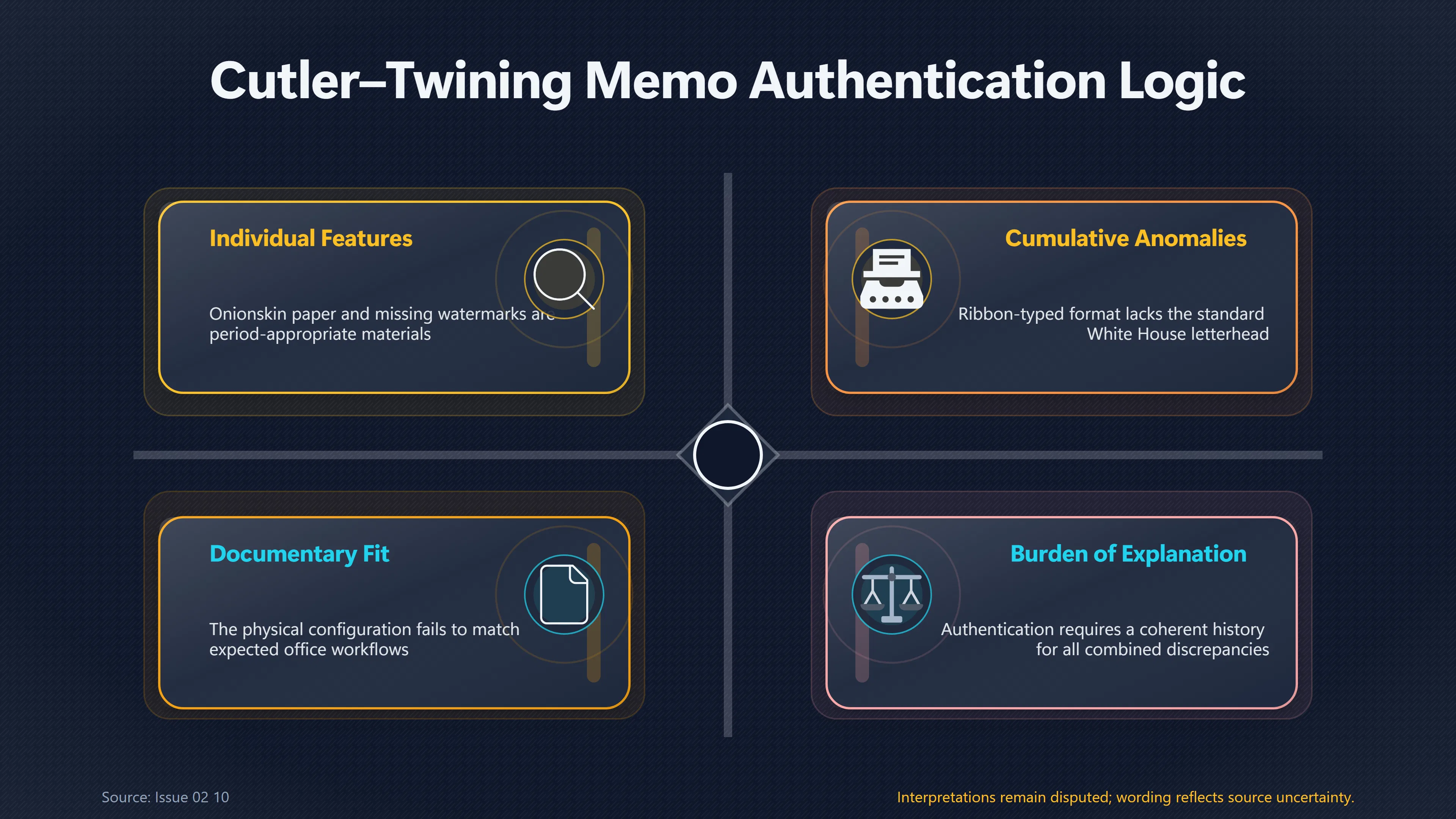
No single stationery feature settles authenticity, but ribbon typing, plain onionskin, absent letterhead and weak office fit become more significant together.
On this page
- Why individual paper discrepancies are not decisive
- How multiple ordinary document features can reinforce one another
- What the cumulative case can and cannot establish about authenticity
Page outline Jump by section
Introduction
The paper clues surrounding the Cutler–Twining memorandum are most persuasive when treated as a pattern rather than as a single forensic “gotcha”. A missing watermark is not enough: authentic 1950s office copies could be made on unwatermarked onionskin. Plain paper is not enough either, because government offices used several grades of stationery. Even onionskin itself was commonplace.

The difficulty is the combination. The National Archives and Records Administration (NARA) found that the surviving sheet has no official letterhead or watermark and was directly ribbon-typed on thin dictation onionskin. The Eisenhower Presidential Library’s comparison material, meanwhile, showed watermarked bond for sampled Cutler originals, variable onionskin for carbon copies, and White House letterhead for most outgoing National Security Council correspondence. Those findings leave no individual paper feature that disproves authenticity, but they make the Cutler–Twining memo an awkward fit with the ordinary document-making practices against which it can be tested.[National Archives]archives.govhttps://www.archives.gov/research/military/air-force/ufosSource details in endnotes.
Why no single paper discrepancy settles the question
The simplest sceptical argument would be that Robert Cutler’s authentic paperwork had an eagle watermark and the Cutler–Twining memo does not, so the memorandum must be false. NARA’s published findings do not support such a categorical test.
The Eisenhower Library examined a representative sample of Cutler material. In that sample, documents produced while Cutler served on the National Security Council staff had an eagle watermark on the bond paper. But the Library also found that onionskin carbon copies could have an eagle watermark or no watermark at all. NARA additionally reported that during the brief period when Cutler left the NSC, his carbon copies were produced on “prestige onionskin”.[National Archives]archives.govhttps://www.archives.gov/research/military/air-force/ufosSource details in endnotes.
That variation matters because it prevents “no eagle watermark” from functioning as a stand-alone authenticity test. MJ-12 defender Stanton Friedman made essentially this objection, arguing that he had found Cutler-file onionskin copies with different watermarks or none, and that the questioned paper itself was period-appropriate Fox Paper Company dictation onionskin. Friedman said Fox had indicated that this stock was produced from 1953 into the early 1970s and sold in bid lots, including to government customers.[Medium]medium.comOpen source on medium.com.
Even if those points are accepted, however, they answer only a limited question: could such paper have existed in a government office in 1954? Period availability is not the same thing as demonstrating that this was the paper and copy format normally used for the particular kind of memorandum the sheet purports to be.
That distinction is central to cumulative authentication. A genuine document need not conform perfectly to the dominant office pattern. But an authentication argument becomes weaker as explanations for several departures have to be supplied independently.
The ribbon copy changes how the clues fit together
The most important physical finding is therefore not simply “onionskin”. NARA’s conservation specialist determined that the Cutler–Twining sheet was a ribbon copy prepared on dictation onionskin. A ribbon copy is the sheet struck directly through the typewriter ribbon, rather than one of the secondary sheets produced through carbon paper.[National Archives]archives.govhttps://www.archives.gov/research/military/air-force/ufosSource details in endnotes.
That creates an important interaction between otherwise ordinary features.
If the questioned sheet were an onionskin carbon, its lack of an eagle watermark would fit a category that the Eisenhower Library itself documented: authentic Cutler onionskin carbons existed without that watermark. The absence of White House letterhead could also be easier to explain if the surviving object were merely an internal file carbon of an outgoing original produced on formal stationery.
But NARA classified the surviving sheet differently. It was the directly typed ribbon sheet. That means the carbon-copy comparison cannot automatically explain its physical form. At the same time, NARA reported that most documents sent out by the NSC were prepared on White House letterhead paper. The questioned memorandum, ostensibly communicating from Cutler’s presidential national-security office to General Nathan Twining, has no such letterhead.[National Archives]archives.govhttps://www.archives.gov/research/military/air-force/ufosSource details in endnotes.
A contemporary sceptical assessment in Skeptical Inquirer highlighted the same tension, reporting visible typewriter-key impressions on the reverse as evidence that the sheet had been directly struck rather than being the carbon it might otherwise resemble. That observation is most useful as corroboration of the underlying NARA conservation finding, not as an independent proof of forgery.[Skeptical Inquirer]skepticalinquirer.orgIssueIssue
The cumulative question can therefore be expressed more precisely. It is not:
Does genuine 1954 government onionskin exist without an eagle watermark?
Clearly it did. The more discriminating question is:
How well does an unletterheaded, directly ribbon-typed sheet of dictation onionskin fit the expected production history of this particular outgoing memorandum?
On the evidence published by NARA, the answer is: imperfectly.
Ordinary features become less ordinary in combination
Document authentication works differently when several features are correlated. Imagine four characteristics, each of which has an innocent explanation when considered alone:
- Thin onionskin: entirely plausible as mid-century office paper.
- No eagle watermark: compatible with some genuine Cutler-file onionskin carbons.
- No White House letterhead: potentially explicable for an internal or working copy.
- Ribbon typing rather than carbon production: also possible in itself; an office could type directly onto lightweight paper.
None establishes fabrication. The difficulty comes from asking whether one coherent office workflow explains all four at once.
The most obvious explanation for plain, unwatermarked onionskin is that the surviving sheet represents a carbon or file copy. Yet NARA’s physical examination cuts against precisely that explanation because it identifies the sheet as the ribbon copy. Conversely, if it represents the directly typed copy of a memorandum being sent from the NSC environment to Twining, the Library’s finding that most outgoing NSC documents used White House letterhead becomes more relevant.[National Archives]archives.govhttps://www.archives.gov/research/military/air-force/ufosSource details in endnotes.
This is why simply counting “matches” and “mismatches” would be misleading. The evidential force comes from the relationship between the features. The characteristic that makes the missing watermark relatively harmless — resemblance to an ordinary onionskin carbon — sits uneasily beside the physical finding that the sheet was not a carbon.
Friedman’s defence demonstrates the other side of the same problem. He stressed that the paper was genuine period-type dictation onionskin and argued that unwatermarked onionskin existed in Cutler’s files. He also cited the document’s red declassification pencil mark and other characteristics as positive indicators.[Medium]medium.comOpen source on medium.com. Those arguments reduce the value of any claim that the paper stock itself was impossible. They do not eliminate the narrower question of why this ribbon copy, with this absence of letterhead, should differ from the strongest available comparisons for Cutler’s office.
There is also evidence in the Moore research files suggesting that Cutler-era paperwork was less mechanically uniform than an oversimplified forgery argument might imply. Notes from research at the Eisenhower Library describe onionskin carbons without watermarks and mention a White House stationery memorandum whose larger type resembled that of the Cutler–Twining sheet.[Project Aquarius]mufon.comOpen source on mufon.com. Such material is important because it cautions against turning any single typographical or stationery convention into an absolute rule.
The cumulative case survives that qualification precisely because it does not require absolute rules.
Office fit matters more than whether the paper was obtainable
This distinction separates two authentication questions that are often blurred together.
The first is material possibility: could someone in 1954 have possessed and typed on this sort of paper? The available evidence gives no sound basis for saying no. The memorandum is not discredited merely because dictation onionskin was an impossible or anachronistic material.
The second is documentary fit: does the surviving object look like the product that the claimed office, author and communication route would normally have generated? Here the evidence is considerably less comfortable. NARA’s comparison joins the ribbon-copy determination to three contextual observations: no official letterhead, no watermark, and a Cutler collection in which sampled originals and outgoing NSC documents normally displayed different stationery characteristics.[National Archives]archives.govhttps://www.archives.gov/research/military/air-force/ufosSource details in endnotes.
This is a stronger form of reasoning than asking whether a suspected forger could have acquired old paper. A sheet can be genuinely old and still carry text added later. Conversely, unusual stationery can appear in an authentic archive. What matters is whether the physical object has a convincing production history connecting paper, typing method, office practice and intended use.
The Cutler–Twining memo lacks an uncomplicated history of that sort. To accept its paper configuration as normal, one must allow that a memorandum associated with Cutler’s office was directly typed on lightweight onionskin without the letterhead normally found on most outgoing NSC documents, while also recognising that the strongest innocent precedent for unwatermarked onionskin concerns carbon copies. That is possible. It is simply a less economical fit with the comparative evidence.
The paper anomalies also sit inside an unusual archival context
The cumulative assessment becomes more significant because NARA did not encounter the stationery issue in isolation. Its MJ-12 reference report lists a series of other discrepancies surrounding the same sheet. The document was found in Record Group 341, entry 267, in a series filed by Top Secret register number, yet it lacked such a number. Its folder contained no other material concerning “NSC/MJ-12”. Searches of Air Force, Joint Chiefs of Staff, defence and NSC records failed to produce corroborating documentation.[National Archives]archives.govhttps://www.archives.gov/research/military/air-force/ufosSource details in endnotes.
These are not paper characteristics, so they should not be used to inflate the stationery case artificially. They matter here in a narrower way: there is little independent archival context available to rescue an unusual physical format. If numerous securely provenanced Cutler–Twining communications survived in the same form — ribbon-typed dictation onionskin, no letterhead, comparable filing — the paper discrepancies would lose much of their force. NARA instead reported that the sheet stood alone in its folder as far as “NSC/MJ-12” material was concerned.[National Archives]archives.govhttps://www.archives.gov/research/military/air-force/ufosSource details in endnotes.
The same report records an additional office-practice problem: Cutler was travelling through Europe and North Africa from 3 to 15 July 1954, covering the memorandum’s date of 14 July. Before leaving, he had instructed subordinates James S. Lay and J. Patrick Coyne on handling NSC administrative business during his absence. NARA therefore observed that, if the memorandum were genuine, one would expect Lay or Coyne to have signed it.[National Archives]archives.govhttps://www.archives.gov/research/military/air-force/ufosSource details in endnotes.
That point lies just outside paper analysis proper, but it clarifies why “office fit” matters. Authentication is not merely a hunt for anachronistic fibres or impossible watermarks. It asks whether the physical document makes sense as the residue of the administrative act it supposedly records. Here, the unexplained paper configuration and the uncertain administrative pathway point in the same direction rather than resolving one another.
What the cumulative case can — and cannot — establish
The cumulative paper evidence supports a more careful conclusion than either “the watermark proves it fake” or “period onionskin proves it genuine”.
NARA itself draws an important institutional boundary. When the National Archives certifies a reproduction, it certifies that the copy accurately represents a document in its custody; it does not authenticate the document or the information contained in it.[National Archives]archives.govhttps://www.archives.gov/research/military/air-force/ufosSource details in endnotes. Thus the memorandum’s physical presence in an archival record group should not be confused with an official finding that Cutler created it.
Nor does NARA’s paper examination amount to laboratory proof that somebody fabricated the sheet after 1954. The published findings do not establish when the typing occurred, who typed it or how the document entered the file. The variation found among authentic Cutler paperwork also means that deviations from a sampled norm must be treated probabilistically, not as rigid rules.
What the paper evidence does establish is a burden of explanation. A persuasive authentication would ideally account for why this particular memorandum is a ribbon copy on dictation onionskin; why the directly typed sheet lacks official letterhead; how that configuration relates to authentic unwatermarked Cutler carbon copies; and why the physical form differs from the principal office patterns identified by the Eisenhower Library.
The pro-authenticity case has credible answers to part of that challenge: onionskin was period-appropriate, government offices used it, and unwatermarked Cutler-file copies existed.[Medium]medium.comOpen source on medium.com. Those facts substantially weaken simplistic claims based on the watermark alone.
They do less to resolve the combined anomaly. The strongest criticism is therefore not that one forbidden piece of stationery exposes a forgery. It is that several individually permissible features fail to combine into an especially convincing example of normal Cutler/NSC document production. Against a document already short of corroborating archival context, that cumulative mismatch is meaningful evidence against authenticity — but evidence of inconsistency, not a self-contained forensic proof of fabrication.[National Archives]archives.govhttps://www.archives.gov/research/military/air-force/ufosSource details in endnotes.
Amazon book picks
Further Reading
Books and field guides related to Do the Paper Clues Add Up Against the Memo?. Use these as the next step if you want deeper reading beyond the article.
Detecting Forgery: Forensic Investigation of Documents
Detecting Forgery reveals the complete arsenal of forensic techniques used to detect forged handwriting and alterations in documents and...
Forensic Document Examination: Principles and Practice
This book introduces the reader to the basic principles of handwriting and the factors that affect their development. The book discusses...
Scientific Examination of Questioned Documents
Disputed document inquiries encompass extensive and varied technical examinations, unique phases of investigation, and specialized legal...
eBay marketplace picks
Marketplace Samples
Live-tested eBay searches with available results related to this page.
Selected fromUFO poster oneBay.co.uk.


Endnotes
1.
Source: archives.gov
Link:https://www.archives.gov/research/military/[air-force
2.
Source: medium.com
Link:https://medium.com/stanton-friedmans-articles/book-review-kevin-d-randles-case-mj-12-the-true-story-behind-the-government-s-ufo-conspiracies-9e06f4e82250
3.
Source: skepticalinquirer.org
Title: Issue 02 10
Link:https://skepticalinquirer.org/wp-content/uploads/sites/29/2019/03/Issue-02-10.pdf
Additional References
4.
Source: youtube.com
Title: The Paracast
Link:https://www.youtube.com/watch?v=Q9ViLvKNno8
Source snippet
Cutler Twining memo Stanton Friedman Karl Pflock discusses The Cutler - Twining Memo...
Published: April 1, 2018
5.
Source: youtube.com
Link:https://www.youtube.com/watch?v=0ZkPtnPOL0U
Source snippet
Karl Pflock - The creation of the MJ-12 documents...
6.
Source: youtube.com
Title: Karl Pflock discusses The Cutler
Link:https://www.youtube.com/watch?v=I6smHEhd9MI
Source snippet
The Majestic Documents: Authentication and Interpretation Michael S. Heiser, PhD...
7.
Source: youtube.com
Title: The Majestic-12 Documents [With Ryan S. Wood]
Link:https://www.youtube.com/watch?v=vzB87RJkQVU
Source snippet
The Paracast: April 1, 2018 — Stanton T. Friedman with J. Randall Murphy...
Published: April 1, 2018
8.
Source: youtube.com
Title: Karl Pflock
Link:https://www.youtube.com/watch?v=8g5tYfcQ9RQ
Source snippet
The Majestic-12 Documents [With Ryan S. Wood]...
9.
Source: raids.org
Link:https://raids.org/files/ufo2/mj12doc6.htm