Within Typography
Can a Typeface Identify the Exact Typewriter?
A font-like resemblance may date a general style, but tying a document to one machine requires recurring defects, wear or alignment evidence.
On this page
- The difference between typeface design and machine identity
- Why designs can persist across models and decades
- Which repeated defects can link text to one machine
Page outline Jump by section
Introduction
A typeface can help identify the kind of typewriting on a document, but it normally cannot identify the exact physical typewriter that produced it. That distinction is crucial in arguments about the alleged MJ-12 documents. A match in letter shapes, pitch or general typestyle may show that a document is compatible with a family of machines, and a securely dated type design can sometimes expose an anachronism. It does not follow that one particular Underwood, Smith-Corona or other machine has been identified.
Forensic document examination treats these as different questions. Type design and spacing are principally class characteristics: features shared by a group of machines. Identifying an individual machine requires sufficiently distinctive characteristics such as recurring damaged characters, abnormal alignment or mechanical irregularities, ideally demonstrated by comparison with known typing from the suspected machine. Current FBI procedures likewise distinguish comparison of class characteristics from the later evaluation of distinguishing characteristics needed for source identification.[FBI Lab Vault]fbilabqsd.fbi.govLab Vault Typewriting ExaminationsFBI Lab VaultTypewriting ExaminationsMay 20, 2026…
That makes the famous MJ-12 dispute over whether the 1947 Truman-Forrestal memorandum resembles a later Smith-Corona or an earlier Underwood more complicated than the shorthand versions suggest. The dispute concerns classification and dating before it concerns identification of an individual typewriter.
Typeface Design Is Not Machine Identity
A typewriter leaves two broad kinds of information on paper. The first comes from its design: character shapes, character size, horizontal pitch, line spacing and related properties. These can narrow the possible source to a class of machines. The second comes from the history and condition of an individual machine: a chipped letter, a character that consistently strikes high, a bent typebar, uneven pressure or another repeatable peculiarity.
The distinction is explicit in forensic practice. New York State’s forensic standardisation guidance defines a typewritten class-characteristic conclusion as one in which documents could have been produced by the same class of machine or by other machines exhibiting the same class features. A conclusion about individual characteristics, by contrast, requires enough distinctive features to determine that documents were produced by the same machine or machine system. Limited text, poor-quality samples or mixtures of similarities and differences can leave the result inconclusive.[NYS Criminal Justice Services]criminaljustice.ny.govS Criminal Justice Services Questioned DocumentsS Criminal Justice ServicesQuestioned Documents…
This is more than terminology. Suppose a disputed page contains ten-character-per-inch typing and letter designs matching a known Underwood specimen. That finding could establish that an Underwood equipped with that design was a plausible source. It would not establish that the page came from a particular Underwood sitting in a particular office.
Forensic literature has long drawn essentially this boundary. An Office of Justice Programs summary on identification of typewritten documents notes that character design, horizontal and vertical spacing and letter height can reveal possible alteration or misdating, whereas individual-machine attribution depends upon such characteristics as typeface defects, platen defects and lateral or vertical misalignment.[Office of Justice Programs]ojp.govOpen source on ojp.gov.
The difference can be expressed simply:
Typeface resemblance: What machines could have produced typing like this?
Machine identification: Did this particular machine produce this typing?
In the MJ-12 debate, conclusions answering the first question have sometimes been reported as though they answered the second.
Why the Same Design Can Appear on Many Machines
Typewriters were manufactured products, not collections of unique alphabets created separately for every machine. Machines of the same model could naturally share type designs, while similar designs could also appear across different machines and manufacturers. A forensic case study published in the Journal of the American Society of Questioned Document Examiners specifically notes that manufacturers could obtain type fonts from the same suppliers, leaving different brands equipped with similar or even identical styles. It consequently distinguishes typewriter classification from typewriter identification.[JASQDE]account.journal.asqde.orgJASQDECause of Typewriter PrintwheelMarch 4, 2026…
That is why recognising a typestyle is potentially valuable without being individualising. Size, spacing and character design can reduce the field. If reliable historical reference specimens show that a distinctive design did not exist until after a disputed document’s stated date, classification alone could become powerful evidence of anachronism. But when several period machines could produce substantially similar characters, resemblance does not tell investigators which one was used.
The problem becomes still more complicated with machines using interchangeable typing elements. Research on print-wheel typewriters, for example, found that their high-quality output could possess limited individuality, changing the identification problem compared with traditional typebar machines.[ScienceDirect]sciencedirect.comScienceDirect Problems in identifying work from print wheel typewritersProblems in identifying work from print wheel typewriters - ScienceDirectJanuary 1, 1986… Although that technology postdates the principal early MJ-12 papers, it illustrates the general forensic principle: the appearance of an alphabet and the identity of the machine carrying it are not necessarily the same thing.
Even ordinary typebar machines require caution. A questioned-document laboratory’s description of conventional examination explains that investigators may sometimes determine a possible make or model by classifying the typing and searching reference collections. Linking the document to a specific machine is a separate microscopic and visual comparison involving features such as alignment, spacing, damaged type, ink density and striking pressure.[Norwitch Lab]questioneddocuments.comNorwitch Lab Typewriter and Typewriting ExaminationsNorwitch LabTypewriter and Typewriting Examinations - Questioned Documents - Norwitch Document Laboratory…
This also explains why a specimen catalogue can establish compatibility more readily than provenance. Finding an authentic 1940 specimen whose alphabet looks like disputed 1947 typing can rebut the assertion that the design necessarily originated in the 1960s. It cannot, by resemblance alone, establish which machine produced the disputed page in 1947.
The Truman Memo Shows the Classification Problem
The alleged Truman-to-Forrestal memorandum dated 24 September 1947 provides a particularly clear MJ-12 example. Questioned-document examiner Peter Tytell was cited by sceptic Philip J. Klass as concluding that its typeface indicated a Smith-Corona machine that first appeared in 1963. Klass published the allegation as evidence that the memorandum could not genuinely date from 1947.[Skeptical Inquirer]skepticalinquirer.orgSkeptical Inquirer SKEPTICALINQUIRER Vol. 14 No. 2/Winter 1990 $6June 27, 2006…
If that classification were securely established, the logic would indeed be strong. A document cannot have been typed in 1947 using a type design or machine configuration first introduced sixteen years later. Notice, however, what would make the argument decisive: the demonstrated date of the relevant class characteristic, not proof that investigators had located the individual typewriter.
MJ-12 advocate Stanton Friedman disputed the Smith-Corona conclusion. In his account, Tytell did not prepare a formal report, while document examiner James Black was subsequently commissioned to examine the material and concluded that the typing was consistent with an Underwood Standard specimen dating from May 1940. Friedman’s published defence therefore treated the later examination as defeating the alleged 1960s anachronism.[The Black Vault]theblackvault.comThe Black Vault Update on Operation Majestic 12 DocumentsThe Black VaultUpdate on Operation Majestic 12 Documents - The Black Vault Case FilesJanuary 17, 2024… Claims circulated by the pro-MJ-12 investigators went further, saying Black had “identified” an Underwood Standard as the typewriter involved.[GeoCities]oocities.orgGeo CitiesGeoCitiesOctober 13, 1999…
The wording needs care. Matching a questioned document to a 1940 Underwood specimen or model typestyle would establish something quite different from linking it to one individual Underwood Standard machine. The former would make a 1947 production date typographically possible. The latter would require individualising evidence from the physical machine or suitable known typing attributable to it.
This is precisely where the forensic distinction prevents overstatement in either direction. Tytell’s reported Smith-Corona conclusion, if correct and chronologically exclusive, would provide an anachronism argument. Black’s reported comparison with a 1940 Underwood specimen, if correct, would answer that particular anachronism argument by demonstrating an earlier compatible source. But an earlier compatible typestyle does not authenticate the memorandum. It merely removes one proposed reason why it could not have been typed in 1947.
Nor does the typography settle the wider authenticity question. The US National Archives records several independent problems with the MJ-12 material, including the unusual filing circumstances of the Cutler-Twining memorandum and the failure of searches across relevant government records to locate corroborating documentation. Those issues are separate from whether a particular typestyle existed at the relevant date.[National Archives]archives.govNational Archives Project BLUE BOOKNational ArchivesProject BLUE BOOK - Unidentified Flying Objects | National ArchivesJune 25, 2024
What Would Identify One Physical Typewriter?
To move from “this resembles an Underwood” to “this was produced by this Underwood”, an examiner looks for a repeatable constellation of individual characteristics. These arise because manufacture, use, wear, damage and adjustment gradually give machines their own mechanical peculiarities.
Traditional individualising features include:
- Damaged typefaces. A chip, dent, broken serif, irregular edge or other defect in a type slug can reproduce the same abnormality whenever that character is struck.
- Vertical misalignment. One character may consistently sit slightly above or below the normal baseline.
- Horizontal misalignment. A character may repeatedly strike too far left or right relative to its expected position.
- Tilt or rotation. A typebar or slug can strike at a slight angle rather than squarely.
- Uneven impressions. Mechanical alignment can cause one part of a character to strike more heavily than another.
- Spacing abnormalities. Wear or mechanical faults can produce repeatable irregularities in character or line spacing.
- Platen and ribbon effects. Defects or characteristic behaviour elsewhere in the typing system can contribute additional comparative information.
These are not hypothetical forensic criteria. The Office of Justice Programs lists typeface and platen defects, alignment, ribbon characteristics and key pressure among potentially individual characteristics.[Office of Justice Programs]ojp.govOpen source on ojp.gov. Laboratory procedures similarly instruct examiners to consider typestyle and spacing alongside typeface defects and alignment defects, and then to compare questioned and known typing side by side.[Forensic Resources Offload Media]forensic-resources-offload-media.s3.amazonaws.comOpen source on amazonaws.com.
A published questioned-document case study describes defects as breaks or irregular impressions caused by such features as chips, bumps, dents and irregular outlines. Wear and damage make those abnormalities valuable because the same physical defect can recur across multiple impressions.[JASQDE]account.journal.asqde.orgJASQDECause of Typewriter PrintwheelMarch 4, 2026…
The important word is recurring. One oddly printed “e” proves little if the anomaly could result from ribbon condition, dirt, paper surface or a single imperfect strike. If the same “e” repeatedly contains the same nick, the “t” repeatedly sits high and another character consistently leans in the same direction — and the same combination occurs in known exemplars from a suspect machine — the cumulative pattern becomes much more discriminating.
A Proper Comparison Needs Known Material
Individual identification is therefore fundamentally comparative. Finding an unusual feature in an MJ-12 photocopy does not by itself identify its source. Investigators need either the suspected machine or reliable known typing from it.
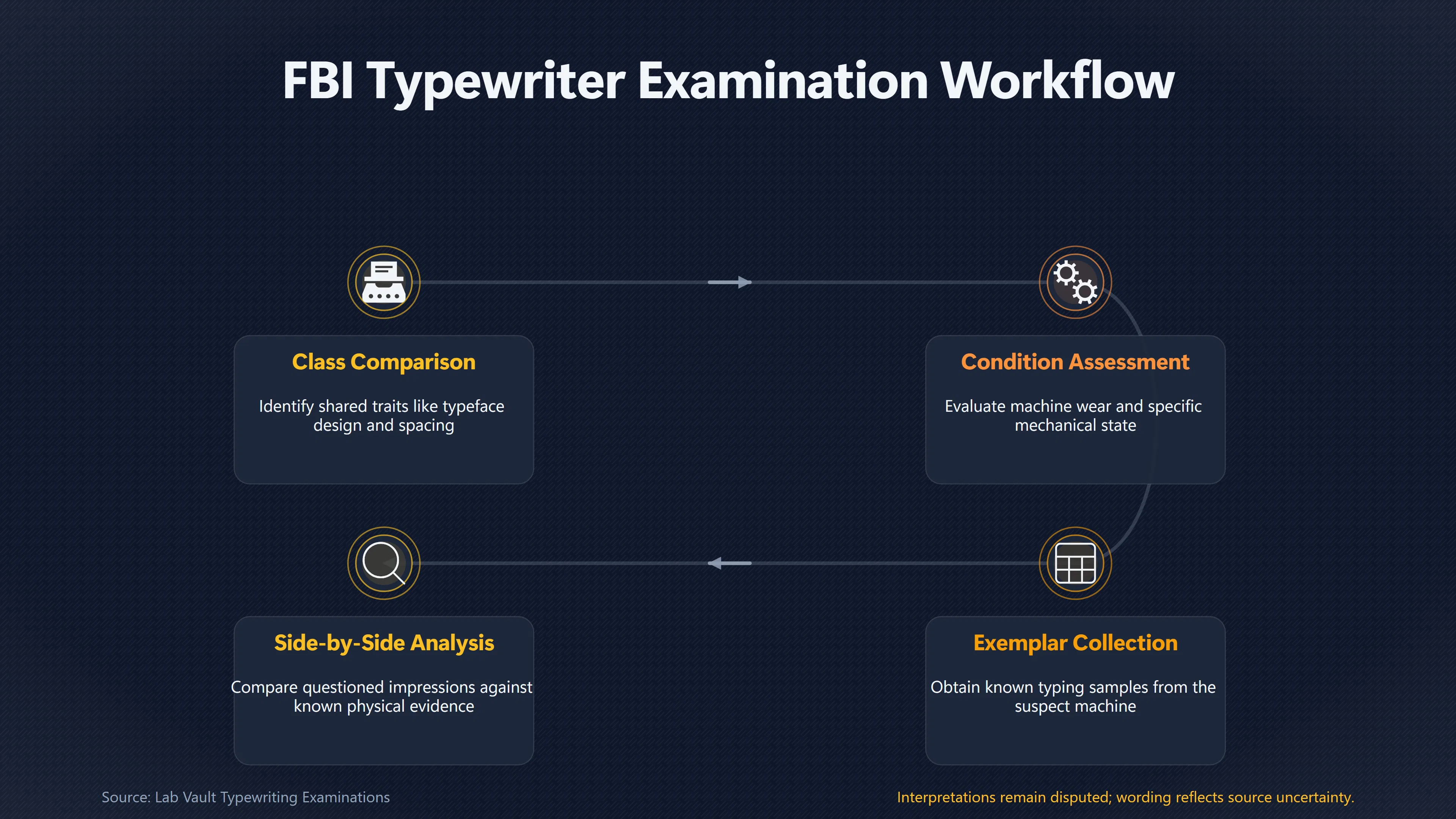
The FBI’s current procedure illustrates the sequence. Examiners first compare class characteristics. If the known machine is inconsistent at that level, it can be excluded. If the class characteristics agree, the examiner assesses the machine’s condition — including whether it is dirty, worn or damaged — obtains exemplars where appropriate, and conducts side-by-side comparison of the questioned and known impressions before evaluating distinguishing characteristics.[FBI Lab Vault]fbilabqsd.fbi.govLab Vault Typewriting ExaminationsFBI Lab VaultTypewriting ExaminationsMay 20, 2026… ASTM’s standard guide likewise covers comparisons between questioned and known typewriting, assessment of whether sufficient material exists and procedures for taking exemplars from typewriters.[ASTM Store]store.astm.orgOpen source on astm.org.
This creates an obvious evidential difficulty for historical controversies. If the exact office typewriter supposedly used in 1947 is unavailable, an examiner cannot simply type an exemplar on it today. Period documents reliably known to have come from that particular machine could potentially preserve its characteristics, but only if their provenance is secure and their reproduction quality retains the tiny defects needed for comparison.
Photocopies and later-generation reproductions can make the problem worse. Fine edges, weak impressions and small defects may be degraded or obscured. Forensic guidance consequently recognises poor image quality and insufficient text as reasons an individual-source determination may remain inconclusive.[NYS Criminal Justice Services]criminaljustice.ny.govS Criminal Justice Services Questioned DocumentsS Criminal Justice ServicesQuestioned Documents…
That limitation matters especially for MJ-12 because some of the most disputed material became available to researchers as photographic reproductions rather than as an unquestionably original sheet paired with its alleged typewriter. A striking resemblance visible in reproduction can therefore support classification more readily than the much stronger proposition of individual-machine identification.
Repeated Defects Can Also Reveal Mixed Typing
Individual characteristics have another useful role: determining whether different passages on a page appear to come from different machines or typing operations. This is more probative than merely noticing that one section “looks different”.
A forensic review indexed by the US Office of Justice Programs states that typewriting examination can help determine whether an entire document was typed on one machine or whether portions came from another. Differences in character design, spacing, alignment, defects, ribbon behaviour and pressure can contribute to such an assessment.[Office of Justice Programs]ojp.govOpen source on ojp.gov.
That distinction bears directly on another disputed feature of the Truman-Forrestal memorandum: claims that part of its date was typed separately. Pro-MJ-12 accounts of James Black’s examination say that the numerals in the date sit vertically out of alignment and that the paper could have been removed and reinserted before that portion was typed.[GeoCities]oocities.orgGeo CitiesGeoCitiesOctober 13, 1999…
Vertical displacement can certainly be relevant to reconstruction of how a page was produced. But it does not, on its own, answer why the page was reinserted or why another machine might have been used. Legitimate office preparation, later correction and fraudulent construction are all mechanisms capable of producing mixed or displaced typing. The evidential question is narrower: can the physical characteristics demonstrate a change of source or typing operation? Interpretation of what that change means requires additional evidence.
What Typography Can and Cannot Establish
The most useful way to read typewriter arguments about MJ-12 is therefore as a ladder of increasingly demanding claims.
At the lower end, an examiner can recognise broad characteristics such as pitch and typestyle. Better reference specimens may narrow the possible manufacturers, models or periods. If every credible source for a distinctive design postdates the document, the result may expose an anachronism without identifying any individual machine.
Higher up the ladder, however, “this looks like an Underwood Standard” remains a class-level conclusion. The existence of a compatible 1940 Underwood specimen would demonstrate that such typing was technically possible before 1947; it would not demonstrate that an Underwood in Truman’s office produced the memorandum.
At the strongest level, source identification requires agreement in distinguishing individual characteristics and the absence of differences that would preclude the proposed source. The FBI’s present reporting framework expressly reserves “source identification” for a determination that questioned typing was prepared by the known typewriter or typing element because distinguishing characteristics agree; where agreement is limited or other limitations remain, weaker or inconclusive conclusions are appropriate.[FBI Lab Vault]fbilabqsd.fbi.govLab Vault Typewriting ExaminationsFBI Lab VaultTypewriting ExaminationsMay 20, 2026…
For the alleged MJ-12 documents, that hierarchy prevents two opposite mistakes. A critic should not treat superficial resemblance to a later typewriter as proof of a post-dated forgery unless the allegedly anachronistic characteristics have actually been shown to be chronologically exclusive. An advocate should not treat resemblance to a period type specimen as proof that the document came from an authentic government machine.
The typography can sometimes answer could this style have existed then? Individual-machine evidence addresses the much harder question did this particular machine make this page? In the MJ-12 controversy, keeping those questions separate turns an apparently simple argument about “the typewriter” into the more precise forensic issue it actually is.
Amazon book picks
Further Reading
Books and field guides related to Can a Typeface Identify the Exact Typewriter?. Use these as the next step if you want deeper reading beyond the article.
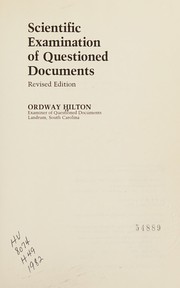
Scientific Examination of Questioned Documents
This guide to all aspects of a questioned document for attorneys, investigators, document examiners, and others covers the scientific exa...
Forensic Document Examination: Principles and Practice
This book introduces the reader to the basic principles of handwriting and the factors that affect their development. The book discusses...
Scientific Examination of Documents: Methods and Techniques
Completely revised and updated to reflect the latest techniques and technological advances, this second edition provides and clear, conci...
eBay marketplace picks
Marketplace Samples
Live-tested eBay searches with available results related to this page.
Selected fromUFO poster oneBay.co.uk.


Endnotes
1.
Source: fbilabqsd.fbi.gov
Title: Lab Vault Typewriting Examinations
Link:https://fbilabqsd.fbi.gov/file-repository/questioned-documents/doc-223-07-typewriting-examinations.pdf/
Source snippet
FBI Lab VaultTypewriting ExaminationsMay 20, 2026...
Published: May 20, 2026
2.
Source: account.journal.asqde.org
Title: JASQDECause of Typewriter Printwheel
Link:https://account.journal.asqde.org/index.php/asqde-j-jasqde/article/download/19/19
Source snippet
March 4, 2026...
Published: March 4, 2026
3.
Source: sciencedirect.com
Title: ScienceDirect Problems in identifying work from print wheel typewriters
Link:https://www.sciencedirect.com/science/article/pii/0379073886901787
Source snippet
Problems in identifying work from print wheel typewriters - ScienceDirectJanuary 1, 1986...
Published: January 1, 1986
4.
Source: archives.gov
Title: National Archives Project BLUE BOOK
Link:https://www.archives.gov/research/military/[air-force
Source snippet
National ArchivesProject BLUE BOOK - Unidentified Flying Objects | National ArchivesJune 25, 2024...
Published: June 25, 2024
5.
Source: store.astm.org
Link:https://store.astm.org/e2494-07.html
6.
Source: typography.guru
Title: Font used for denominations on certain poker chips
Link:https://typography.guru/forums/topic/137077-font-used-for-denominations-on-certain-poker-chips/
7.
Source: sciencedirect.com
Link:https://www.sciencedirect.com/science/article/pii/0379073890902949
8.
Source: sciencedirect.com
Title: Problem of the identification of typewriter makes and models
Link:https://www.sciencedirect.com/science/article/pii/0379073878900889
9.
Source: fbi.gov
Link:https://www.fbi.gov/video-repository/newss-mp4-docs040909.mp4/view
10.
Source: fbilabqsd.fbi.gov
Title: questioned documents
Link:https://fbilabqsd.fbi.gov/file-repository/questioned-documents
11.
Source: archives.fbi.gov
Link:https://archives.fbi.gov/archives/about-us/lab/forensic-science-communications/fsc/oct1999/posters2.htm
12.
Source: typewriter.wiki
Title: Makes and Models
Link:https://typewriter.wiki/index.php/Typewriter_Makes_and_Models
13.
Source: typewriter.wiki
Title: Corona 3
Link:https://www.typewriter.wiki/index.php/Corona_3
14.
Source: typewriter.wiki
Title: Smith-Corona Classic 12
Link:https://www.typewriter.wiki/index.php/Smith-Corona_Classic_12
15.
Source: criminaljustice.ny.gov
Title: S Criminal Justice Services Questioned Documents
Link:https://www.criminaljustice.ny.gov/forensic/standardization/questioned-documents.html
Source snippet
S Criminal Justice ServicesQuestioned Documents...
16.
Source: ojp.gov
Link:https://www.ojp.gov/ncjrs/virtual-library/abstracts/identification-typewritten-documents
17.
Source: questioneddocuments.com
Title: Norwitch Lab Typewriter and Typewriting Examinations
Link:https://www.questioneddocuments.com/questioned-document-overviews/typewriter-and-typewriting-examinations/
Source snippet
Norwitch LabTypewriter and Typewriting Examinations - Questioned Documents - Norwitch Document Laboratory...
18.
Source: skepticalinquirer.org
Title: Skeptical Inquirer SKEPTICAL
Link:https://skepticalinquirer.org/wp-content/uploads/sites/29/2019/03/Issue-02-12.pdf
Source snippet
INQUIRER Vol. 14 No. 2/Winter 1990 $6June 27, 2006...
Published: June 27, 2006
19.
Source: theblackvault.com
Title: The Black Vault Update on Operation Majestic 12 Documents
Link:https://www.theblackvault.com/casefiles/update-on-operation-majestic-12-documents/
Source snippet
The Black VaultUpdate on Operation Majestic 12 Documents - The Black Vault Case FilesJanuary 17, 2024...
Published: January 17, 2024
20.
Source: oocities.org
Title: Geo Cities
Link:https://www.oocities.org/Area51/Shadowlands/6583/maji021.html
Source snippet
GeoCitiesOctober 13, 1999...
Published: October 13, 1999
21.
Source: forensic-resources-offload-media.s3.amazonaws.com
Link:https://forensic-resources-offload-media.s3.amazonaws.com/wp-content/uploads/2019/09/03111806/IA2-Typewriters-and-Other-Machine-Impressions-6-11.pdf
22.
Source: medium.com
Link:https://medium.com/stanton-friedmans-articles/update-on-operation-majestic-12-documents-ed2df58fd8a1
23.
Source: theblackvault.com
Title: Debunkers At It Again
Link:https://www.theblackvault.com/casefiles/debunkers-at-it-again/
24.
Source: nij.ojp.gov
Title: basic toolmark identification
Link:https://nij.ojp.gov/nij-hosted-online-training-courses/firearms-examiner-training/module-13/basic-toolmark-identification
25.
Source: nij.ojp.gov
Link:https://nij.ojp.gov/nij-hosted-online-training-courses/firearms-examiner-training/module-11/identification
26.
Source: nij.ojp.gov
Title: afte theory identification
Link:https://nij.ojp.gov/nij-hosted-online-training-courses/firearms-examiner-training/module-09/afte-theory-identification
27.
Source: nij.ojp.gov
Title: class and individual characteristics
Link:https://nij.ojp.gov/nij-hosted-online-training-courses/firearms-examiner-training/module-06/class-and-individual-characteristics
28.
Source: journal.asqde.org
Link:https://journal.asqde.org/articles/10.69525/jasqde.263
29.
Source: lurch2.blogspot.com
Title: majestic 12
Link:https://lurch2.blogspot.com/2013/09/majestic-12.html
30.
Source: khouse.org
Title: Majestic-12 | Koinonia House
Link:https://www.khouse.org/personal_update/articles/2003/majestic-12
31.
Source: indiankanoon.org
Link:https://indiankanoon.org/doc/389295/?type=print
32.
Source: ojp.gov
Link:https://www.ojp.gov/ncjrs/virtual-library/abstracts/examination-typewritten-document
33.
Source: ojp.gov
Link:https://www.ojp.gov/ncjrs/virtual-library/abstracts/problems-identification-typewriter-makes-and-models
34.
Source: ojp.gov
Link:https://www.ojp.gov/ncjrs/virtual-library/abstracts/handwriting-typewriting-shoeprints-and-tire-treads-fbi-laboratorys
35.
Source: ojp.gov
Link:https://ojp.gov/ncjrs/virtual-library/abstracts/identification-indented-typewritten-entries-characters-present-lift
36.
Source: ojp.gov
Link:https://ojp.gov/ncjrs/virtual-library/abstracts/embosser-type-three-dimensional-type-examination-differences
37.
Source: ojp.gov
Link:https://www.ojp.gov/ncjrs/virtual-library/abstracts/forensic-handwriting-identification-fundamental-concepts-and
39.
Source: forensicspot.com
Link:https://forensicspot.com/topics/questioned-document
40.
Source: scribd.com
Title: Majestic 12
Link:https://www.scribd.com/document/1606041/Majestic-12
41.
Source: internationalflyingsaucerbureau.com
Title: Majestic 12
Link:https://www.internationalflyingsaucerbureau.com/majestic-12/
42.
Source: hub.catalogit.app
Link:https://hub.catalogit.app/broomfield-history-collections/folder/entry/typewriter
Additional References
43.
Source: youtube.com
Title: Typewriter Fonts are Dead. Long Live the Typewriter Fonts!
Link:https://www.youtube.com/watch?v=M9jqKqcKc2g
Source snippet
Forensic document examination typewriter class characteristics Questioned Documents...
44.
Source: youtube.com
Title: Questioned Document Examination and Typewriter Identification Testimony
Link:https://www.youtube.com/watch?v=xWuidd_YIv0
Source snippet
Typewriter Fonts are Dead. Long Live the Typewriter Fonts...
45.
Source: youtube.com
Title: Typewriter typefaces, dig into the past for future reference
Link:https://www.youtube.com/watch?v=dkUSvQe1gn8
Source snippet
Questioned Document Examination and Typewriter Identification Testimony...
46.
Source: researchgate.net
Link:https://www.researchgate.net/publication/226781627_Firearms_and_Toolmarks
47.
Source: allinonefilms.com
Link:https://www.allinonefilms.com/transcripts/friedman.htm
48.
Source: medium.com
Link:https://medium.com/debunk-arena/albert-einsteins-top-secret-alien-document-a-critique-e4a965ba8f0b
49.
Source: medium.com
Link:https://medium.com/stanton-friedmans-articles/book-review-kevin-d-randles-case-mj-12-the-true-story-behind-the-government-s-ufo-conspiracies-9e06f4e82250
50.
Source: scribd.com
Link:https://www.scribd.com/document/939245308/CHAPTER-5-CHEMICAL-ASPECTS-OF-DOCUMENT-EXAMINATION-INK-NAD-PAINTS
51.
Source: classictypewriter.com
Link:https://www.classictypewriter.com/classic-12
52.
Source: ebsco.com
Link:https://www.ebsco.com/research-starters/science/document-analysis